China's Concrete Engine Stalled. Beijing Isn't Restarting It.
China's construction PMI just printed the lowest reading in the survey's history — and the July Politburo looked at it and declined to reach for the old playbook. The commodity floor global markets have priced for twenty years is being withdrawn, deliberately.

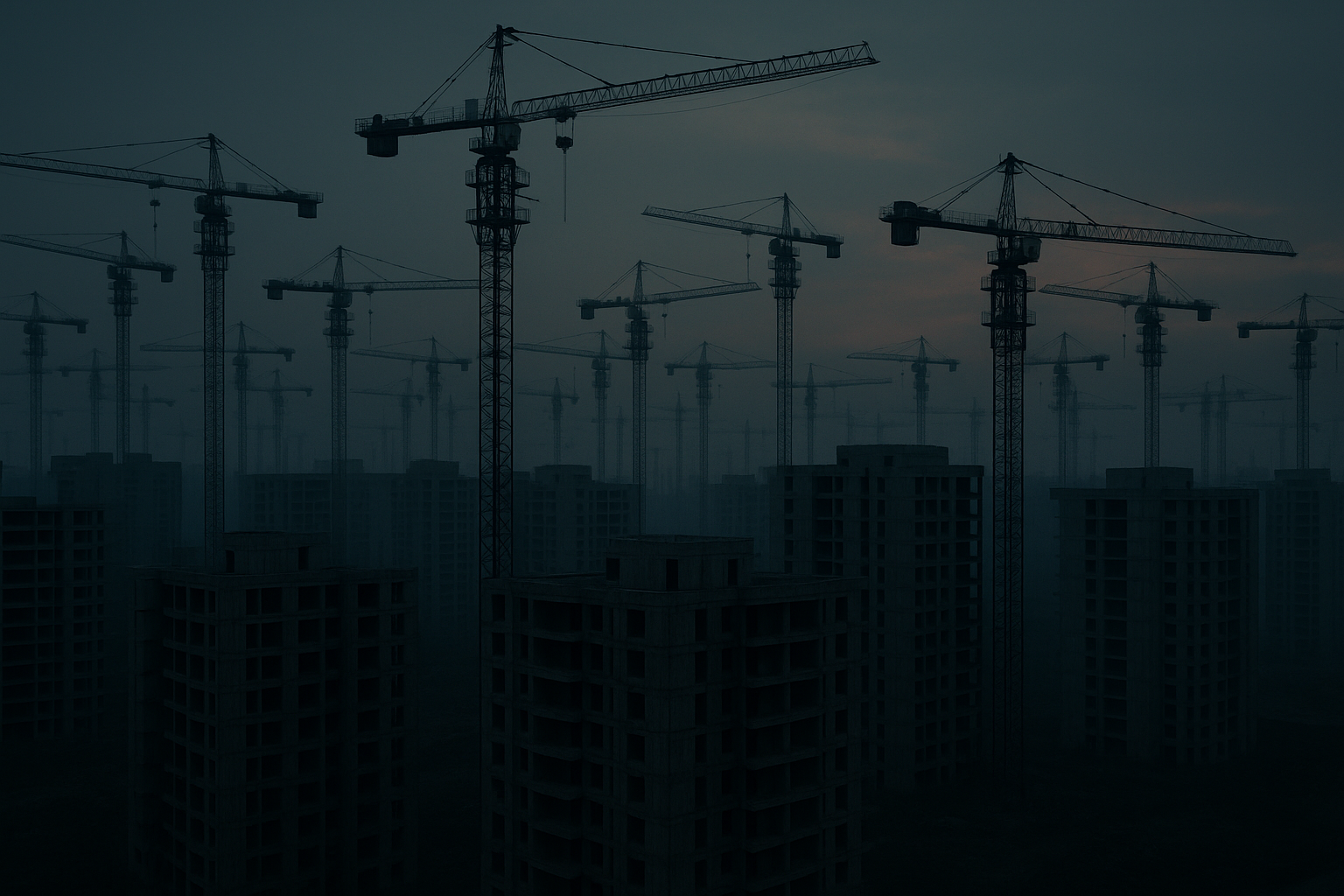
China released its July purchasing managers' indexes on Friday, and one number in the release had never been printed before. The construction PMI fell to 47.0 — the lowest reading in the history of the survey. Not the lowest since the property crisis began. Not the lowest since Covid. The lowest ever recorded, in the country that poured more cement in three years of the early 2010s than the United States poured in the entire twentieth century.
It did not come alone. Manufacturing slipped to 49.2 from 50.3 — the first contraction since February, against expectations of a flat 50.0 print. The services gauge fell to its weakest level since the initial Covid lockdowns of early 2020. The composite index, at 49.3, is now the lowest since the pandemic ended. New manufacturing orders hit a three-year low. Every engine of the world's second-largest economy decelerated in the same month.
The Typhoon Excuse
Beijing's statistics bureau attributed part of the weakness to a spate of typhoons that halted work on construction projects. Weather is real, and it did shut down sites along the coast. But the excuse does not survive contact with the rest of the data. Typhoons do not explain a three-year low in new manufacturing orders. They do not explain services activity at post-lockdown depths. And they certainly do not explain producer prices that have now been falling for more than three years straight — the longest factory-gate deflation in China's modern history.
What the July data actually describes is an economy where the export front-running that flattered the first half is fading, domestic demand never showed up to replace it, and the sector that once absorbed every downturn — construction — has stopped absorbing anything at all.
The Playbook That Isn't Coming Back
For most of the last two decades, this exact configuration of data had a predictable sequel. Growth slows, and Beijing pours concrete.
In 2008, the answer to the global financial crisis was a 4 trillion yuan stimulus aimed overwhelmingly at infrastructure and housing. In 2015–16, the answer to a manufacturing recession was shantytown redevelopment — trillions of yuan of central bank money funneled into demolishing old housing and building new blocks. In 2020, the answer to Covid was another infrastructure wave. Each time, the transmission mechanism was the same: state credit flows into construction, construction buys steel and cement, steel mills buy iron ore and coking coal, excavators and cranes get ordered, and within two quarters the reflation shows up in every commodity price and mining equity on earth.
Global markets learned the reflex so well that it became a floor under an entire asset class. When Chinese data got bad enough, you bought miners — because bad data meant stimulus, and stimulus meant construction.
The July 30 Politburo meeting is the clearest signal yet that the reflex is dead. The readout pledged to "accelerate fiscal expenditure and the use of bond proceeds," promised moderately accommodative monetary policy, and gestured at "timely incremental measures." What it did not do was announce anything resembling a construction-led package — no new special bond quota for housing, no revival of the central-bank lending facilities that funded the shantytown boom. The designated levers for expanding domestic investment this cycle are the "AI+" initiative and network infrastructure: data centers, compute, power grids, digital systems. Analysts at ING summarized the meeting as supportive in tone and light on deliverables. Caixin called the promised measures "incremental."
Read those two releases together — a record-low construction print on Friday, and a Politburo that looked at it and declined to reach for the old playbook on Thursday — and the message is hard to miss. Beijing is not failing to restart the concrete engine. It is choosing not to.
That choice has a price, and most of it will be paid outside China. If the marginal yuan of Chinese stimulus now flows into chips and grid software instead of rebar and cement, the demand floor that has underpinned twenty years of commodity pricing — and the miners, currencies, and inflation assumptions built on top of it — is being quietly withdrawn.
The question that matters for positioning: who is still priced for the old floor?
The rest of this briefing is for paid members: the iron ore cost-curve math and the order in which producers bleed as the floor drops, the deflation-export divergence trade forming between Chinese and US long bonds, the specific Beijing policy triggers that would flip this call, and the bottom-line positioning framework.
AlphaBriefing Paid gets you every investment thesis, scenario framework, and catalyst brief we publish — the analysis private intel clients pay four figures for, at a fraction of that.