Europe's Drone Wall Is Due in 100 Days. The Drones Aren't Waiting.
Brussels gave itself until New Year's to field a continental counter-drone network. NATO pledged $40 billion. The winners aren't the missile primes — they're the sensor, jamming, and cheap-effector layer.

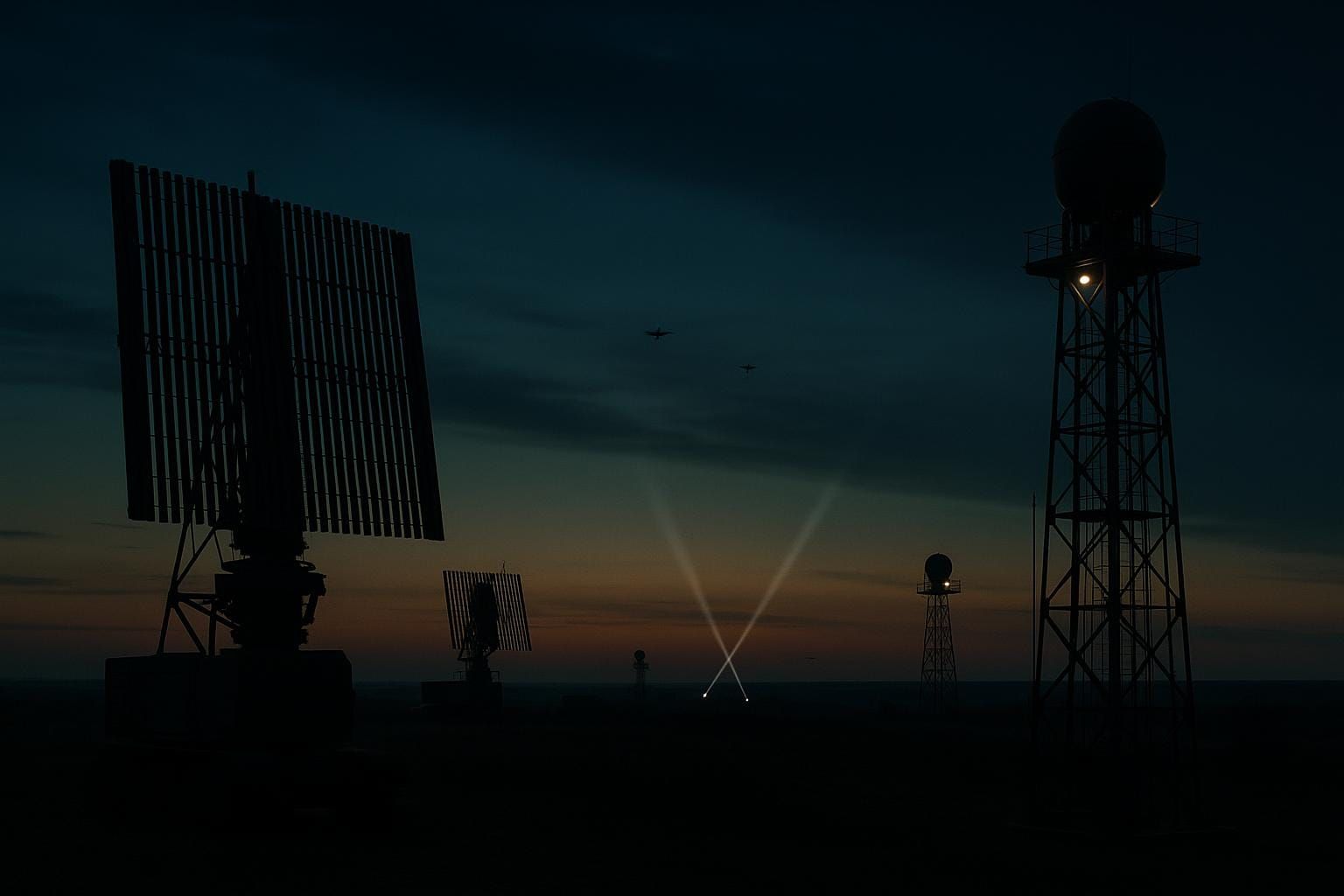
On Thursday evening, Luxembourg's only commercial airport stopped flying because somebody reported drones. The sightings were probably aircraft — investigators think so, anyway — but nobody in European aviation is taking chances anymore. Six weeks earlier, ground crews at Leipzig/Halle found a drone carrying explosives parked near a Ukrainian cargo aircraft. That one was not a false alarm.
It has now been just over a year since roughly 20 Russian military drones crossed into Polish airspace in a single night — the September 2025 incursion that forced Warsaw to close four airports, invoke NATO's Article 4, and triggered the alliance's Operation Eastern Sentry. That night did for European air defense what February 2022 did for European defense budgets generally: it converted a theoretical vulnerability into a line item.
The line item now has a deadline. And the deadline is about 100 days away.
The promise Brussels made itself
The European Commission's Defence Readiness Roadmap 2030 names four flagship projects: the European Drone Defence Initiative (EDDI), Eastern Flank Watch, the European Air Shield, and a European Defence Space Shield. EDDI — the project everyone insists on calling the "drone wall," to the visible discomfort of the officials running it — got the most aggressive schedule of the four: launched in the first quarter of 2026, initial operational capability by the end of 2026, full functionality by the end of 2027.
It is late September. Initial operational capability is due by New Year's.
What EDDI is actually supposed to be is not a wall but a network: layered sensors (radar, radio-frequency detection, acoustics, cameras) fused into a common operating picture, feeding a mix of jammers, spoofers, and cheap kinetic interceptors, stretched along the EU's eastern border from the Baltic to the Black Sea. Eastern Flank Watch, the broader ground-defense program wrapped around it, spans thirteen EU member states plus Norway and Ukraine, carries an indicative price tag of €60–100 billion, and runs on a timeline out to 2036.
The money, for once, is not the bottleneck. In February the Commission published its Action Plan on Drone and Counter-Drone Security. In April it allocated €1.07 billion across 57 European Defence Fund projects explicitly in support of the four flagships. The EU's SAFE lending facility puts €150 billion of joint borrowing capacity behind member-state rearmament. And at the July NATO summit, allies committed over $40 billion to counter-drone capabilities across the next five years, alongside a pledge to train five times as many drone operators by the end of 2027.
National governments are moving faster than Brussels. Poland — the country with the most direct experience of what this threat looks like — picked a Kongsberg-led consortium with state-owned PGZ back in February to build its national anti-drone layer. Germany, after Leipzig, is assembling what Berlin calls an anti-sabotage shield covering drones, cyber intrusions, and infrastructure attacks. Belgium bought Senhive detection systems and DroneShield jammers after a wave of sightings over its own airports and bases.
The arithmetic that makes this permanent
Air defense has always been expensive. What drones changed is the direction of the cost curve. A Shahed-type attack drone costs somewhere in the tens of thousands of dollars. The missile that a NATO fighter used to shoot one down over Poland costs hundreds of thousands to over a million. Ukraine downs hundreds of Russian drones a week; the night Poland was hit, two of roughly twenty incoming drones were intercepted.
That exchange ratio is why the counter-drone buildout is not a procurement cycle — it is a structural repricing of what European security costs. You cannot defend a continent with million-dollar interceptors against thousand-dollar threats. The entire program logic of EDDI is to invert the economics: make detection cheap and ubiquitous, make the kill mechanism cost less than the thing it kills, and make the whole system software-defined so it improves faster than the threat does.
For investors, that logic points at a specific and fairly short list of companies — and mostly not at the ones the defense ETFs are weighted toward.
Get the next briefing in your inbox before the market reads it: Join AlphaBriefing free
The rest of this briefing is for paid members: the four-layer breakdown of where the drone-wall money actually lands, the pure-play whose committed revenue already covers most of its guidance, the two European primes best positioned for the sensor and effector layers, and the catalyst calendar between now and the December deadline.
AlphaBriefing Paid gets you every investment thesis, scenario framework, and catalyst brief we publish — the analysis private intel clients pay four figures for, at a fraction of that.