America Just Banned the Grid Equipment It Can't Replace Until 2029
Executive Order 14421 declares foreign grid equipment a national emergency — and gives Washington the power to rip out what's already installed. The largest domestic transformer investment in U.S. history won't ship a unit until 2029.

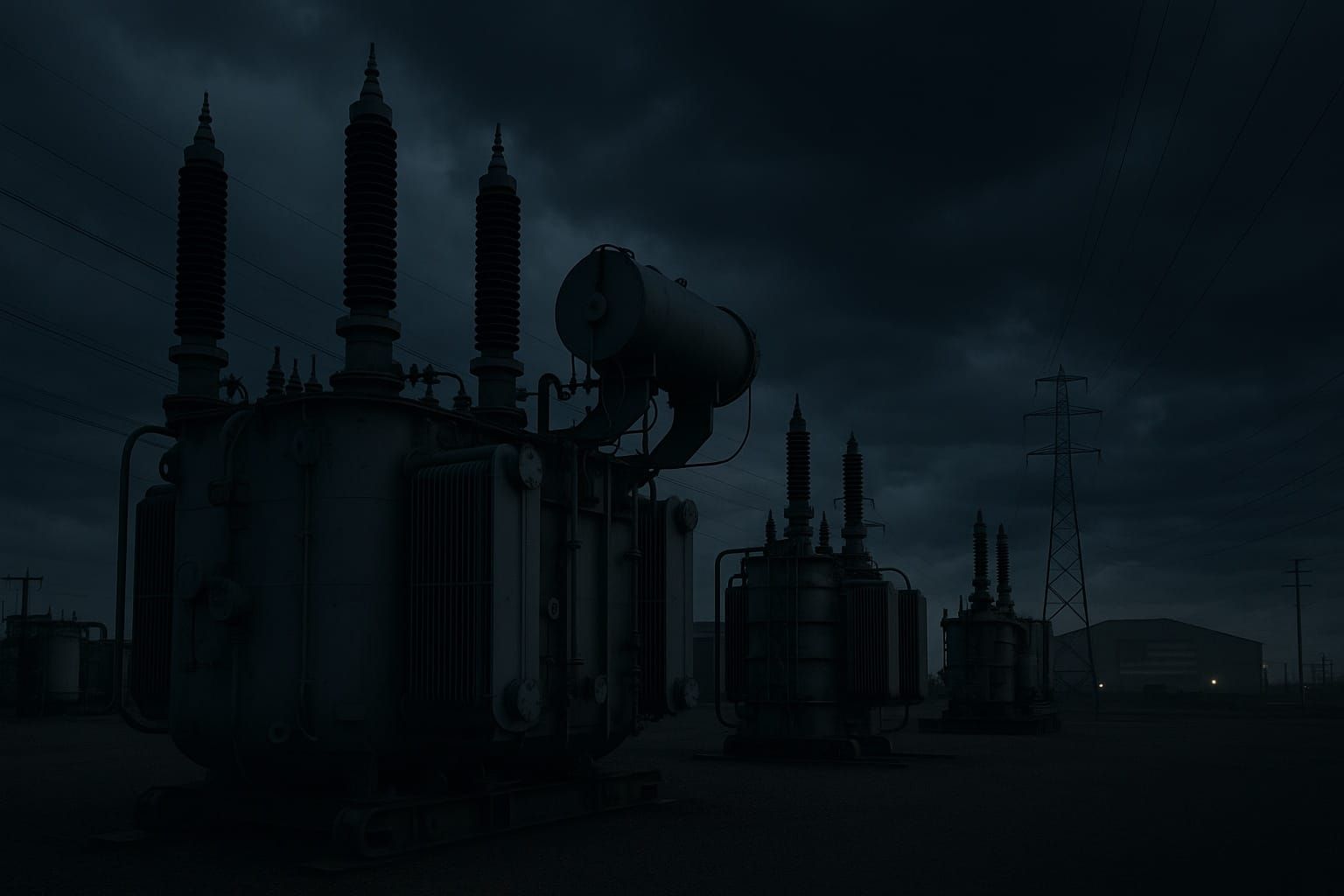
In late August, with markets focused on the Fed and the AI trade, the White House signed Executive Order 14421 — a declaration that foreign-made equipment inside America's bulk-power system constitutes a national emergency. The order bans new purchases of covered foreign transformers, inverters, circuit breakers, battery systems, generators, and control software. More striking, it grants the Department of Energy the power to order equipment that is already installed to be isolated, disconnected, or physically removed from the grid.
Three weeks later, on September 15, Hitachi Energy announced the largest transformer manufacturing investment in U.S. history: $528 million to expand its Copiah County, Mississippi factory, creating 654 jobs.
Buried in the press release is the detail that explains this entire story. Production at the expanded plant starts in 2029.
That gap — between an emergency declared today and replacement capacity arriving in three years — is now one of the most consequential open questions in American infrastructure. Here's what the order actually does, why it happened now, and what it collides with.
What the order actually says
EO 14421, "Declaring a National Emergency to Secure the United States Bulk-Power System," invokes the International Emergency Economic Powers Act — the same legal machinery used for sanctions. It makes two claims: that foreign-made grid equipment may contain "digital backdoors" allowing remote access by hostile governments, and that dependence on foreign suppliers is itself a supply chain vulnerability.
The operative provisions are broad:
- A prohibition on acquiring, importing, or installing bulk-power equipment designed, manufactured, or supplied by entities under the jurisdiction of a "Covered Foreign Entity" — where the Energy Secretary determines the transaction poses an undue risk of sabotage, remote manipulation, or supply disruption.
- A removal power for equipment already in the ground. The Secretary can impose conditions on the continued use of previously installed foreign equipment, up to and including orders to disconnect, replace, or remove it.
- A rulemaking clock. The Department of Energy has four months to publish implementing rules — meaning the industry learns which products, which vendors, and which contexts are covered around the end of December.
The restrictions nominally target around two dozen countries. In practice, this is about one. Ben Boucher, principal supply chain analyst at Wood Mackenzie, told Latitude Media that "99.9% of the import values are going to be tied back to China."
If this feels familiar, it should. Trump signed a nearly identical order — EO 13920 — in May 2020. Biden suspended it. The 2026 version covers a broader range of technologies and adds the removal power, which the 2020 order lacked. Utilities, having watched this movie before, have quietly avoided Chinese bulk-power equipment for years. That caution is the main reason the order didn't shock the industry.
Briefings like this land in members' inboxes before the market prices them in. Join free →
Why now: the AI load boom changed the math
The order is unusually candid about its own motivation. It cites "the rapid growth of advanced manufacturing, data centers, artificial intelligence, and defense production" as the reason the threat has become "even more acute" since 2020.
The numbers behind that sentence are stark. Historically, the U.S. bought very few large power transformers from China — the market belonged to domestic plants and allied suppliers in South Korea, Japan, and Europe. But Boucher has tracked a quadrupling of Chinese transformer imports since 2023, an uptick correlated directly with data center demand. When American hyperscalers needed transformers faster than Western factories could deliver them, Chinese factories filled the gap.
That is exactly the dependency the order now proposes to unwind — at the precise moment demand is going vertical.
The collision: banning supply during a shortage
The U.S. has been in a transformer shortage for years. Lead times for distribution transformers stretched from a few months before 2020 to two years or more; large power transformers can take three to four years from order to delivery, and prices across the category have risen sharply. The shortage has slowed interconnection of new power plants and new large loads alike — it is one of the quiet reasons grid connection queues are measured in years.
Now consider what the order layers on top of that:
New supply gets restricted. The fastest-growing import source is the one being cut off. Every megawatt of data center capacity, every reshored factory, every new substation still needs the same iron-and-copper hardware — from a smaller approved supplier pool.
Existing supply could shrink. The removal clause is the wild card. If DOE orders installed Chinese transformers pulled from service — even selectively — replacements come out of the same constrained pipeline. As Boucher put it: removing already-crunched supply "is going to cause that shortage to get worse." He calls it the biggest risk from a utility standpoint.
Batteries are the acute exposure. Roughly 95% of U.S. grid storage systems trace back to Chinese supply chains. Data centers increasingly rely on battery systems as on-site backup; grid operators rely on them to firm renewables. Domestic battery manufacturing is growing but nowhere near self-sufficiency. If the rules are drawn strictly, the storage buildout slows with no near-term substitute.
Data centers sit in a gray zone. Equipment serving data centers doesn't typically fall under the "bulk power" definition, which suggests the order stops at the substation transformer. But the order's own text is aimed squarely at AI infrastructure dependence, and analysts are openly speculating about a data-center-specific follow-up. Either way, the power infrastructure feeding those campuses — the substations, the step-down transformers — is covered.
The reshoring response is real. It is also slow.
The policy is already pulling investment announcements. Hitachi Energy's $528 million Mississippi expansion — its largest ever in the U.S. — was announced with the Trump administration's explicit blessing, and the company's CEO framed it as a bet on "a pivotal time for U.S. energy security." Korean and Japanese manufacturers with existing U.S. factories are widely seen as the other immediate winners, since they offer allied supply that sidesteps the restrictions entirely.
But the Mississippi timeline is the tell. Construction begins later this year. Transformer production starts in 2029. That is the fast case — an expansion of an existing site by the world's most capable transformer maker, with state tax incentives and federal political tailwinds. Greenfield plants, workforce training, and the specialized electrical steel supply chain all take longer.
In other words: the ban is immediate, the emergency powers are immediate, and the domestic capacity is a 2029 story. The intervening three years get bridged by allied imports, by whatever DOE chooses to grandfather, and by price.
What to watch
- The DOE rules, due around late December. They define everything: which vendors are "Covered Foreign Entities," whether data center equipment is swept in, and how aggressively the removal power gets used. A narrow rule is a manageable procurement headache; a broad one is a multi-year supply shock.
- The removal decisions. Boucher expects targeted removals of high-risk suppliers rather than blanket mandates — a blanket battery removal alone would touch 95% of installed storage. The first removal order, whenever it comes, sets the precedent.
- A data-center follow-up order. If the administration extends the same logic behind the meter, hyperscaler buildout timelines are directly in play.
- Electricity prices. Constrained equipment plus surging load is arithmetic. Somebody pays for scarcity, and grid equipment costs flow into rate cases with a lag.
The United States has decided, formally and with emergency powers, that its grid hardware is a national security domain. The decision may well be right on the merits — the cybersecurity concerns are not invented, and the dependency was growing fast. But declaring an emergency doesn't build a factory. For the next three years, America's grid strategy rests on a bet that it can quit its fastest-growing supplier before the domestic replacements exist.
The 654 workers in Gallman, Mississippi will start shipping the answer in 2029. The demand curve isn't waiting.
If this analysis was useful, this is what AlphaBriefing does every day — geopolitics and markets, connected to what it means for your money. Free members get the daily brief in their inbox; paid members get the investment frameworks, scenario pricing, and catalyst calendars behind the paywall.
Sign up free → — upgrade whenever it earns it.
Get this level of intelligence every day. Subscribe to AlphaBriefing — free, member, and paid tiers available.
Sources & Further Reading
- The White House — Executive Order 14421: Declaring a National Emergency to Secure the United States Bulk-Power System
- Latitude Media — Three questions left open by Trump's bulk power executive order
- Office of Governor Tate Reeves — Hitachi Energy Bringing Its Largest Transformer Manufacturing Investment in U.S. to Mississippi
- Latitude Media — Catalyst: Understanding the electric transformer shortage
- Federal Register — Executive Order 13920 (2020): Securing the United States Bulk-Power System
Disclaimer
AlphaBriefing is an independent intelligence publication. The content in this article is produced for informational and educational purposes only. Nothing published by AlphaBriefing constitutes financial, investment, legal, tax, or regulatory advice, nor should it be construed as a solicitation or recommendation to buy, sell, or hold any security, asset, or financial instrument.
All views expressed are those of the author at the time of writing and are subject to change without notice. Markets are volatile and unpredictable; past performance is not indicative of future results. Any investment involves risk, including the possible loss of principal.
AlphaBriefing and its principals, employees, or contributors may hold positions in securities or assets mentioned in this article. This should be considered a potential conflict of interest. No material relationship with any company referenced exists unless explicitly disclosed. Readers should conduct their own due diligence and consult qualified financial, legal, and tax advisors before making any investment decisions.
Information in this article is drawn from public sources believed to be reliable at the time of publication. AlphaBriefing makes no warranty, express or implied, as to the accuracy, completeness, or timeliness of any information herein. AlphaBriefing accepts no liability for any loss or damage arising from reliance on this content.
© AlphaBriefing. All rights reserved. Unauthorised reproduction or distribution is prohibited.