Boeing's Biggest Bottleneck Is Now Boeing
Boeing's CEO just admitted the 737 ramp is stuck on the company's own wing shop, not the supply chain. The real trade: 30-plus finished jets parked on the ramp, a multi-billion-dollar inventory unlock, and a margin flip dated to next year.

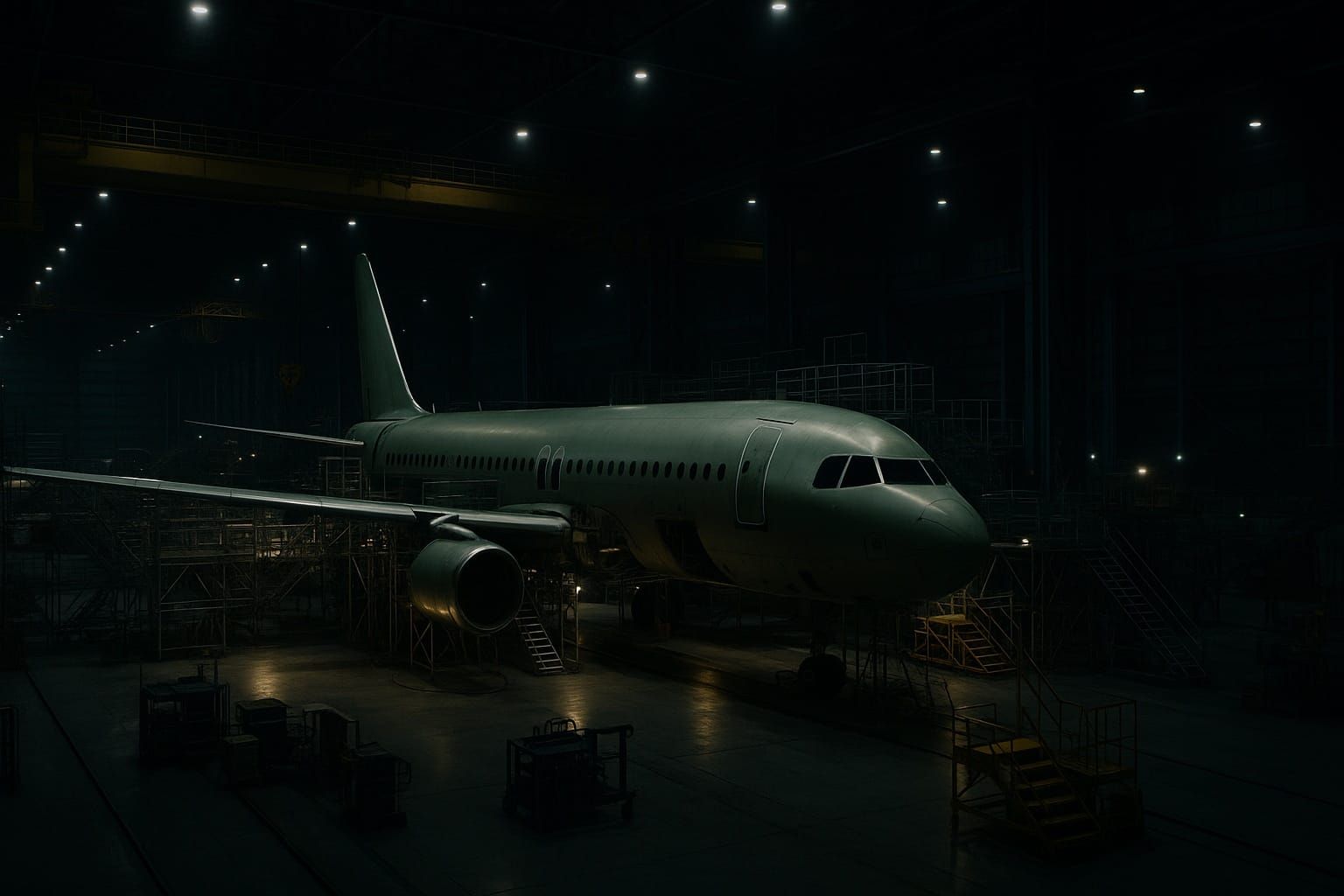
At an investor conference in Laguna Beach on September 16, Boeing CEO Kelly Ortberg said something that should have gotten more attention than it did. Asked about the 737 MAX production ramp — the single most important number in the company's recovery story — he told the room the supply chain is in "really good shape." Engines from CFM International: adequate. Parts: flowing. The external constraints that defined Boeing's last three years: largely solved.
Then came the rest of the sentence. "The area where we're constrained right now is our wings production," Ortberg said. "We actually produce all our wings in Renton for our MAX line, and we just have not seen the flow improvements that we expected in this time frame."
Read that again. Boeing's binding constraint is no longer Spirit AeroSystems, not engine makers, not the FAA's post-crisis production cap. It is Boeing's own wing shop, in Boeing's own factory, staffed by Boeing's own workforce. After years in which every missed target came with an external culprit attached, the company has run out of suppliers to point at.
The Rate Ladder, and Where It Just Broke
Boeing's entire commercial recovery is a staircase of monthly production rates: 38, then 42, then 47, then 52, eventually 57 and — in Ortberg's words — "someday" 63. Each step is worth billions in annual cash flow, because Boeing collects the bulk of an aircraft's price on delivery.
In May, Ortberg told investors Boeing was "off and rolling at the 47 rate." At Laguna, the language changed: Boeing is "driving at 47 a month" but is "not stable yet." The move from 42 to 47 has simply taken longer than management expected. And the next step has a hard dependency: rate 52 requires both a stabilized Renton line and FAA certification of the new North Line in Everett, which loaded its first aircraft — a 737 MAX 10 bound for WestJet — in July. Hitting rate 52 by year-end, the previous target, now looks improbable.
The scoreboard shows what instability costs. Boeing delivered 41 MAX jets in August, down from 43 in July; Airbus delivered 43 A320neo-family aircraft in the same month and has pulled ahead for the year, roughly 475 deliveries to Boeing's 418 through August. Rate 52 matters for another reason too: it was the program's high-water mark before the 2018–19 MAX crisis. Getting back there isn't expansion. It's repair.
Briefings like this land in members' inboxes before the market prices them in. Join free →
Why the Market Shrugged — and Why That's the Question
Here's the puzzle: none of this dented the recovery narrative. Boeing kept its $1 billion to $3 billion free cash flow guidance for 2026. The backlog sits at a record — more than 6,100 aircraft, roughly $715 billion — and the first half of 2026 was Boeing's strongest for deliveries since 2018. The MAX 7 finally won FAA certification in August after years of delay, and Ortberg says the MAX 10 is "coming very shortly," with flight testing complete and only documentation remaining.
Demand was never the problem. Boeing could stop selling aircraft tomorrow and have a decade of work. The stock's bull case rests entirely on execution: convert the backlog into deliveries, deliveries into cash, cash into a repaired balance sheet.
But the wing-shop admission cuts at exactly that thesis — and it surfaced something more interesting than a schedule slip. Buried in CFO Jay Malave's remarks at the same conference was the real near-term money: billions of dollars in cash sitting on Boeing's balance sheet in a form most investors never look at, plus a quiet accounting inflection that management expects to flip next year. Where that cash is parked, when it unlocks, and what has to go right first — that's the actual Boeing trade from here.
Get the next briefing free in your inbox: Join AlphaBriefing
The rest of this briefing is free — it just requires a free AlphaBriefing account: the 30-plus finished jets Boeing built but legally couldn't deliver and the 18-month clock on turning them into cash, the deferred-production accounting flip Malave says arrives next year, and the five catalyst gates that decide whether 2027 is the cash harvest or another reset.
Create your free account → — 30 seconds, no card.