Why Is Washington Paying Companies Not to Build Power Plants?
The federal government has now spent nearly $4 billion buying back offshore wind leases — erasing roughly ten gigawatts of planned power from America's tightest electricity markets while the money is redirected into gas. Who pays, and who collects.

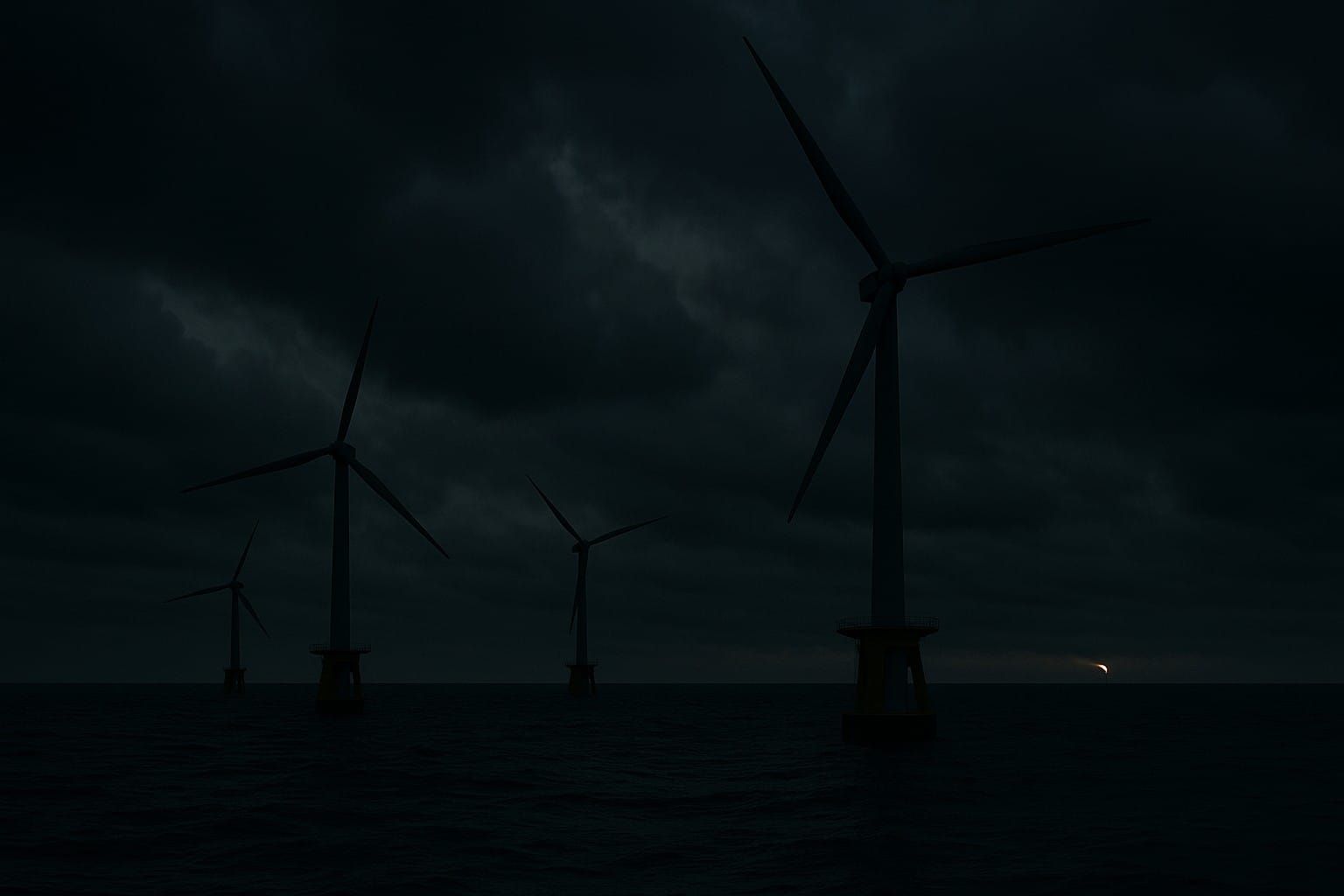
On Thursday, the German energy giant RWE announced it had reached a $1.2 billion settlement with the Trump administration — not to build something, but to walk away. In exchange for $1.22 billion, RWE is relinquishing offshore wind leases off New York, California, and Louisiana that could have generated about seven gigawatts of electricity, enough to power more than five million homes. The company now holds zero US offshore wind leases.
It is the third such deal since March, and it brings the running total to roughly $3.9 billion of federal money spent paying energy companies to not produce energy.
That sentence is worth sitting with. The United States is in the middle of its first sustained surge in electricity demand in a generation — driven by data centers, reshored manufacturing, and electrification — and the federal government is spending billions to delete planned generating capacity from the grid. Whatever your politics on wind power, the market consequences are the same: less future supply, meeting more future demand, at higher prices. Someone pays for that spread, and someone collects it.
A refund with strings attached
The buyback program exists because the direct route failed. The administration spent 2025 trying to halt offshore wind by executive action — stop-work orders, permit freezes — and federal courts repeatedly blocked it. So the strategy changed: if you can't cancel the leases, buy them back.
The deals so far:
- TotalEnergies (March): roughly $1 billion — effectively a refund of its two leases off New York and North Carolina — on the condition that the French company reinvest the money in fossil fuel projects instead.
- Invenergy (Wednesday): $765 million in reimbursed lease fees for four leases off New Jersey, Maine, and California. The Chicago-based developer says the money will go into natural gas and geothermal projects that can be built faster.
- RWE (Thursday): $1.22 billion for its remaining portfolio off three states. RWE simultaneously announced $900 million for a liquefied natural gas project in Louisiana and $300 million for gas turbines, and says it is developing fifteen natural gas projects across the US.
Notice the pattern. These are not simple cancellations — they are capital rotations, in at least one case contractually required. Money that entered the country to build wind farms is being recycled, with a taxpayer top-up, into gas infrastructure. The federal government sold these leases at competitive auction, collected billions for them, and is now paying the money back — in some cases with consideration on top — to make the projects disappear.
Briefings like this land in members' inboxes before the market prices them in. Join free →
The arithmetic problem
Here is what makes the timing remarkable. The capacity being erased sits almost entirely off the East and West Coasts — precisely the regions where the supply picture is tightest.
PJM, the largest US grid operator, serving 65 million people from the mid-Atlantic to Chicago, came up nearly seven gigawatts short in its most recent capacity auction and cleared at its administrative price cap for the second straight year. Its board is now openly discussing requiring new data centers to bring their own generation. New England and New York import power at some of the highest wholesale prices in the country. The offshore leases now being unwound — across TotalEnergies, Invenergy, and RWE, on the order of ten gigawatts of potential capacity — were among the few large-scale supply additions physically possible near those coastal load centers, where there is no spare land for solar farms and no gas pipeline capacity to spare.
The administration's argument is that gas is dependable baseload and wind is not, and that redirecting capital toward "secure energy infrastructure" will lower utility costs. The counterargument, made by offshore wind advocates and now by state attorneys general, is blunter: a gas plant in Louisiana does not power a home in Brooklyn. Electricity is a regional commodity. Deleting supply in the Northeast and replacing it on the Gulf Coast doesn't rebalance the Northeast market — it shorts it.
Both things can be true. Gas is more dispatchable than wind. And the Northeast still ends up with less planned supply than it had a year ago, with demand rising either way.
Follow the money
For investors, the interesting question is never whether a policy is good — it's where the money goes next. Three flows stand out.
Gas turbines just got another buyer. RWE's $300 million turbine order joins a global queue. Turbine manufacturers are already quoting delivery slots years out; every converted wind developer joins the back of that line with cash in hand. The equipment layer of the gas buildout — turbines, compression, grid interconnection hardware — is absorbing demand from two directions at once: the data-center boom and now the wind unwind.
Incumbent generators in coastal markets inherit scarcity. Every gigawatt of canceled future supply improves the pricing power of the plants already running in New England, New York, and the mid-Atlantic. Owners of existing generation in constrained coastal markets are the quiet beneficiaries of a policy aimed at their would-have-been competitors.
European capital is taking the exit package. RWE is German. TotalEnergies is French. Both entered US offshore wind as a growth market; both are leaving with their lease fees refunded and redeploying into US gas, where the policy wind is at their backs. For European boards weighing future US infrastructure commitments, the lesson is being absorbed in real time: federal auctions can be unwound, and long-duration US energy investment now carries a policy-reversal premium that didn't exist in the price two administrations ago. That premium doesn't show up in any single deal — it shows up in the discount rate on every future one.
The counterattack
None of this is settled. New York's attorney general, joined by six other states, sued in federal court in Washington this week to vacate the TotalEnergies settlement, arguing the leases were canceled without lawful procedure. California says it intends to sue over its own coastal projects. Congressional Democrats have opened an investigation into the payouts.
And on the same Thursday the RWE deal was announced, a federal judge in Oregon ruled against the administration on the other half of its wind freeze — ordering the Pentagon to resume the stalled national-security siting reviews that had brought onshore wind development on private land to a halt.
That leaves the sector in a strange superposition. The buybacks may be locked in by settlement, or unwound by a court. Onshore wind may be thawing just as offshore is liquidated. The only certainty is that "federal energy policy" is now a litigation calendar, and the discovery documents from the state lawsuits — how these settlements were negotiated, and what the companies were promised — may end up being the most consequential energy filings of the year.
The bottom line
Nearly $4 billion has now been spent to remove roughly ten gigawatts of planned generation from the tightest power markets in America, while the capital is redirected into gas on the Gulf Coast. The near-term winners are turbine makers, LNG developers, and every incumbent generator on the Eastern Seaboard. The near-term losers are coastal ratepayers, who face the same demand curve with less future supply, and the offshore supply chain — ports, vessels, and factories — built for an industry that no longer has a US pipeline.
The deeper cost is harder to price: the United States has demonstrated that a federal lease, bought at auction and held through years of permitting, can be politically unwound for the right settlement figure. Markets forgive individual policies. They reprice institutional risk. Watch the D.C. district court — if the states win and a settlement gets vacated, every one of these deals reopens, and so does the question of what a US government contract is worth.
Get this level of intelligence every day. Subscribe to AlphaBriefing — free, member, and paid tiers available.
Sources & Further Reading
- AP — Trump administration is ending more wind power projects by buying leases
- AP — Trump administration ending 4 wind power projects by buying up leases
- AP — New York sues Trump administration over deal to end offshore wind project
- AP — California intends to sue over canceled offshore wind project
- AP — Renewable energy groups sue Pentagon over stalled wind farm reviews
- AP — Federal courts blocked earlier efforts to stop offshore wind by executive action
Disclaimer
AlphaBriefing is an independent intelligence publication. The content in this article is produced for informational and educational purposes only. Nothing published by AlphaBriefing constitutes financial, investment, legal, tax, or regulatory advice, nor should it be construed as a solicitation or recommendation to buy, sell, or hold any security, asset, or financial instrument.
All views expressed are those of the author at the time of writing and are subject to change without notice. Markets are volatile and unpredictable; past performance is not indicative of future results. Any investment involves risk, including the possible loss of principal.
AlphaBriefing and its principals, employees, or contributors may hold positions in securities or assets mentioned in this article. This should be considered a potential conflict of interest. No material relationship with any company referenced exists unless explicitly disclosed. Readers should conduct their own due diligence and consult qualified financial, legal, and tax advisors before making any investment decisions.
Information in this article is drawn from public sources believed to be reliable at the time of publication. AlphaBriefing makes no warranty, express or implied, as to the accuracy, completeness, or timeliness of any information herein. AlphaBriefing accepts no liability for any loss or damage arising from reliance on this content.
© AlphaBriefing. All rights reserved. Unauthorised reproduction or distribution is prohibited.