Why Is Costco Selling Ozempic?
Employers are dropping weight-loss drug coverage while Walmart, Costco, and Amazon race to sell GLP-1s for cash. America's biggest drug market is leaving insurance — and retail wants the refill.

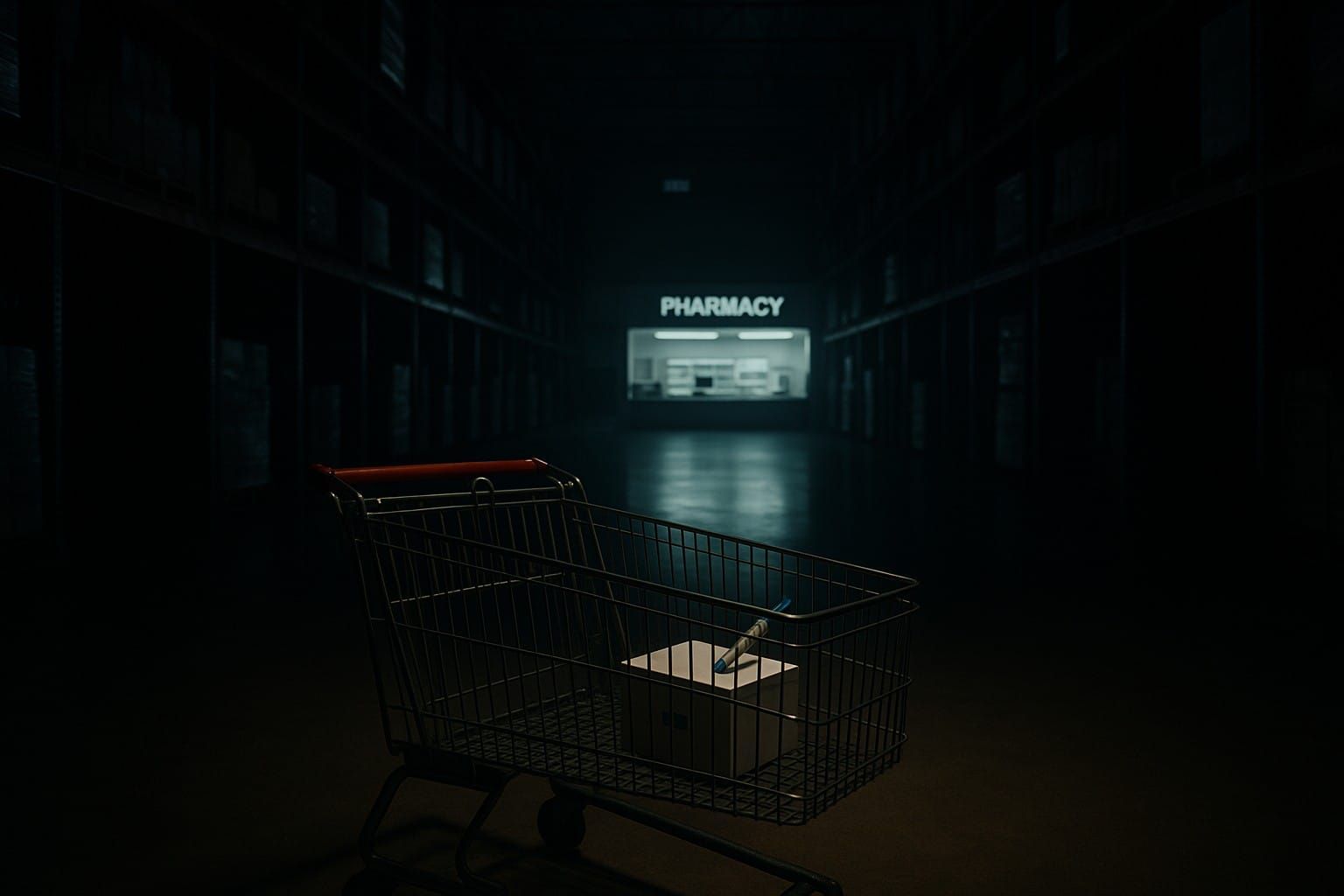
The most important drug market in America is quietly walking away from health insurance — and the biggest names in retail are racing to catch it.
Costco will sell you Wegovy for cash. Walmart has a deal with Eli Lilly to be the pickup counter for Zepbound. Amazon will prescribe a GLP-1 through One Medical and deliver it the same day in nearly 3,000 cities. None of this runs through the traditional machinery of American health coverage — no employer plan, no pharmacy benefit manager negotiating in the dark. Just a listed price, a credit card, and a refill date.
That's not a gimmick. It's a structural shift in how the largest drug category in the country gets paid for, and it's accelerating for a simple reason: the people who were supposed to pay for these drugs are backing out.
The coverage retreat
GLP-1 drugs like Wegovy and Zepbound work. That's the problem — for the entities paying list prices north of $1,000 a month, they work for far too many people.
The numbers tell the story. According to a June survey by the International Foundation of Employee Benefit Plans covering nearly 300 US employer health plans, just 36% of employers cover GLP-1s for both diabetes and weight loss — flat from 2025. Sixty percent cover them for diabetes only. A Mercer survey found 6% of large employers dropped GLP-1 coverage outright this year, even as the drugs' share of annual claims swelled to 11.4%, up from 6.9% in 2023. Cigna — a health insurer — said it would stop covering the medicines for its own employees.
Employers aren't pretending the demand doesn't exist. They're just rerouting it: 27% now actively encourage workers to obtain GLP-1s through direct-to-consumer platforms, and another 21% point employees toward their FSA and HSA dollars. In plain terms: we won't pay for it, but here's the door.
Every patient who loses coverage has to choose a new front door for their care. Walmart, Costco, Amazon, and CVS are competing to be that door at the exact moment the decision gets made.
Briefings like this land in members' inboxes before the market prices them in. Join free →
The cash-pay stack
What's replaced the insurance card is a rapidly assembling stack of direct-pay programs, each engineered less like healthcare and more like a subscription business:
- LillyDirect sells Zepbound for $299 to $449 a month in cash — with the better pricing tied to refilling within 45 days. As Gartner Consulting's Jackie Swanson put it to CNBC, that's "a loyalty program dressed as a discount schedule."
- NovoCare, Novo Nordisk's answer, prices introductory months at $199 before stepping up to $349 — a classic acquisition funnel.
- Costco's partnership with telehealth platform Sesame prices Wegovy around $349 a month — and requires a Costco membership. The prescription now helps sell the $65 card.
- Amazon launched a GLP-1 management program in April through One Medical and Amazon Pharmacy, with insured patients paying as little as $25 a month and same-day delivery expanding to 4,500 cities by year's end.
- Walmart expanded its Better Care Services platform in April to bundle GLP-1 prescriptions with nutrition coaching, fitness apps, and AI-driven support — a one-stop destination rather than a pickup counter.
- Washington is in the game too. The Trump administration's TrumpRx.gov platform routes self-pay patients to drugmakers' discount sites, with average injection costs expected around $350 and falling toward $250. And a new Medicare program launched July 1 offers eligible seniors GLP-1s for weight loss at a flat $50 monthly copay — the first time Medicare has covered the drugs for obesity, structured as an 18-month experiment.
Layer on the product cycle and the direction of travel is unmistakable. Novo's Wegovy pill — the first GLP-1 in pill form approved for weight loss — prices its two lowest doses at $149 a month for cash payers. Lilly's rival pill is expected to win approval later this year. Retatrutide, Lilly's triple-hormone injection, posted nearly 29% average body-weight loss in Phase 3 data. More products, more competition, lower cash prices — and less reason than ever to route any of it through an insurance plan that doesn't want to pay anyway.
Why retail wants the refill
Here's the part that matters if you're watching the stocks rather than the scale: the retailers aren't in this for drug margins. By all accounts those are thin — Kroger's CEO said as much back in 2023 when the boom started.
They're in it for the refill.
A GLP-1 prescription is a recurring, non-negotiable customer visit, repeating every month, potentially for years — because the weight tends to come back when patients stop. "Pharmacy lock-in is loyalty-program economics applied to medicine," Swanson told CNBC. "In a retail industry that spends billions chasing foot traffic, that is the most reliable recurring customer relationship on the market." The patient who picks up a prescription at Walmart walks through the store to reach the counter — and tends to buy the groceries, the deodorant, and everything else on the way out.
There's also a market-share war underneath. Walmart operates nearly 4,600 pharmacies but holds just 4.8% of the US pharmacy market, according to Drug Channels Institute data — far behind CVS at 14.7% and Walgreens at 14.6%. Direct-to-consumer GLP-1 programs are Walmart's tool for closing that gap, one locked-in refill at a time. As Eric Bormel of Solomon Partners framed it: retailers are betting that becoming "the front door for obesity care" earns a relationship that extends far beyond a single prescription.
The skeptic's note: big retail has tried to conquer healthcare before and mostly failed. Walmart shuttered all 51 of its health clinics in 2024. Amazon killed its Amazon Care telehealth service and watched Haven — its joint venture with JPMorgan and Berkshire Hathaway — dissolve without results. CVS closed swaths of its MinuteClinics. What's different this time is the direction of acquisition: the clinics tried to build healthcare and hoped customers would come. The GLP-1 boom delivers the customers, pre-motivated and pre-funded, and asks retail to do the one thing it's genuinely good at — logistics, price, and keeping people coming back.
Who loses
Three groups sit on the wrong side of this shift.
Independent pharmacies. The DTC programs are negotiated with chains that can sign one contract covering thousands of stores. Dared Price, who owns nine pharmacies in small Kansas towns, told CNBC his customers now drive to big chains for their GLP-1s — and that his systems can't even see those prescriptions to flag dangerous interactions with drugs like insulin or oral contraceptives. Care fragmentation isn't a talking point; it's a patient-safety gap being built in real time.
Pharmacy benefit managers. The cash-pay channel is being constructed deliberately around them. Every prescription that moves to LillyDirect or a Costco membership deal is a prescription whose pricing the PBMs never touch — a slow leak in the model that controls 80% of US prescriptions.
The insurance model itself. The quiet precedent here is enormous: the biggest drug launch cycle in pharmaceutical history is scaling up largely outside employer-sponsored insurance. If chronic obesity care — projected to touch tens of millions of Americans — can be delivered subscription-style at $150 to $450 a month, the question stops being "will insurers cover it" and becomes "does coverage matter." That's a question with implications far beyond weight loss.
The bottom line
Watch three things from here. First, the pharmacy metrics inside Walmart, Costco, and Amazon earnings — script growth and membership attach rates will show whether the front-door bet is converting. Second, Lilly and Novo's direct-to-consumer mix: every point of channel shift toward cash-pay is pricing power reclaimed from middlemen, but also list-price transparency they can't take back. Third, the Medicare experiment — 18 months of real-world data on whether covering these drugs actually reduces downstream costs. If it does, employers pile back in and the cash-pay stack becomes a bridge. If it doesn't, what's being built right now — obesity care as a retail subscription — is the permanent architecture.
Either way, the refill has become the most valuable customer relationship in American retail. Costco isn't selling Ozempic because it wants to be a pharmacy. It's selling Ozempic because the prescription sells everything else.
If this analysis was useful, this is what AlphaBriefing does every day — geopolitics and markets, connected to what it means for your money. Free members get the daily brief in their inbox; paid members get the investment frameworks, scenario pricing, and catalyst calendars behind the paywall.
Get this level of intelligence every day. Subscribe to AlphaBriefing — free, member, and paid tiers available.
Sources & Further Reading
- CNBC — As Americans go direct with GLP-1 prescriptions, Walmart, Costco, Amazon will be big weight-loss winners
- CNBC — Employers aren't expanding coverage of GLP-1 obesity drugs — many are finding ways around it
- NBC News — What to watch for in weight loss drugs in 2026: price changes, GLP-1 pills and more
- CNBC — Medicare coverage of obesity drugs begins July 1
- CNBC — Employers are dropping coverage of GLP-1 weight loss drugs
- Eli Lilly — Retatrutide Phase 3 results
Disclaimer
AlphaBriefing is an independent intelligence publication. The content in this article is produced for informational and educational purposes only. Nothing published by AlphaBriefing constitutes financial, investment, legal, tax, or regulatory advice, nor should it be construed as a solicitation or recommendation to buy, sell, or hold any security, asset, or financial instrument.
All views expressed are those of the author at the time of writing and are subject to change without notice. Markets are volatile and unpredictable; past performance is not indicative of future results. Any investment involves risk, including the possible loss of principal.
AlphaBriefing and its principals, employees, or contributors may hold positions in securities or assets mentioned in this article. This should be considered a potential conflict of interest. No material relationship with any company referenced exists unless explicitly disclosed. Readers should conduct their own due diligence and consult qualified financial, legal, and tax advisors before making any investment decisions.
Information in this article is drawn from public sources believed to be reliable at the time of publication. AlphaBriefing makes no warranty, express or implied, as to the accuracy, completeness, or timeliness of any information herein. AlphaBriefing accepts no liability for any loss or damage arising from reliance on this content.
© AlphaBriefing. All rights reserved. Unauthorised reproduction or distribution is prohibited.