Why Are Farmers Going Broke While Their Land Hits Record Highs?
Farm bankruptcies are up 46%, row-crop losses hit $34.6 billion, and Washington now supplies 29% of farm income — yet farmland sits at record values. The divergence between the farm and the farmer is the trade.

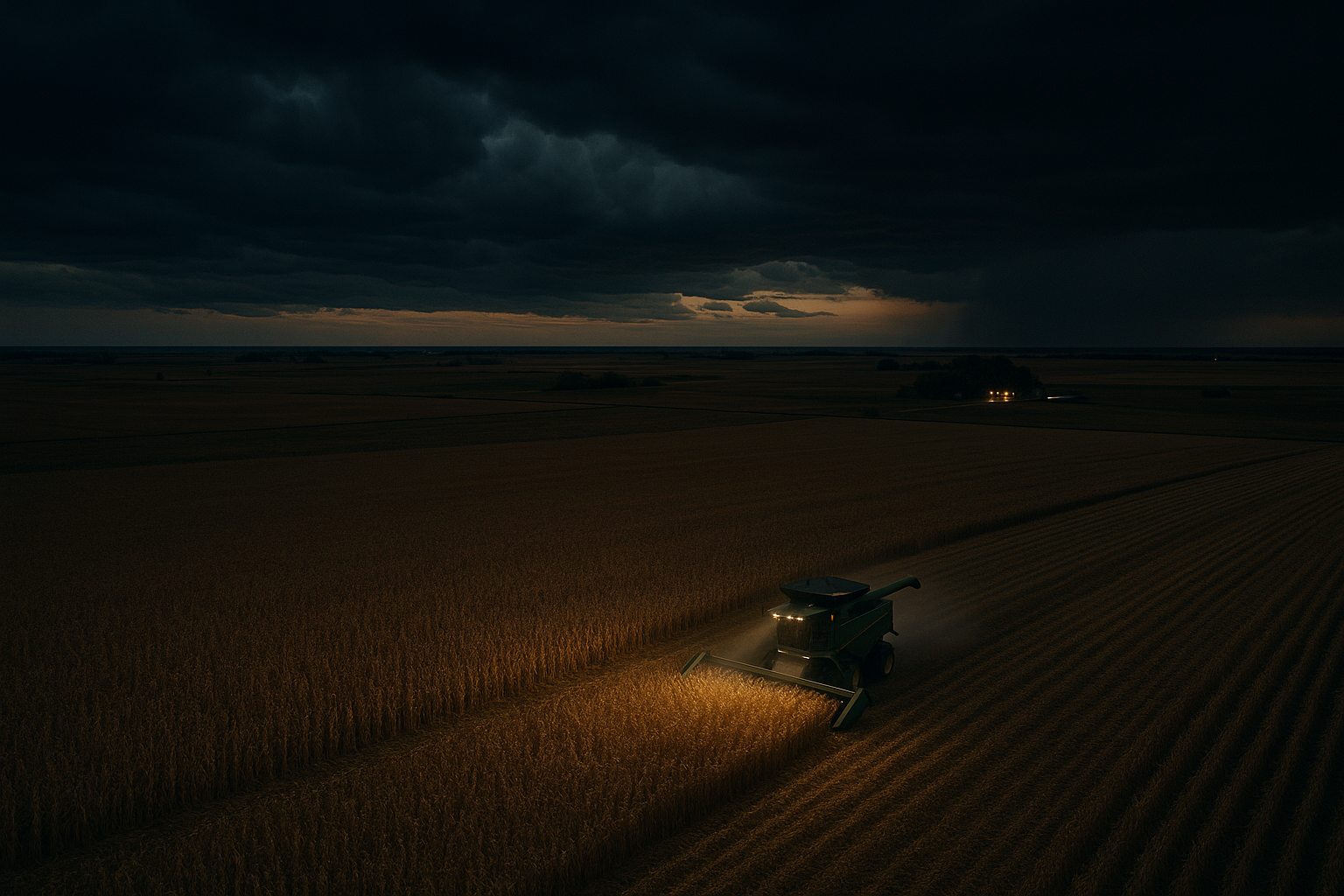
The last week of July delivered two headlines from the American farm belt that should not be able to coexist.
On July 27, the Federal Reserve's agricultural lender surveys reported another quarter of deteriorating farm finances: loan repayment rates falling, renewals and extensions rising, and lenders bracing for a second consecutive year in which most row-crop operations lose money. Chapter 12 family-farm bankruptcies jumped 46% last year and are still climbing. Row-crop producers lost a combined $34.6 billion before crop insurance and government support. Sector debt is heading for a record $624.7 billion.
And yet, in the very same Federal Reserve surveys, the asset at the center of all this distress refuses to fall. Nonirrigated cropland values across the Midwest and Plains are up about 3% from a year ago — sitting at or near record levels. In the Dallas Fed's district, dryland values grew more than 7%.
Farmers are going broke on land that has never been worth more.
That is not a contradiction. It is the story. American agriculture is quietly splitting into two economies — the business of farming, which is in its worst stretch since the 1980s, and the ownership of farmland, which is having a fine decade. Understanding why they diverged, and why the gap is likely to widen, is one of the more useful things an investor can do this year — because the divergence itself is the trade.
The operator's ledger no longer works
Start with the income statement of the people who actually grow things.
Crop prices have fallen as much as 58% from their 2022 peaks. Corn and soybeans have spent two years grinding along at or below the cost of production for many operations. The USDA projects net farm income of $153.4 billion for 2026 — down slightly from last year and roughly $48 billion, or 24%, below the 2022 record.
But the headline number flatters the patient. Buried inside it is $44.3 billion in direct government payments — up $13.8 billion from last year, between disaster assistance and farm-bill triggered programs. Washington's checks now account for roughly 29% of the sector's bottom line. Strip them out, and market-derived net farm income falls almost 12%, to about $109 billion. Nearly a third of American farm profitability is now a policy decision.
The expense side offers no relief. Production costs are projected at $477.7 billion for 2026 — the second-highest on record. Anhydrous ammonia, the workhorse nitrogen fertilizer, still costs 26% more than a year ago; the closure-then-trickle of the Strait of Hormuz has choked off a meaningful share of seaborne nitrogen trade, and the World Bank spent the summer flagging fertilizer supply as a structural, not cyclical, problem. Even December's $12 billion federal bailout and China's negotiated return to the soybean market — 25 million metric tons a year committed through 2028 — have not moved the arithmetic. As one Midwest farmer put it after the China deal was announced: the future still looks daunting.
When income falls and costs don't, the difference goes on the balance sheet. Farm debt is growing $30.8 billion this year. The Farm Credit Administration reports nonperforming assets rising to 1.09% of loans from 0.96% a year earlier — still low, but moving in one direction. Operating loans are getting bigger. Carryover debt — this year's unpaid bills rolled into next year's loan — is back in lenders' vocabulary for the first time in a generation.
So why won't the land fall?
In the 1980s farm crisis, this exact configuration — collapsing crop prices, record debt, rising bankruptcies — took farmland down with it. Land values fell by roughly 40% in parts of the Midwest, hundreds of agricultural banks failed, and the operator crisis became an asset crisis.
That transmission chain is broken in 2026, for reasons that are structural rather than sentimental. The question that matters for positioning is who ends up owning the farm economy when the operators can no longer afford to — and the answer is already visible in the flows.
The rest of this briefing is for paid members: the three forces holding the farmland bid at record levels while its operators go broke, the 1980s-divergence framework that explains where the stress actually lands, the ownership-side vehicles (and the two operator-side exposures to avoid), and the catalyst calendar from Wednesday's Fed decision through the December bailout round.
AlphaBriefing Paid gets you every investment thesis, scenario framework, and catalyst brief we publish — the analysis private intel clients pay four figures for, at a fraction of that.