Why America's Biggest Grid Wants AI to Bring Its Own Power
PJM came up 6.8 gigawatts short and hit its price cap for the second straight year. Now its board wants new data centers to bring their own power — or accept being unplugged first. The AI buildout's binding constraint just changed.

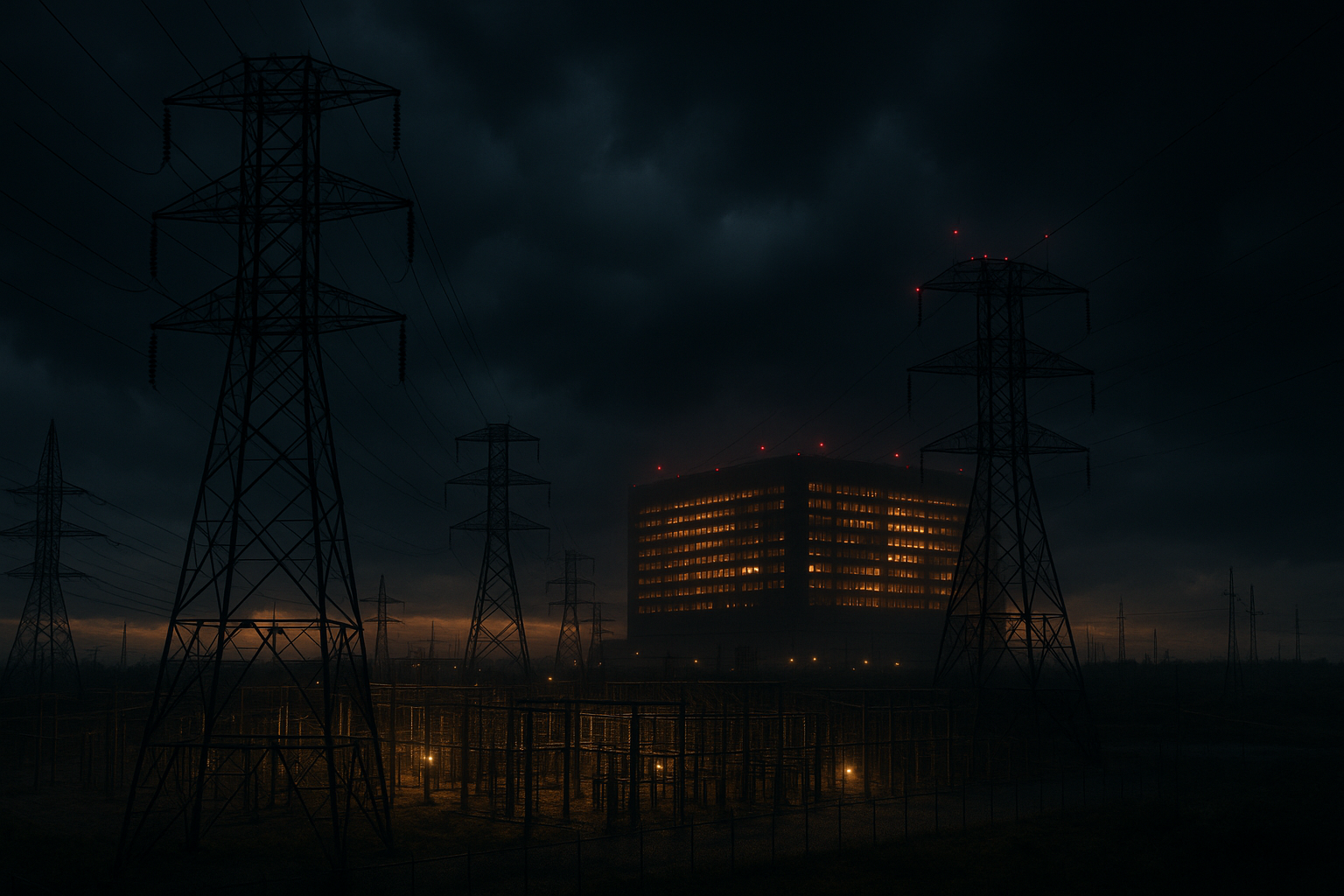
On July 27, the board of PJM Interconnection — the operator of America's largest power grid, serving 65 million people across 13 states and Washington, D.C. — put something in writing that no US grid operator has said this plainly before: it can no longer procure enough electricity to cover everyone who wants to plug in, and the loads that broke the math should either bring their own supply or turn themselves off when the grid runs tight.
The board's words were more diplomatic. Its proposal was not: "Existing consumers should not bear higher capacity costs caused by new large loads that do not bring, or otherwise contract for, the new supply necessary to serve them."
For two years, the story of AI and the American grid has been told as a cost story — data centers push up demand, capacity prices spike, household bills follow. That story is now obsolete. What PJM's board proposed last Monday converts the AI power squeeze from a cost problem into a permission problem. And permission problems create very different winners.
The Auction That Came Up Short
Start with what forced PJM's hand. On July 14, the grid operator published the results of its annual capacity auction — the market where it buys commitments from power plants to be available during the delivery year beginning in mid-2028. The auction procured 138,318 megawatts of capacity.
It needed roughly 6,800 more.
The auction fell 6,831 MW short of PJM's reliability target — a larger deficit than the prior year — and cleared at $325 per megawatt-day, pinned at the price cap for the second consecutive auction. That cap exists only because Pennsylvania Governor Josh Shapiro took PJM to federal regulators after the 2024 auction produced a tenfold price jump, and the 13 PJM-state governors negotiated a collar. Without it, prices would have cleared meaningfully higher. The bill for the latest auction: $16.4 billion, paid by everyone who uses electricity in the PJM footprint.
PJM's Independent Market Monitor, Joseph Bowring of Monitoring Analytics, has put numbers on who is driving that bill. Data centers account for $6.3 billion of the $16.4 billion in the latest auction — 38%. Across the last four capacity auctions, data-center-driven charges total $29.4 billion, or 46% of the $63.6 billion in cumulative capacity costs.
"PJM is continuing to act like it's business as usual," Bowring warned. "You have to open your eyes and recognize that it is really a paradigm shift, and failing to do that imposes costs on other customers."
The Two-Part Fix
The board's July 27 response has two mechanisms, and both are without precedent at this scale in a US power market.
First, a one-time backstop auction. Between September 30 and October 21, PJM will attempt to buy the missing ~6.8 gigawatts directly — but on radically different terms than its normal market. Suppliers must commit for 15 years, new resources must be online by June 1, 2032, and the price can run as high as $555 per megawatt-day — roughly 70% above the capped price in the base auction. PJM has also hired Charles River Associates to run a bilateral "matchmaking" process pairing large loads directly with generators, with the first matches expected in August.
Second — and far more consequential — a curtailment framework. Under the proposed Interim Resource Adequacy Service, new data centers and other large loads that connect without dedicated power supplies must reduce consumption or switch to backup generation during emergency grid conditions. PJM will maintain a registry of facility locations, ramp schedules, and supply arrangements to establish the order in which loads get curtailed.
Read that carefully. The largest electricity market in the country is proposing to formalize a queue for who gets unplugged first — and the way to the front of the safe list is to show up with your own contracted generation.
The proposals now go to the Federal Energy Regulatory Commission, with PJM's filing expected within days. As ClearView Energy Partners noted, FERC's answer will "influence utility capital investment, data center development timelines and the allocation of reliability risks and costs" — which is a careful way of saying that a federal agency is about to decide the operating rules of the AI buildout in the eastern United States.
The market has barely begun to reprice what that means. Because once grid access becomes conditional on bringing your own supply, the scarce asset is no longer capital, land, or even GPUs. It is contracted electrons — and a very short list of companies owns them.
The rest of this briefing is for paid members: the three tiers of companies the July 27 filing quietly repriced, the FERC scenario tree and what each outcome does to capacity prices, the haves-and-have-nots split now running through the data center pipeline, and the four dates between now and December that decide the trade.
AlphaBriefing Paid gets you every investment thesis, scenario framework, and catalyst brief we publish — the analysis private intel clients pay four figures for, at a fraction of that.