What Happens When SpaceX Opens Its Books?
The largest IPO in history closed July 20% below its offer price. On Tuesday, SpaceX reports earnings for the first time ever — and 48 hours later, insiders holding 95% of the company get their first chance to sell.

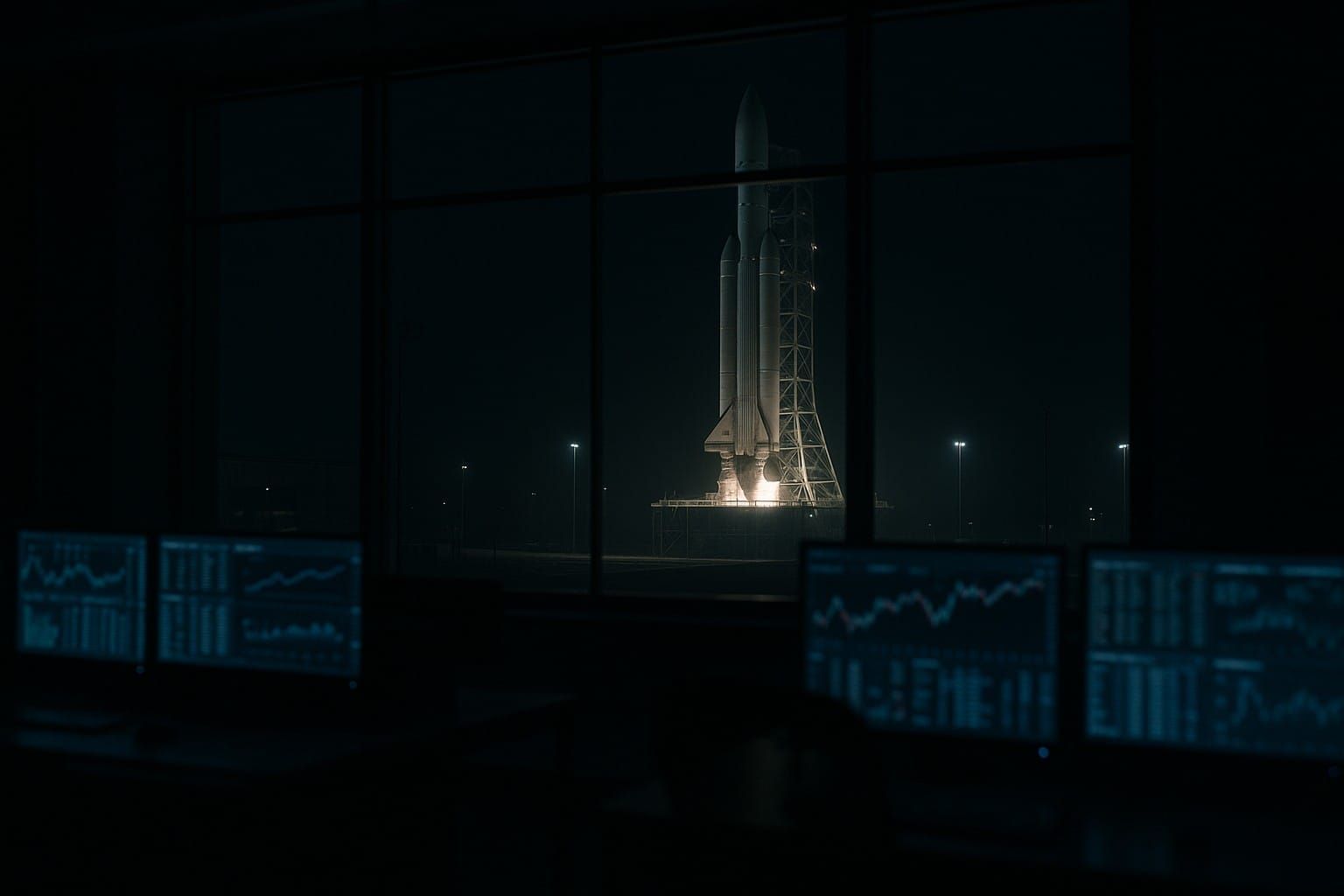
Seven weeks ago, SpaceX pulled off the largest initial public offering in history — $75 billion raised at a $1.75 trillion valuation, priced at $135 a share. On Friday, the stock closed at $108.37.
That is 20% below the offer price, down 31% for July alone, and roughly half the June peak above $225. A company that briefly traded near a $3 trillion market cap is now worth $1.42 trillion — and on Tuesday, August 4, it does something it has never done in its 24-year existence: report quarterly earnings to the public.
Then, two days later, comes the event that may matter more. On August 6, the first IPO lockup expires, and insiders holding roughly 95% of the company get their first legal window to sell.
This is the week the most hyped stock of 2026 collides with its own numbers.
How the Biggest IPO in History Went Underwater
The June debut was a spectacle. Retail demand was frantic, the stock ran from $135 to above $225, and for a moment SpaceX traded like the market's answer to a question nobody had fully articulated — a single ticker offering rockets, satellites, sovereign defense infrastructure, and (via the xAI merger) a frontier AI lab.
July answered differently. The Nasdaq is approaching correction territory, down nearly 10% since June. The AI trade has been repricing globally — South Korea's Kospi just posted the worst month in its history as leveraged AI bets unwound, and Meta's warning of higher-than-expected 2026 capital expenditures knocked its own shares 4% after hours this week. In that tape, SpaceX stopped being a story stock and started being a math problem.
The math is uncomfortable. SpaceX absorbed xAI in February, and the S-1 laid out what that means: the combined company generated more than $18.5 billion of revenue in 2025 — and lost nearly $5 billion doing it.
One Cash Machine, Two Furnaces
Strip the company into its three parts, and the S-1 tells a story very few trillion-dollar valuations have ever told.
Starlink is the engine. The satellite internet business did $11.4 billion of revenue in 2025 at EBITDA margins above 60%, passed 10 million subscribers, and is projected to reach roughly $20 billion of revenue in 2026 — 70 to 75% of the whole company. It is one of the best infrastructure businesses ever built, and it is carrying everything else.
The rocket business loses money. Launch — the thing SpaceX is famous for — posted an operating loss of $619 million, with Starship development consuming capital years ahead of any commercial return. The Pentagon remains a committed customer (the Space Force just awarded SpaceX $1.6 billion for 18 more Falcon 9 missions through 2027), but government launch revenue does not yet cover the cost of building the next-generation vehicle.
xAI burns whatever is left. The AI unit lost more than $6 billion in 2025 and burned another $2.5 billion in the first quarter of 2026 alone. Frontier-model compute is the most capital-hungry race in business history, and SpaceX shareholders are now the ones funding it.
That is the actual structure of the company: one profitable business subsidizing two of the most expensive engineering programs on Earth. The bull case is that this is Amazon in 2001 — a cash engine funding empires. The bear case is that it is a very good $20 billion telecom attached to $9 billion a year of losses, priced at 70 times revenue.
Briefings like this land in members' inboxes before the market prices them in. Join free →
What Tuesday Actually Has to Show
Because this is SpaceX's first earnings report, there is no track record of guidance, no consensus history, no pattern of sandbagging or overpromising. Nobody — including the analysts covering it — knows how this management team communicates quarterly. Four things will decide how the print lands:
Starlink subscriber growth and pricing. The entire valuation rests on Starlink compounding. Net additions, average revenue per user, and any disclosure on the direct-to-cell business with T-Mobile are the numbers that matter most. Deceleration here has no offset anywhere else in the company.
The xAI burn rate. Q1's $2.5 billion loss set the baseline. If Q2 comes in materially higher — and every competitor's compute spending suggests it might — the market will start extrapolating annual AI losses into the teens of billions, in a month when investors have already turned hostile to exactly that kind of spending.
Starship program costs. The launch segment's losses are a proxy for how expensive the path to Mars-class hardware really is. Any disclosure on Starship's commercial timeline — Starlink V3 deployment, the Artemis schedule — moves the long-term model.
Whether management guides at all. Elon Musk has spent two decades making claims on his own timeline. SEC-audited quarterly disclosure is a different discipline. Whether SpaceX offers formal guidance — and whether Musk himself shows up on the call — will tell investors a great deal about how this company intends to be public.
Thursday Is the Bigger Test
Earnings are Tuesday. The supply arrives Thursday.
August 6 is the first lockup expiration, and the structure matters. The IPO floated only about 5% of the company; early shareholders and employees hold the other 95%. On Thursday, they can sell up to 20% of their holdings — a maximum of roughly $106 billion of stock at current prices, against the $75 billion of total demand the IPO itself absorbed in June.
There was supposed to be a bonus release: an additional 10% if the stock traded 30% above the IPO price for five of the ten preceding sessions. At $108, that provision is dead — a detail that itself tells you how far the stock has fallen from the script. Eight more lockup expirations follow over the coming quarters.
Nobody expects insiders to dump $106 billion into a falling tape. But the marginal price-setter changes on Thursday. For seven weeks, SpaceX's float has been a scarce asset chased by retail money and index funds — passive demand that mechanically grows as index weightings step up each quarter. From Thursday, every rally has natural sellers into it: employees with a decade of paper wealth and venture funds with fifteen-year-old positions to distribute.
What Is It Actually Worth?
The honest answer is that the market has no idea, and the range of published views is extraordinary for a company this size.
Morningstar's June analysis valued SpaceX at roughly $780 billion — about half the IPO valuation — arguing that Starlink justifies an enormous number on its own but that xAI's losses and strategic opacity deserve a discount, not a premium. The stock would need to fall another 45% from Friday's close to reach that number.
The sell side sees the opposite: the average 12-month analyst price target sits near $244, implying the stock could more than double. That gap — $780 billion to $2.9 trillion, on the same company, in the same month — is not really a disagreement about spreadsheets. It is a disagreement about whether xAI is an asset or a liability, and Tuesday is the first time management has to argue its case with audited numbers instead of ambition.
Seven weeks ago, that question was priced on faith. This week, for the first time, it gets priced on disclosure.
If this analysis was useful, this is what AlphaBriefing does every day — geopolitics and markets, connected to what it means for your money. Free members get the daily brief in their inbox; paid members get the investment frameworks, scenario pricing, and catalyst calendars behind the paywall.
Get this level of intelligence every day. Subscribe to AlphaBriefing — free, member, and paid tiers available.
Sources & Further Reading
- The Motley Fool — SpaceX Earnings Are Coming Aug. 4. Here's Why Aug. 6 Could Be Even More Important for Investors
- Morningstar — 6 Charts on SpaceX's Pre-IPO Financials
- CNBC — SpaceX Is Worth Less Than Half of Its $1.75 Trillion IPO Target, Morningstar Says
- Capital.com — SpaceX IPO: Everything You Need to Know
- MarketBeat — SpaceX (SPCX) Stock Price History
- Spaceflight Now — SpaceX Launch Coverage and Mission Reporting
Disclaimer
AlphaBriefing is an independent intelligence publication. The content in this article is produced for informational and educational purposes only. Nothing published by AlphaBriefing constitutes financial, investment, legal, tax, or regulatory advice, nor should it be construed as a solicitation or recommendation to buy, sell, or hold any security, asset, or financial instrument.
All views expressed are those of the author at the time of writing and are subject to change without notice. Markets are volatile and unpredictable; past performance is not indicative of future results. Any investment involves risk, including the possible loss of principal.
AlphaBriefing and its principals, employees, or contributors may hold positions in securities or assets mentioned in this article. This should be considered a potential conflict of interest. No material relationship with any company referenced exists unless explicitly disclosed. Readers should conduct their own due diligence and consult qualified financial, legal, and tax advisors before making any investment decisions.
Information in this article is drawn from public sources believed to be reliable at the time of publication. AlphaBriefing makes no warranty, express or implied, as to the accuracy, completeness, or timeliness of any information herein. AlphaBriefing accepts no liability for any loss or damage arising from reliance on this content.
© AlphaBriefing. All rights reserved. Unauthorised reproduction or distribution is prohibited.