What Happens to a Town When Its College Dies?
The enrollment cliff arrived on campus this month — not as a uniform decline, but as a sorting. Flagships are posting record classes while small colleges close, and the losses are landing on towns built on the assumption the campus is permanent.

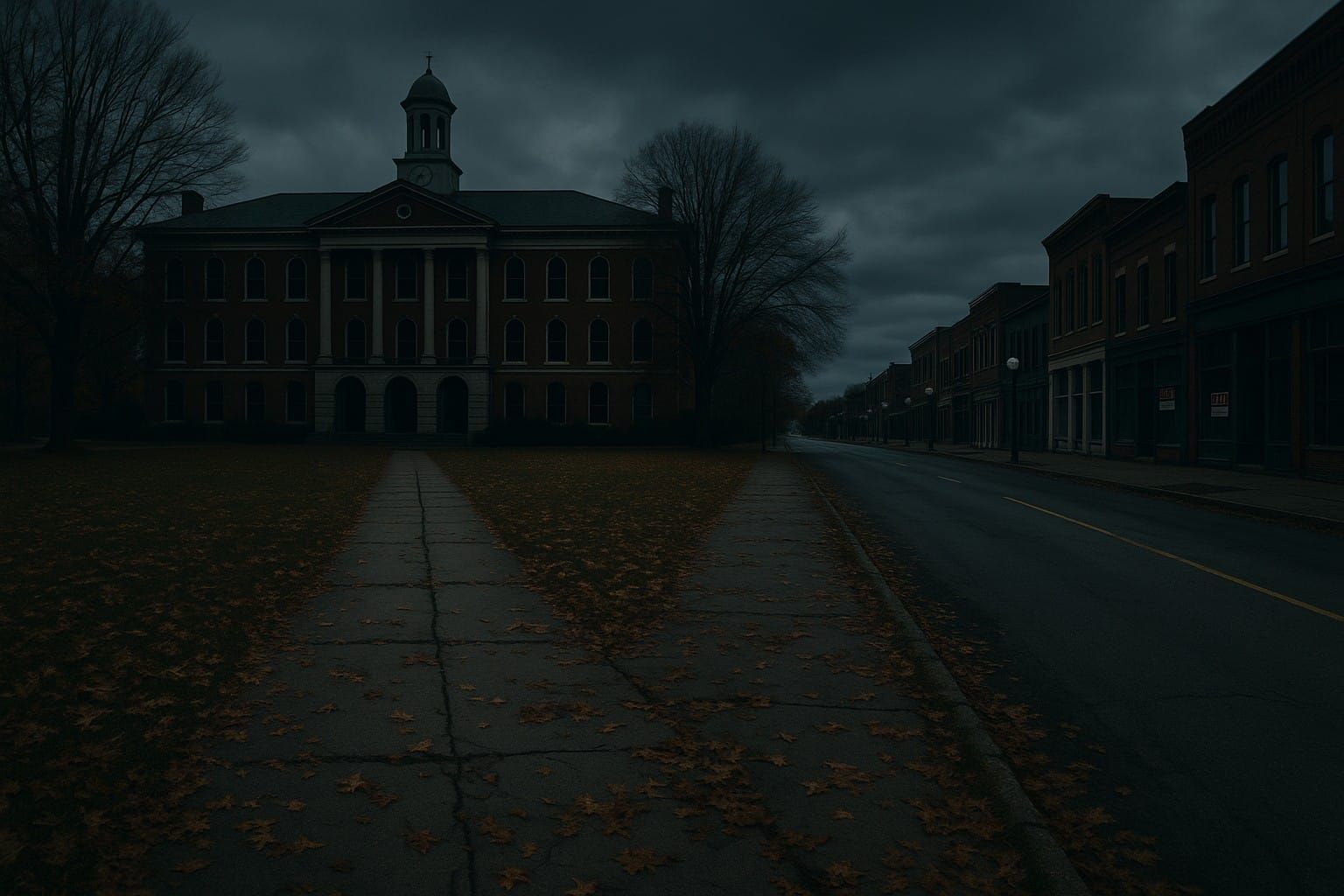
On August 21, the University of Valley Forge — a Pennsylvania institution with roots going back nearly a century — shut its doors. Enrollment had fallen 50% since 2007. Six days from now, Labouré College of Healthcare in Milton, Massachusetts follows. Across the state in Amherst, Hampshire College is teaching its final semester this fall; it enrolled 168 new students last year against $21 million in bond debt it cannot service.
The same week Valley Forge closed, the University of Tennessee's flagship campus in Knoxville crossed 40,000 students — its sixth consecutive record year. The University of Cincinnati welcomed the largest freshman class in its history, more than 9,000 students. Penn State's University Park campus set an all-time undergraduate enrollment record.
Both things are true at once, and that is the story. The "enrollment cliff" that higher education has dreaded for a decade and a half arrived on American campuses this month — and it did not arrive as a tide going out evenly. It arrived as a sorting machine. The strong institutions are posting records. The weak ones are dying. And the economic damage is not landing on "higher education" as a sector — it is concentrating, town by town, on hundreds of communities whose entire economy was built on the assumption that the campus is permanent.
The Freshmen Who Were Never Born
The mechanics are brutally simple. In 2007, the United States recorded about 4.3 million births — an all-time high. Then the financial crisis hit, and Americans responded the way they always do in hard times: they stopped having children. Births fell in 2008, kept falling, and never recovered; by the early 2020s the annual figure was under 3.7 million.
Add 18 years to 2008 and you get the fall 2026 freshman class — the first one drawn from the post-crisis birth trough. This is why the cliff was always a "when," never an "if." According to the Western Interstate Commission for Higher Education, the number of US high school graduates peaked in 2025 and will decline roughly 13% through 2041 — eliminating about 576,000 students from each year's traditional college pipeline by the end of the projection.
Two properties make this different from every previous enrollment downturn. First, it is structural, not cyclical: every person who will turn 18 in the next 18 years has already been born, and there are not enough of them. No marketing budget, no tuition discount, no recession-driven enrollment surge changes that arithmetic. Second, it is geographically uneven: the Northeast and Midwest — precisely the regions with the densest concentration of small, tuition-dependent private colleges — face the steepest declines, with parts of the northern Midwest projected to lose nearly one in five college-age students.
Briefings like this land in members' inboxes before the market prices them in. Join free →
A Sorting, Not a Sinking
If you want to watch the sorting happen inside a single institution, look at Penn State. One university, one state, one brand — and two completely different realities.
At University Park, the flagship campus, fall 2026 brought a record 42,822 residential undergraduates. Applications rose 10% year-over-year to 145,654 — a record. The university's strategic plan calls for growing the flagship's freshman class further, to 10,000.
At Penn State's 20 commonwealth campuses — the regional branch network spread across smaller Pennsylvania towns — enrollment fell 5.7% in a single year. Not one campus grew. Seven are scheduled to close after spring 2027. Penn State Wilkes-Barre lost 29.4% of its students in one year, dropping from 329 to 232.
The same brand, the same tuition engine, the same state. Demand didn't disappear — it walked up the prestige ladder. Tennessee shows the identical pattern at state scale: UT Knoxville's enrollment jumped 30% between 2015 and 2023 while the state's ten regional public colleges collectively shrank. Analysts have started calling it a "flight to quality," and the phrase is apt: students facing rising costs are concentrating their bets on the institutions whose brand, network, and completion rates most credibly justify the price. The scarce resource in American higher education is no longer seats. It is students — and the bidding war for them has clear winners.
The losers are just as identifiable. Nearly every college that has announced a closure shares the same profile: small, private, tuition-dependent, and located in exactly the regions where the demographic decline is steepest. The 2026 casualty list — Valley Forge, Anna Maria College, Hampshire, Labouré, Lourdes University in Ohio, California College of the Arts — follows at least 16 campus closures in 2025 and more than 240 since 2013.
The financial trajectory says the pace accelerates from here. Moody's projects sector revenue growth of just 3.5% in 2026 — and only 2.7% for small private institutions — against expense growth of 4.4%. The share of private colleges running negative operating margins has climbed from 7.2% in 2024 to an estimated 12.2% in 2025, and Moody's projects 16% next year. One in six private colleges losing money, before the smallest freshman classes in a generation even hit the books. Fitch calls the sector's 2026 outlook "deteriorating." Consultants at Huron project that nearly a quarter of America's roughly 1,700 private nonprofit four-year colleges could close or merge within a decade.
The Town Holds the Bag
Here is what the sector-level statistics miss: a college closure is not primarily an education story. It is a local economic collapse — and the pattern it follows is one America has seen before.
Macomb, Illinois is the template. Western Illinois University has lost nearly half its students since 2010. The city's sales tax revenue fell almost in lockstep with enrollment. The town's population is down more than 20%. Dorms have closed, landlords are cutting rents into rising vacancies, and the restaurants and clothing stores that dressed and fed generations of students are shuttered or up for sale. Economic modeling by IMPLAN puts the average college closure at 265 lost jobs and $14 million in vanished local labor income — and that understates places like Amherst, where Hampshire's wind-down alone eliminates 269 jobs. Across the country, 75% of metro areas that depend heavily on higher education grew more slowly than the national average between 2011 and 2023.
If that arc sounds familiar, it should. It is the factory-town playbook: a single anchor employer, a non-diversified local economy, and a slow-motion repricing of every asset in town — houses, storefront rents, school budgets, municipal credit — once the anchor starts to shrink. The Rust Belt at least got a warning label. College towns spent decades being told they were recession-proof, because enrollment historically rose in downturns. That insurance policy just expired: the demographic cliff doesn't care about the business cycle.
For markets, the exposure runs deeper than the colleges' own debt — though that matters too, as Hampshire's $21 million in stranded bonds demonstrates. The larger question sits in the municipal market's quieter corners: general-obligation and sales-tax bonds issued by towns whose tax base, employment, and property values all assume the campus operates forever. A university is the rare employer that cannot relocate — but it can evaporate, and when it does, the demand for everything around it evaporates with it. Student housing built in the wrong markets, downtown commercial strips, county hospital volumes, school district enrollment: all of it reprices. The credit ratings on those towns largely don't reflect it yet, for the same reason factory-town credits didn't in 1978 — the decline is visible in the data but absent from the narrative.
The winners' side of the ledger is real, but narrow. Flagship university towns are absorbing the demand the periphery is losing — record classes mean housing pressure, construction, and expanding payrolls in places like Knoxville and State College. The mega-online institutions and trade programs are capturing students who price out of the traditional model entirely — a rational response in an economy short half a million electricians. And a redevelopment trade is forming around the carcasses: shuttered campuses are hitting the market as ready-made sites for senior living, corporate training centers, and housing — often the only asset the closing college has left.
The Bottom Line
The enrollment cliff will not sink American higher education. It will consolidate it — violently. The flagships and brand-name privates will finish this decade bigger and more selective than ever. The long tail of small, tuition-dependent colleges will keep closing at an accelerating rate, because the students they need were never born and the students who exist are choosing bigger names. In between sit hundreds of towns — disproportionately in the Northeast and Midwest, disproportionately already-struggling — about to learn that their anchor institution was not infrastructure but a business, and that the business has lost its customers.
America has run this experiment before. The towns that bet everything on one employer spent forty years paying for it. The second run starts this semester.
If this analysis was useful, this is what AlphaBriefing does every day — geopolitics and markets, connected to what it means for your money. Free members get the daily brief in their inbox; paid members get the investment frameworks, scenario pricing, and catalyst calendars behind the paywall.
Sign up free → — upgrade whenever it earns it.
Get this level of intelligence every day. Subscribe to AlphaBriefing — free, member, and paid tiers available.
Sources & Further Reading
- University Business — The College Closings and Mergers of 2026
- StateCollege.com — Penn State Reports Record-High Undergraduate Enrollment at University Park, Continued Decline at Commonwealth Campuses
- CRE Daily — College Towns Enrollment Decline Reshapes Local Economies
- Higher Ed Dive — Higher Education Outlook Remains Negative for 2026, Moody's Says
- Higher Ed Dive — Higher Education Faces 'Deteriorating' 2026 Outlook, Fitch Says
- WICHE — Knocking at the College Door: Projections of High School Graduates
- University of Tennessee — Record Enrollment and Enhanced Campus Experience Define New Year at UT
- WVXU — Area Universities Report Larger Freshman Classes This Fall
Disclaimer
AlphaBriefing is an independent intelligence publication. The content in this article is produced for informational and educational purposes only. Nothing published by AlphaBriefing constitutes financial, investment, legal, tax, or regulatory advice, nor should it be construed as a solicitation or recommendation to buy, sell, or hold any security, asset, or financial instrument.
All views expressed are those of the author at the time of writing and are subject to change without notice. Markets are volatile and unpredictable; past performance is not indicative of future results. Any investment involves risk, including the possible loss of principal.
AlphaBriefing and its principals, employees, or contributors may hold positions in securities or assets mentioned in this article. This should be considered a potential conflict of interest. No material relationship with any company referenced exists unless explicitly disclosed. Readers should conduct their own due diligence and consult qualified financial, legal, and tax advisors before making any investment decisions.
Information in this article is drawn from public sources believed to be reliable at the time of publication. AlphaBriefing makes no warranty, express or implied, as to the accuracy, completeness, or timeliness of any information herein. AlphaBriefing accepts no liability for any loss or damage arising from reliance on this content.
© AlphaBriefing. All rights reserved. Unauthorised reproduction or distribution is prohibited.