What Good Is More Crude If Nobody Can Refine It?
OPEC+ just approved its last production hike of the year. It won't lower fuel prices — the world isn't short of crude, it's short of refineries. Inside the 4.5-million-barrel hole in global fuel supply, and who collects the spread.

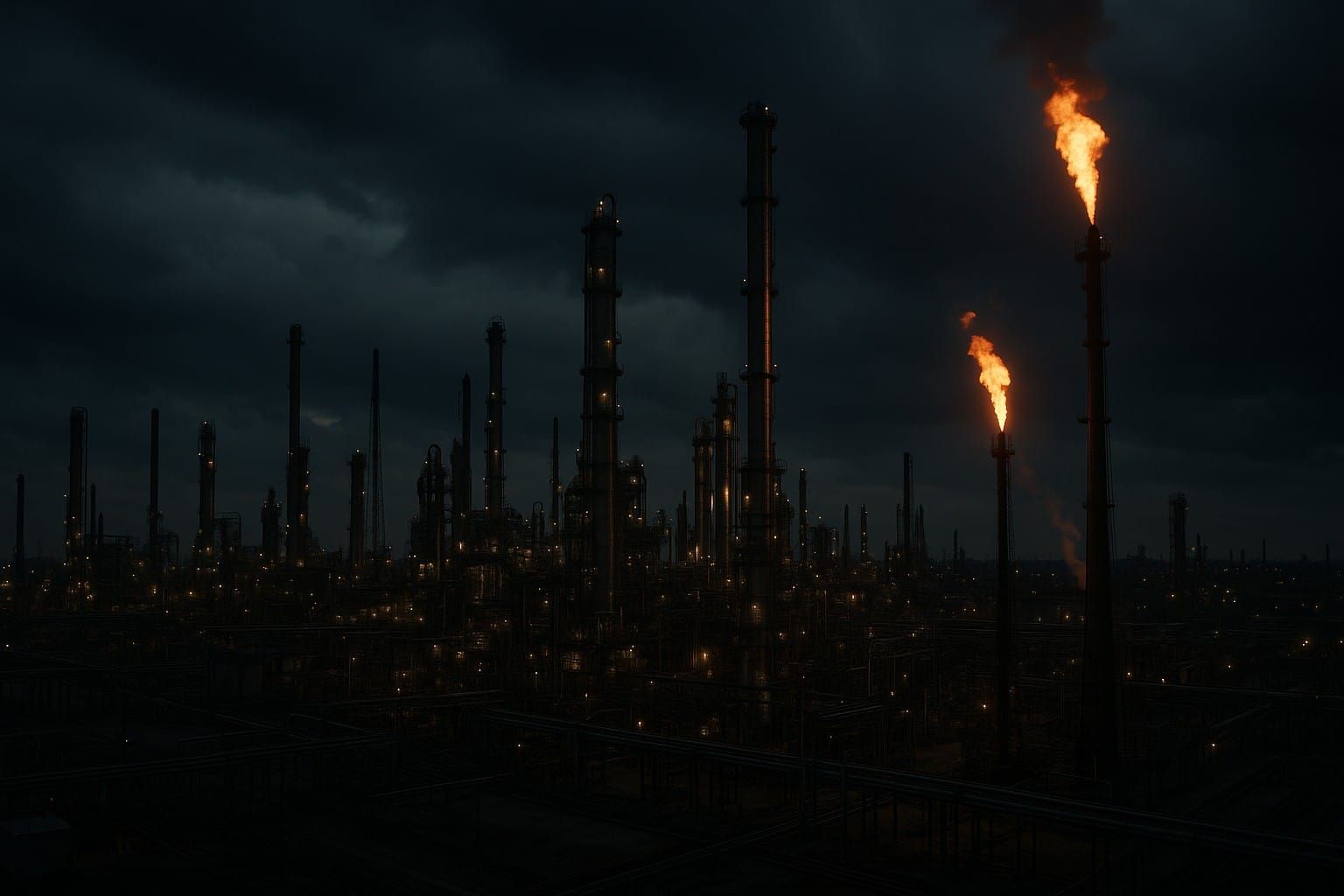
On Sunday, OPEC+ delegates agreed in principle to one more token production increase — roughly 188,000 barrels a day for September — and signaled that after that, the quota hikes stop for the rest of the year. The move completes the long unwind of the cuts the group made back in 2023. Markets will read it as the cartel calling time on the supply cycle.
Here is what it won't do: lower the price of diesel, jet fuel, or gasoline by any amount that matters.
That's because the defining feature of the 2026 energy market is a disconnect that most investors still haven't internalized. Crude oil — the thing OPEC+ controls — has fallen from its April panic peak above $126 a barrel back into the mid-$80s, with WTI settling near $85 on Friday. Refined products — the things economies actually run on — have refused to follow. The NYMEX 3-2-1 crack spread, the standard proxy for what a refiner earns turning crude into gasoline and diesel, broke above its June 2022 record this July, printing as high as $64.58 a barrel on the prompt contract.
In plain terms: the world is no longer short of oil. It is short of the machines that turn oil into fuel. And machines are much harder to restart than oil wells.
The 4.5-Million-Barrel Hole
The International Energy Agency's July report put a number on it: global refinery output ran roughly 4.5 million barrels a day below normal in the second quarter — about 5.4% of the world's refining throughput, gone.
That hole was dug from three directions at once.
War damage. The Iran conflict knocked out or disrupted refining and export infrastructure across the Gulf, and the Strait of Hormuz — five weeks into a ceasefire — is still moving a fraction of its normal traffic. Meanwhile, Ukraine's long-range drone campaign has systematically hit Russian refineries, deep inside the country and repeatedly. Russia's refining crisis is now severe enough that Moscow — historically the world's largest diesel exporter after the US — banned diesel exports outright in July to keep its own domestic market supplied. On July 27, Deputy Prime Minister Alexander Novak extended Russia's gasoline export ban through the end of 2026 and said the diesel ban will lift only "as the market recovers." No date attached.
Permanent closures. Before a single missile flew, the Atlantic basin was already shrinking its refining base. LyondellBasell's Houston refinery ran its last crude in early 2025. Phillips 66 shut its Los Angeles complex. Grangemouth ended six decades of Scottish refining. These plants aren't idled — they're being demolished or converted. Their capacity does not come back when a ceasefire holds.
Nothing new coming. Against those losses, the IEA expects global net refining capacity to grow by well under a million barrels a day in 2026 — barely enough to match demand growth in a normal year, and nowhere near enough to backfill what the war subtracted.
This is why more OPEC+ crude doesn't fix the problem. Every incremental barrel the cartel adds has to pass through the same shrunken refining system. Extra crude supply with fixed product supply doesn't lower fuel prices — it lowers the refiner's input cost. It can actually widen the spread.
Briefings like this land in members' inboxes before the market prices them in. Join free →
The Margin Moved Downstream
For most of the past two decades, the profits of the oil age accrued upstream — to whoever owned the reserves. What 2026 has built is the mirror image: a market where crude is adequate, products are scarce, and the toll booth sits at the refinery gate.
The earnings are already showing it. Phillips 66's realized refining margin jumped 48% year over year in the first quarter, with utilization running at 95%. Marathon Petroleum captured 99% of its market margin indicator in Q1 — while completing 40% of its annual maintenance — and its stock has risen more than 50% in six months. Valero swung from a forgettable 2025 to $1.8 billion of quarterly refining operating income. The refining complex, left for dead during the energy-transition rerating of the early 2020s, is quietly posting some of the best numbers in the S&P 500.
Which raises the only question that actually matters for the trade — and it's the one 2022 taught investors to ask: is this a structural deficit, or a peak-margin trap? The last time crack spreads hit records, the investors who bought refiners at the top watched margins mean-revert within a year. Whether this time is different comes down to a handful of specific, datable variables.
The rest of this briefing is for paid members: the four variables that decide whether record crack spreads hold into 2027 or collapse like 2022's did, the specific refiners and product-tanker names positioned to collect the spread, the mid-cycle margin math that tells you what's already priced in, and the catalyst calendar — including the one Russian announcement that ends this trade.
AlphaBriefing Paid gets you every investment thesis, scenario framework, and catalyst brief we publish — the analysis private intel clients pay four figures for, at a fraction of that.