The Seabed War: China Just Tested a Deep-Sea Cable Cutter — and Billions Are Flooding Into Undersea Defense
China's successful test of a 3,500-meter cable-cutting device signals a new era of undersea warfare. With billions now flowing into submarine cable security from the U.S., EU, and NATO, here's the investment map for the seabed arms race.

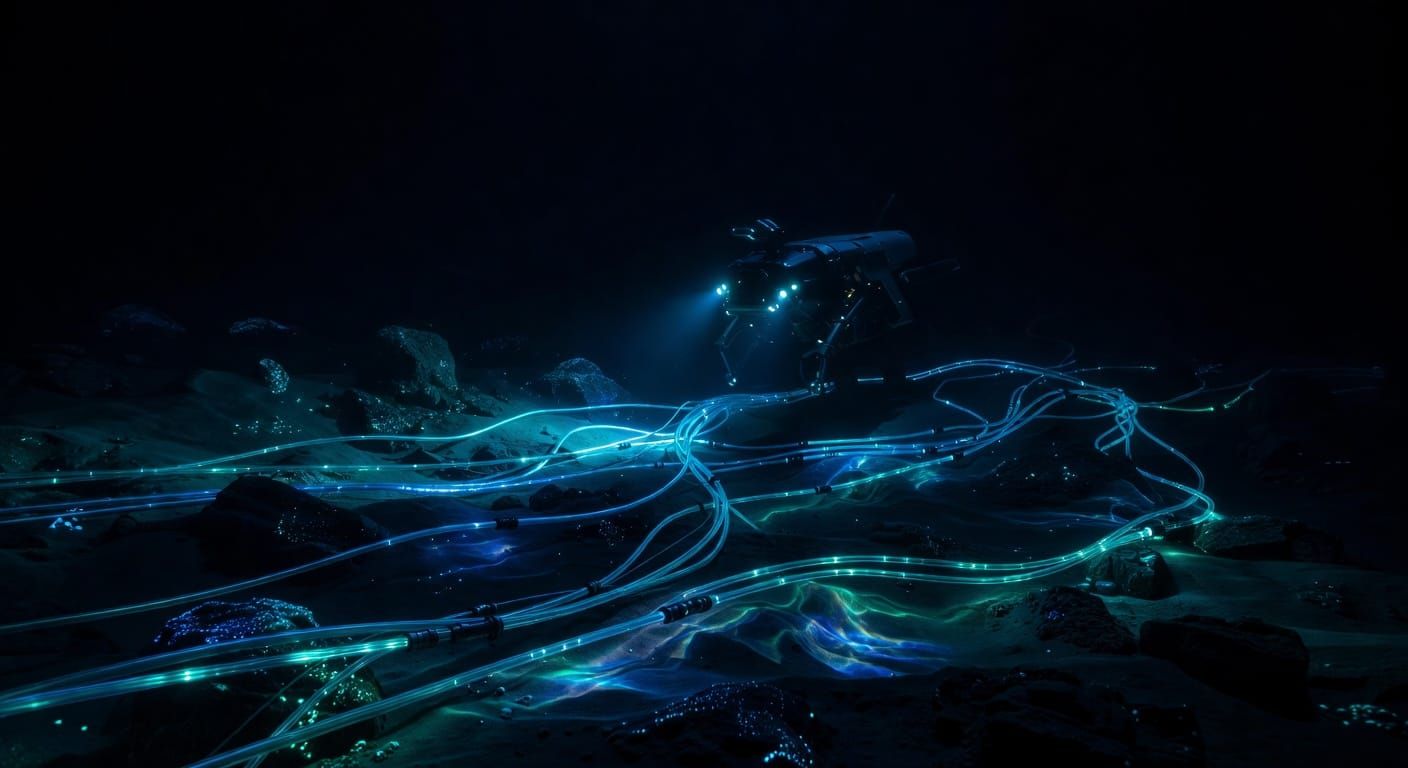
On April 11, 2026, aboard the research vessel Haiyang Dizhi 2, Chinese scientists completed the first successful deep-sea test of an electro-hydrostatic actuator (EHA) capable of severing armored submarine cables at 3,500 meters below the ocean surface.
State media called it "bridging the last mile" from development to deployment. Western defense analysts called it something else: a declaration of capability in the most consequential domain of 21st-century warfare that most investors have never thought about.
The timing was not subtle. The test came amid a rolling wave of suspected cable sabotage incidents stretching from the Baltic Sea to the Taiwan Strait — and just weeks after the European Union committed €347 million to submarine cable protection and the U.S. Congress introduced the Strategic Subsea Cables Act of 2026.
Beneath the surface of the world's oceans lies the most critical — and most vulnerable — infrastructure in the global economy. Approximately 1.5 million kilometers of submarine fiber-optic cables carry 99% of intercontinental internet traffic, enable $10 trillion in daily financial transactions, and underpin everything from cloud computing to military command-and-control networks.
And now, multiple state actors have demonstrated both the willingness and the capability to cut them.
The Anatomy of a Gray-Zone Weapon
China's EHA is a compact, self-contained unit integrating a hydraulic system, electric motor, and control module — no external piping, deployable on remotely operated vehicles (ROVs). Specifications are striking: it withstands over 35 megapascals of external pressure, delivers more than 50 kilonewtons of output force, and uses a diamond-coated grinding wheel capable of slicing through armored cables up to 60 millimeters thick.
Officially, Beijing frames the technology as civilian infrastructure — for oil and gas pipeline maintenance, scientific research, and salvage operations. But the dual-use implications are impossible to ignore. Taiwan's 24 submarine cables, the links connecting U.S. military installations in Guam and the Pacific, the transatlantic arteries feeding Europe's digital economy — all are now demonstrably within reach.
China is not alone. Since late 2023, suspected Russian-linked vessels have been implicated in at least six cable cuts in the Baltic Sea, including a Finland-Estonia link severed in late 2025. The Red Sea has seen cable damage during the Houthi conflict. The pattern is clear: submarine cable sabotage has become a preferred tool of gray-zone warfare — deniable, devastating, and extraordinarily difficult to attribute.
The Defense Response: Billions Flowing Into Cable Security
The scale of the policy response tells you how seriously governments are taking this threat.
United States: The Strategic Subsea Cables Act of 2026 (S.3249), introduced in March with bipartisan backing, establishes sanctions against foreign persons who sabotage cables, creates 10 dedicated State Department positions for subsea infrastructure diplomacy, mandates supply chain controls, and expands the Cable Security Fleet of U.S.-flagged repair ships. The FCC has simultaneously accelerated permitting for new cable deployments while strengthening security reviews.
European Union: A €347 million package announced in February funds emergency repair capacity (€60 million priority allocation), monitoring technology, and the new "Cable Security Toolbox" — a detection-and-response framework focused on Baltic and North Sea hotspots. Finland and Estonia have deployed enhanced undersea surveillance following the 2025 incidents, and 10 North Sea nations are investing billions in anti-sabotage measures for cables and offshore wind infrastructure.
NATO: The alliance's Baltic Sentry operation now patrols with drones, frigates, and intelligence, surveillance, and reconnaissance (ISR) assets. A new Critical Undersea Infrastructure Network coordinates deterrence across member states. Sweden has deployed its A26 stealth submarine — purpose-built for shallow-water operations — to protect Baltic seabed infrastructure.
This is where the analysis gets actionable. AlphaBriefing members get the full investment framework — scenarios, positioning, and the bottom line.
Subscribe to AlphaBriefing — Free, Member, and Paid tiers available.