The Arms Pipeline: Russia Is Arming Iran Mid-War — and the World Just Found Out

The ceasefire between the United States and Iran expires at midnight GMT tonight. As the world holds its breath, a parallel drama unfolded at the United Nations on Monday — one that may shape the next chapter of this conflict far more than any peace talks in Islamabad.
The United States formally accused Russia of supplying Iran with fighter jets, tanks, and advanced missile systems in a heated UN Security Council session. Moscow dismissed the allegations as a "cheap show." But leaked documents, confirmed contracts, and satellite imagery tell a different story — one of the most consequential arms pipelines of the 21st century, built in plain sight while the world was looking elsewhere.
The Arsenal
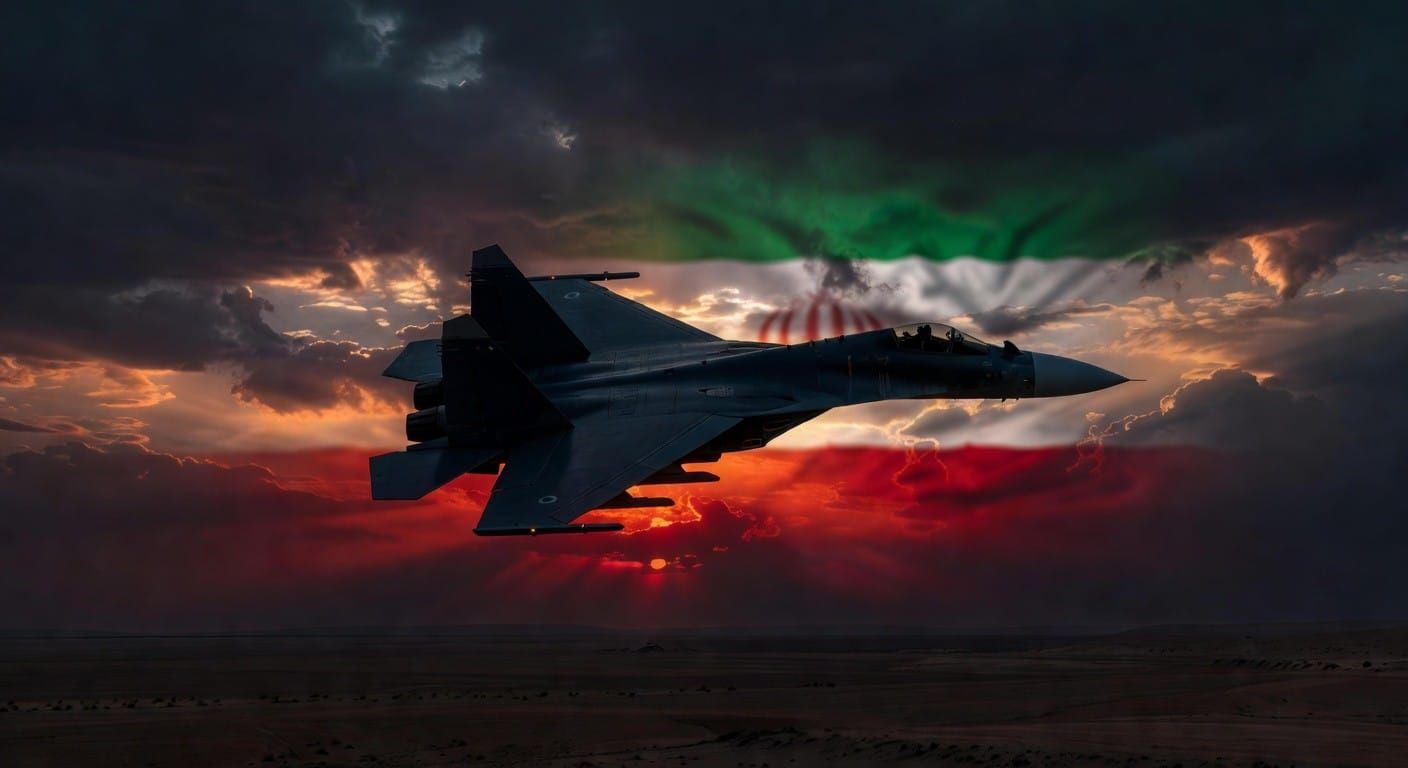
The centerpiece is a $6.5 billion deal for up to 48 Sukhoi Su-35SE multirole fighter jets — Russia's most advanced export fighter. Leaked documents from KRET, a Russian defense electronics firm, confirm production is underway. The first batch of 16 jets is expected by Q3 2026, with Iranian pilots already training on the platform.
But the Su-35s are just the headline. The pipeline includes:
- Mi-28N attack helicopters — Russia's answer to the Apache, capable of anti-armor and close air support missions
- Yak-130 advanced trainers — some already delivered, serving as light combat aircraft
- Verba MANPADS — a €500 million deal signed in February 2026 for advanced man-portable air defense systems
- T-90 tanks and armored vehicles — quantities unconfirmed, but US intelligence assessments cite "significant transfers"
For Iran, whose air force has relied on aging American F-14 Tomcats and Chinese-origin platforms for decades, the Su-35 alone represents a generational leap. These are aircraft designed to compete with — if not match — the F-15E Strike Eagles currently flying combat missions over Iranian airspace.
The Barter Economy of War
What makes this pipeline unique is its currency. Iran isn't paying in dollars or euros. It's paying in drones, missiles, and battlefield intelligence.
Since Russia's invasion of Ukraine in 2022, Iran has supplied thousands of Shahed-series kamikaze drones and, according to Western intelligence, ballistic missiles to Moscow's war effort. The Su-35 deal formalizes what was already an open secret: a wartime barter arrangement between two sanctioned powers, each providing what the other desperately needs.
Russia gets cheap, effective weapons for its Ukraine campaign. Iran gets the air power it has coveted for 40 years.
The Comprehensive Strategic Partnership Treaty signed in January 2025 — which entered into force last October — codified this relationship. It commits both nations to military-technical cooperation, joint exercises, and mutual defense consultation. U.S. officials have called it a "de facto military alliance."
Why the UN Session Matters
Monday's Security Council confrontation wasn't just diplomatic theater. The U.S. presentation included intelligence assessments, intercepted logistics data, and commercial satellite imagery of production lines at Russia's Komsomolsk-on-Amur Aircraft Plant — the facility building Iran's Su-35s.
The American delegation argued that these transfers violate the spirit, if not the letter, of multiple UN resolutions restricting arms flows to Iran. Washington is pushing for a new enforcement resolution — a move Russia and China will almost certainly veto.
Moscow's response was telling. Rather than denying the transfers outright, Ambassador Nebenzia called the presentation a "cheap show designed to distract from America's own war of aggression." The deflection tacitly confirmed what the documents already show.
For Beijing, the session posed an uncomfortable dilemma. China has positioned itself as the responsible mediator of the Iran conflict — Xi Jinping just urged a "comprehensive ceasefire" in a call with Saudi leaders on Sunday. But China has also blocked every meaningful effort to enforce arms restrictions on its strategic partners. You can't broker peace while enabling the weapons that make war possible.
The Ceasefire Clock
All of this unfolds against the most critical 24 hours of the eight-week-old conflict. The Pakistan-brokered ceasefire — a fragile, two-week pause agreed on April 8 — expires at midnight GMT on April 22.
The signals are not encouraging:
- Trump has called an extension "highly unlikely" and warned Iran of "problems" if talks fail
- Iran has signaled it may skip fresh negotiations entirely
- The U.S. Navy seized an Iranian-flagged tanker attempting to breach the Hormuz blockade just days ago
- Iran fired on commercial shipping in the Strait last week
Oil markets are pricing the uncertainty. Brent crude sits at roughly $95/barrel — down from crisis peaks above $110 but still carrying a significant risk premium. Analysts estimate a full resumption of hostilities could push prices to $120-130, triggering what the IMF last week called a potential "severe scenario" of sub-2% global growth and 6%+ inflation.
The IMF's April World Economic Outlook, released during last week's Spring Meetings, already downgraded 2026 global growth to 3.1% — shaving 0.2 percentage points off its January forecast. Emerging markets took the hardest hit, with growth cut 0.3 points to 3.9%. The Fund's adverse scenario — sustained conflict, higher energy prices, tighter financial conditions — models 2.5% global growth and 5.4% inflation.
What Russia's Arms Pipeline Changes
If the ceasefire collapses, Russia's weapons deliveries become operationally relevant almost immediately.
The Su-35s won't arrive in time for the current phase of fighting — Q3 2026 at the earliest. But the Verba MANPADS, Mi-28 helicopters, and armored vehicles are either already in-country or in transit. These systems could materially change the ground calculus in any Iranian defensive operation, particularly against Israeli ground incursions in Syria or direct U.S. strikes on Iranian territory.
More critically, the arms pipeline signals Moscow's strategic bet: that Iran surviving this war — battered but intact — serves Russia's interests better than any peace deal Washington might offer. A weakened but armed Iran remains a check on American power in the Middle East, a guaranteed customer for Russian weapons, and a reliable source of drones for the Ukraine front.
This is the logic of the new axis. Not an alliance of ideology, but one of mutual necessity. Russia, Iran, and North Korea — with China as the silent banker — have built an interlocking system of arms transfers, sanctions evasion, and strategic coordination that no single Western sanction regime has been able to break.
The Investment Implications
For markets, Monday's UN confrontation crystallizes several themes:
Energy volatility is structural, not cyclical. The Hormuz chokepoint carries roughly 20% of global oil flows. As long as this conflict persists — and Russia actively arms one side — the risk premium in energy markets isn't going away. The IMF's "reference case" assumes a short-lived conflict. The arms pipeline suggests otherwise.
Defense spending acceleration continues. Trump has proposed a record $1.5 trillion defense budget. Europe's rearmament wave — already the subject of extensive coverage — now has a new justification: if Russia can arm Iran mid-war while fighting Ukraine, the threat calculus for NATO's eastern flank gets worse, not better.
Sanctions regimes are failing. The Russia-Iran barter system demonstrates that traditional financial sanctions are increasingly irrelevant when adversaries trade in hardware, not dollars. This has implications for every sanctions-dependent foreign policy tool the West relies on — from North Korea to China's tech sector.
The global growth outlook has a fat left tail. The IMF's three scenarios — reference (3.1%), adverse (2.5%), severe (~2%) — are all worse than pre-conflict projections. Russia's arms deliveries make the adverse scenario more likely by extending the conflict's duration and raising the stakes for all parties.
The Bottom Line
The story at the United Nations on Monday wasn't about diplomatic posturing. It was about the architecture of a new global arms economy — one that operates outside Western financial systems, beyond the reach of sanctions, and in direct opposition to the rules-based order that has governed international arms transfers for decades.
Russia is arming Iran in the middle of a war with the United States. That sentence would have been unthinkable five years ago. Today, it's a line item in a leaked defense contract.
The ceasefire expires tonight. The weapons keep flowing regardless.
Get this level of intelligence every day. Subscribe to AlphaBriefing — free, member, and paid tiers available.
Sources & Further Reading
- Reuters — Oil Prices Rebound as Strait of Hormuz Closes Again
- IMF — World Economic Outlook, April 2026
- United24 Media — What Weapons Russia Supplied to Iran Ahead of the 2026 War
- Defence Security Asia — Russia Building Su-35s for Iran in $6 Billion Deal
- Al Jazeera — US Veterans Arrested in Capitol During Iran War Protest
- CNBC — China's Role in Iran Ceasefire: Energy, Economy, Strategy
- Semafor — US-Iran Ceasefire Nears Expiry, Extension in Doubt
- UN News — Security Council Debate on Iran Arms Transfers
Disclaimer
AlphaBriefing is an independent intelligence publication. The content in this article is produced for informational and educational purposes only. Nothing published by AlphaBriefing constitutes financial, investment, legal, tax, or regulatory advice, nor should it be construed as a solicitation or recommendation to buy, sell, or hold any security, asset, or financial instrument.
All views expressed are those of the author at the time of writing and are subject to change without notice. Markets are volatile and unpredictable; past performance is not indicative of future results. Any investment involves risk, including the possible loss of principal.
AlphaBriefing and its principals, employees, or contributors may hold positions in securities or assets mentioned in this article. This should be considered a potential conflict of interest. No material relationship with any company referenced exists unless explicitly disclosed. Readers should conduct their own due diligence and consult qualified financial, legal, and tax advisors before making any investment decisions.
Information in this article is drawn from public sources believed to be reliable at the time of publication. AlphaBriefing makes no warranty, express or implied, as to the accuracy, completeness, or timeliness of any information herein. AlphaBriefing accepts no liability for any loss or damage arising from reliance on this content.
© AlphaBriefing. All rights reserved. Unauthorized reproduction or distribution is prohibited.