The Great AI Heist: Inside the Espionage Wave Reshaping America's Technology Security — and Where to Invest
The FBI's counterintelligence arrests have surged 112% in 2026 as foreign agents target America's most valuable AI secrets. From convicted Google engineers to a $2.5 billion chip smuggling ring, the great AI heist is reshaping national security — and creating a new investment thesis.

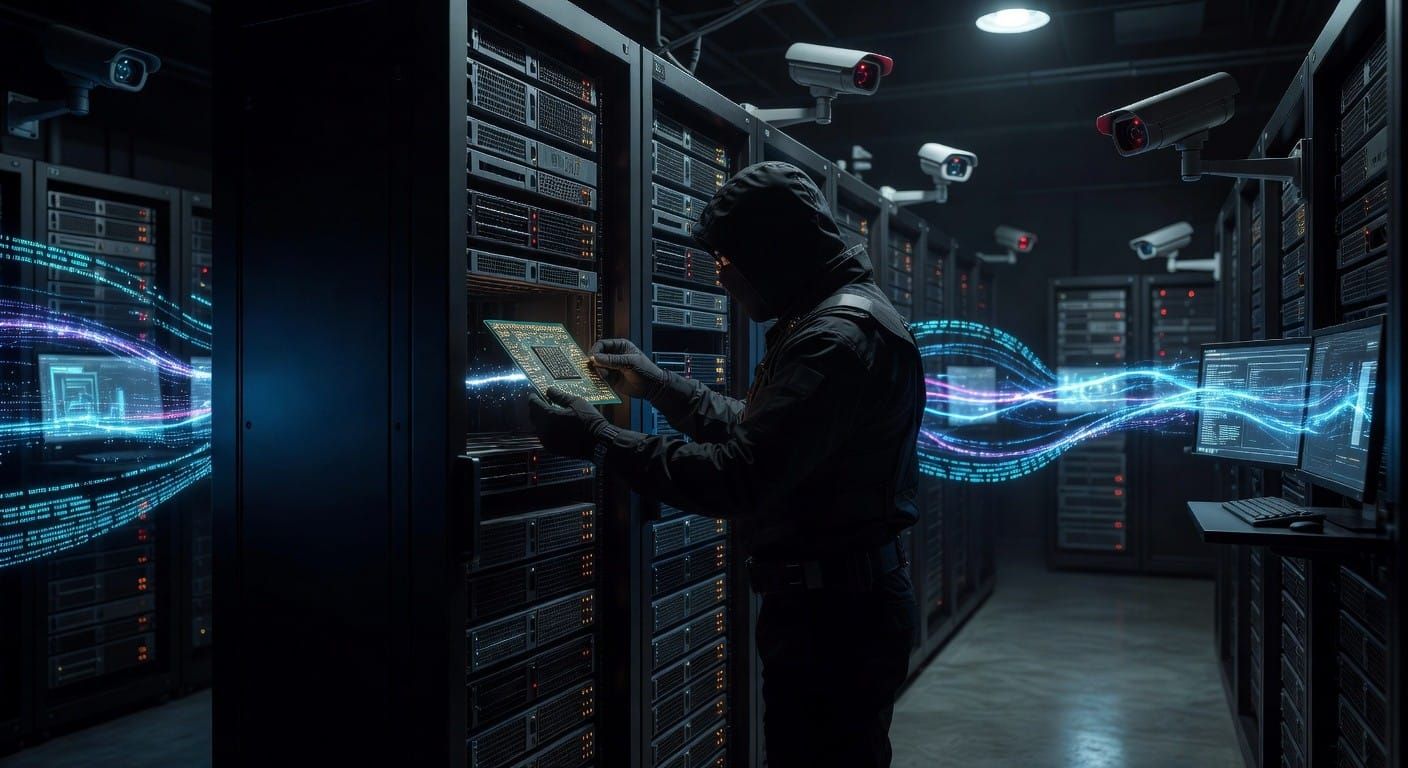
America's most closely guarded secrets — the proprietary AI architectures powering everything from Google's search algorithms to the Pentagon's next-generation defense systems — are walking out the door. And in 2026, the pace of theft has become staggering.
In the first four months of this year alone, the FBI and Department of Justice have brought more AI-related espionage and technology theft cases than in the entirety of 2024. A former Google engineer convicted of stealing supercomputing blueprints for Beijing. A Supermicro co-founder charged in a $2.5 billion scheme to smuggle Nvidia's most advanced AI chips to China using dummy servers and a hairdryer. Two Iranian-born sisters arrested for exfiltrating processor security designs from Silicon Valley's biggest firms.
This is not a subplot. This is the main event.
The intelligence community's 2026 Annual Threat Assessment, released in March, named China the "most active and persistent cyber threat" to U.S. networks and identified its ambition to "displace the U.S. as the global AI leader by 2030" as the defining strategic challenge of the decade. But the assessment undersold the problem. The threat is not just cyber intrusion from abroad — it is human-enabled exfiltration from within.
The Insider Threat Goes Industrial
The numbers tell a clear story. The FBI reported a 40% rise in counterintelligence arrests in 2025, detaining over 85 individuals linked to foreign intelligence services. By early April 2026, the bureau had arrested 51 more foreign intelligence agents — from China, Russia, Iran, and North Korea — representing a projected 112% year-over-year surge.
But raw arrest numbers obscure the real shift: the nature of what is being stolen has fundamentally changed.
A decade ago, counterintelligence cases revolved around military secrets — troop movements, weapons specifications, classified communications. Today, the most consequential espionage targets sit on corporate servers in Mountain View, Santa Clara, and Austin. The secrets that will determine which nation dominates the 21st century economy are not stored in Pentagon vaults. They are in the proprietary training infrastructure of AI labs, the chip designs of semiconductor firms, and the algorithms that power autonomous systems.
The Linwei Ding case is the archetype. The 38-year-old Chinese national spent a year at Google systematically downloading over 2,000 pages of documents detailing the company's AI supercomputing infrastructure — GPU and TPU architectures, software platforms for training large language models, and data center designs. He was simultaneously employed by two undisclosed Chinese tech firms and building his own AI startup in Beijing. A federal jury in San Francisco convicted him in January on all 14 counts of economic espionage and trade secret theft. He faces up to 170 years in prison.
The $2.5 Billion Smuggling Operation
If the Ding case represents the lone-wolf insider threat, the Supermicro indictment reveals something far more organized — and far more alarming.
In March, the DOJ unsealed charges against Supermicro co-founder Yih-Shyan "Wally" Liaw, Taiwan general manager Ruei-Tsang "Steven" Chang, and contractor Ting-Wei "Willy" Sun for allegedly orchestrating a scheme to divert approximately $2.5 billion worth of AI servers containing Nvidia's restricted H200 and B200 GPUs to buyers in China.
The tradecraft was brazen. The trio allegedly directed a shell company in Southeast Asia to purchase U.S.-assembled servers from Supermicro, then rerouted them to China without export licenses. To evade detection, they manufactured thousands of dummy servers with fake components and used a hairdryer to remove serial number labels from real hardware and reattach them to decoys.
Some of the diverted servers ended up at Chinese universities with documented ties to the People's Liberation Army.
Supermicro's stock cratered 22-33% in a single day. The company launched an internal probe and insisted the actions violated its policies. Chang remains a fugitive.
Prosecutors described it as one of the largest export control violations in U.S. history.
The Iran Vector
The threat is not exclusively Chinese. In February, the FBI arrested three Silicon Valley engineers — sisters Samaneh and Soroor Ghandali, along with Samaneh's husband Mohammadjavad Khosravi — on charges of stealing trade secrets from Google and other major tech companies and transferring them to Iran.
The stolen materials included sensitive data on processor security, cryptography, and Google's Tensor chip architecture. Prosecutors alleged the trio used low-tech methods to evade detection: photographing computer screens, transferring files to personal devices, and timing exfiltration around international travel.
The case is significant not just for its Iran connection — relatively rare in economic espionage — but for what it reveals about the breadth of the threat. Every major AI company is a target. Every nation with strategic ambitions is a potential buyer.
This is where the analysis gets actionable. AlphaBriefing members get the full investment framework — scenarios, positioning, and the bottom line.
Subscribe to AlphaBriefing — Free, Member, and Paid tiers available.