The Pacifist No More: Inside Japan's $60 Billion Military Transformation — and the Stocks Riding the Wave

Japan just crossed a line it drew for itself 80 years ago.
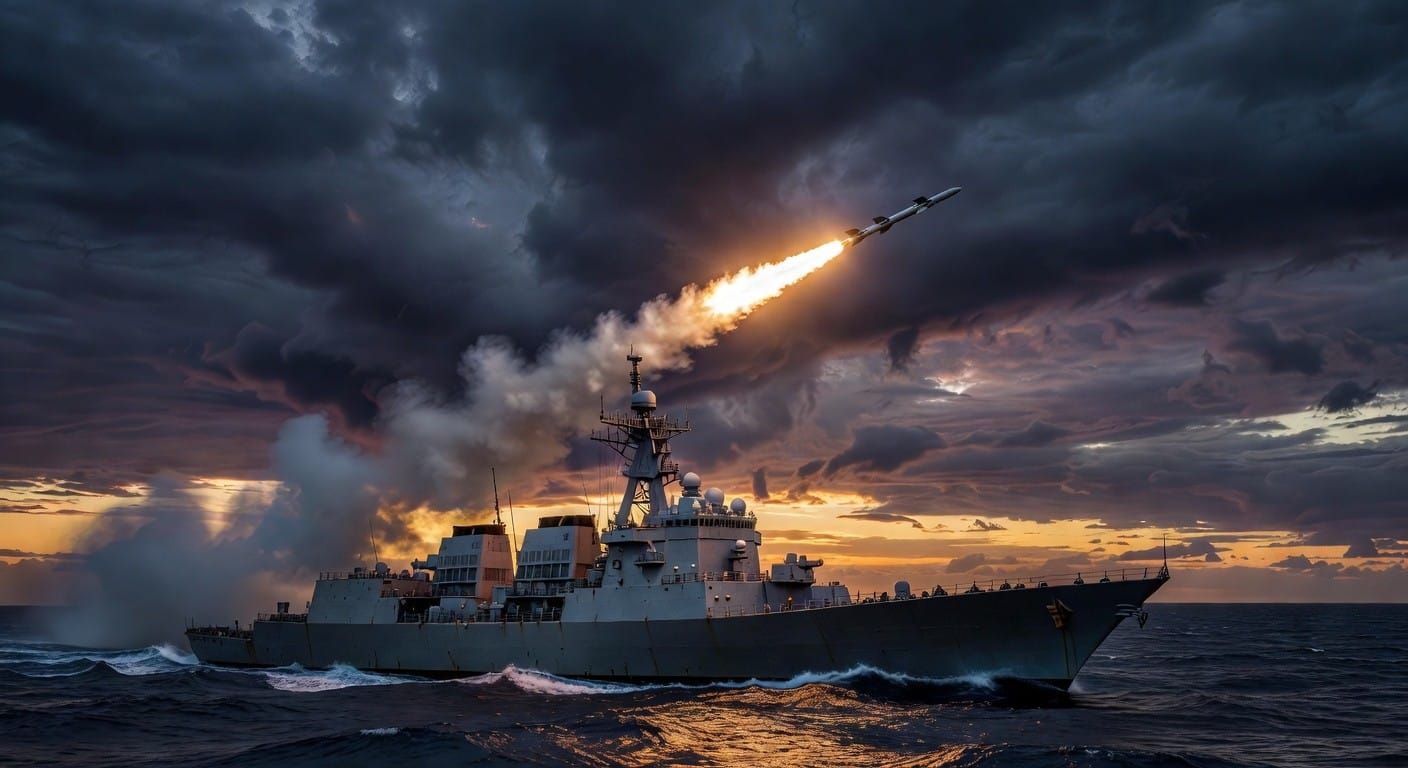
On March 27, 2026, the Japan Maritime Self-Defense Force destroyer JS Chokai completed modifications making it the country's first vessel capable of firing American Tomahawk cruise missiles — weapons designed not for defense, but for striking targets deep inside enemy territory. Days later, a ground-based unit in Kyushu became operational with upgraded Type-12 missiles capable of hitting targets over 1,000 kilometers away.
For a country whose postwar constitution was interpreted for decades as prohibiting offensive military capability, the shift is seismic. And for investors watching the $60 billion annual defense budget now flowing through Japanese industry, the implications are enormous.
The Quiet Revolution
Japan's transformation from pacifist power to Asia's newest military heavyweight has been building since former Prime Minister Fumio Kishida's government rewrote the National Security Strategy in December 2022. The plan was ambitious: double defense spending to 2% of GDP within five years, acquire long-range strike capabilities, and fundamentally reorient the Self-Defense Forces from a static territorial defense posture to a mobile, offensive-capable force.
Three and a half years later, it's actually happening.
The FY2026 defense budget — approved in early April at 9.04 trillion yen ($58–60 billion) — marks the fourth consecutive record. Including support costs for U.S. forces in Japan and Okinawa facilities, total defense-related spending hits 10.6 trillion yen ($66.5 billion), or roughly 1.9% of GDP. Japan is now the world's tenth-largest military spender.
But the budget numbers tell only half the story. What matters is where the money is going.
Counterstrike: Japan's New Doctrine
The centerpiece of Japan's military overhaul is what Tokyo euphemistically calls "counterstrike capability" — the ability to hit enemy missile launchers, command centers, and military infrastructure before they can attack Japan.
This is, in practice, a preemptive strike doctrine. And it's being built around three pillars:
American Tomahawks. Japan ordered approximately 400 Tomahawk Block IV/V cruise missiles in a $2.35 billion deal — one of the largest foreign orders for the weapon in its history. The missiles have a range of roughly 1,600 kilometers, putting Chinese coastal military installations well within reach from Japanese waters. First deliveries arrived in March 2026, with the JS Chokai now operational and live-fire tests planned for summer 2026 in the eastern Pacific.
Homegrown standoff missiles. Tokyo isn't putting all its eggs in the American basket. Upgraded Type-12 anti-ship and land-attack missiles — range extended to 1,000–1,200 kilometers — began deploying to bases in Kyushu by end of March. These are Japan's own missiles, manufactured domestically, reducing supply chain dependence. Hypersonic glide vehicles are in development, with funding allocated in the current budget.
The GCAP sixth-generation fighter. The Global Combat Air Programme, a trilateral project with the UK and Italy, received its first major contract on April 2 — a £686 million ($850 million) deal with Edgewing, the three-nation joint venture led by BAE Systems, Leonardo, and Japan Aircraft Industrial Enhancement Co. Italy approved €8.8 billion in funding through 2037, while Japan fast-tracked export rules to allow future arms sales. A demonstrator flight is expected by 2027, with service entry around 2035.
Together, these capabilities give Japan something it hasn't possessed since 1945: the ability to project military power far beyond its borders.
Why Now?
The strategic math is straightforward.
China's People's Liberation Army has spent two decades building what military planners call an anti-access/area-denial (A2/AD) bubble across the western Pacific — a layered network of missiles, submarines, and electronic warfare systems designed to keep American forces at arm's length. The DF-26 "Guam Killer" ballistic missile can strike U.S. bases 4,000 kilometers away. PLA Navy ships routinely patrol near the Senkaku Islands. Chinese military aircraft cross the Taiwan Strait median line with increasing frequency.
North Korea, meanwhile, tested over 100 missiles between 2022 and 2025, including ICBMs and tactical nuclear-capable weapons.
Japan sits within range of all of it.
For decades, Tokyo's answer was to shelter under the American nuclear umbrella and maintain a purely defensive military posture. But Washington's attention is increasingly divided — between Ukraine, the Middle East, and domestic politics — and Japan's leaders have concluded that relying solely on the United States is a strategic risk they can no longer afford.
Prime Minister Sanae Takaichi, who took office in late 2025, has accelerated the buildup. Her government views military self-reliance not as a break from the U.S. alliance, but as a way to strengthen it — making Japan a more capable partner rather than a dependent one.
The Investment Angle
Japan's rearmament is creating one of the most concentrated defense spending surges in any major economy since the Cold War. And it's flowing overwhelmingly through three companies: Mitsubishi Heavy Industries (7011.T), IHI Corporation (7013.T), and Kawasaki Heavy Industries (7012.T).
These are Japan's defense industrial "Big Three" — the contractors building everything from submarines to jet engines to missile systems.
Mitsubishi Heavy Industries is the anchor. It's the prime contractor for Japan's Aegis destroyer upgrades, the Type-12 missile program, and GCAP. The company has a defense backlog exceeding 7.5 trillion yen and its stock has outperformed the broader Nikkei 225 significantly since the rearmament push began. Analyst consensus targets imply 18–22% upside from current levels, with 12-month targets averaging ¥5,400.
Kawasaki Heavy Industries builds military helicopters, submarine components, and defense electronics. Its stock surged 48% year-to-date through mid-April, driven in part by the Takaichi government's February defense acceleration announcement. Analyst targets point to roughly 20% further upside.
IHI Corporation manufactures jet engines — including for the F-35 and future GCAP fighter — and naval gas turbines. Despite a correction from 2025 highs, 13 of 17 analysts covering the stock rate it Strong Buy, with an average target implying 43% upside.
For non-Japanese investors, ADRs are available: MHVYF (Mitsubishi), KWHIY (Kawasaki), and IHICF (IHI).
The Risks Nobody's Pricing
Japan's defense story comes with complications that the bull case sometimes glosses over.
Supply chain vulnerability is already biting. U.S. strikes on Iran depleted American Tomahawk stockpiles — over 850 were fired in recent operations — and Washington has notified Tokyo that bulk deliveries may face delays. Raytheon's production capacity is limited, and each missile takes roughly two years to manufacture. If a Taiwan crisis erupted tomorrow, Japan's counterstrike arsenal would be thinner than planned.
Valuation stretch is real. MHI trades at elevated multiples relative to its historical range, and some discounted cash flow models suggest it's overvalued by as much as 73%. The defense stock rally in Japan has attracted momentum investors alongside strategic buyers, creating the conditions for sharp pullbacks on any negative catalyst.
China will respond. Beijing has already imposed retaliatory export controls targeting Japanese defense firms, causing a brief sell-off in February. The more capable Japan becomes militarily, the more Beijing will treat it as a threat — potentially escalating the very tensions the rearmament is designed to deter.
Constitutional and political risk endures. While public opinion has shifted in favor of stronger defense, Article 9 of Japan's constitution — which renounces war — has not been formally amended. A future government could slow or reverse the buildup, particularly if the fiscal cost becomes politically untenable.
The Bigger Picture
Japan's rearmament is not just a Japanese story. It's reshaping the entire security architecture of the Indo-Pacific.
A Japan that can strike back fundamentally changes China's military calculus in a Taiwan scenario. It means the PLA can no longer assume it can neutralize U.S. bases in Japan with a first strike without facing immediate retaliation from Japanese forces operating independently. It raises the cost of aggression.
It also creates a new axis of defense industrial cooperation. GCAP binds Japan to the UK and Italy in a decades-long fighter program. Canada is seeking observer status. Germany is reportedly interested. What started as a Japanese response to a Chinese threat is evolving into a broader democratic alliance's industrial answer to authoritarian military buildups.
For investors, the signal is clear: Japan's defense sector isn't a trade — it's a structural shift. The 43-trillion-yen, five-year spending plan runs through FY2027, and the political consensus behind it appears durable. Whether you're positioned in the Big Three directly, in the broader Japanese industrial complex that feeds them, or in the global defense names (BAE Systems, Leonardo) riding the GCAP wave, this is a multi-year theme.
Japan drew a line 80 years ago. It just erased it.
Get this level of intelligence every day. Subscribe to AlphaBriefing — free, member, and paid tiers available.
Sources & Further Reading
- Defense News — Japanese Destroyer Can Now Fire Tomahawk Missiles
- The Diplomat — Japan Will Begin Deploying Homegrown Longer-Range Missiles
- Defense News — Money Starts Flowing for New GCAP Fighter
- Nikkei Asia — Japan's Defense Contractors Rush to Tap Government Spending Boost
- IISS — Japan's Emerging Counterstrike Missile Posture
- Japan Times — Japan Tomahawk Missile Deliveries Delayed
- Reuters — Italy's Parliament Approves €8.8 Billion for GCAP Programme
Disclaimer
AlphaBriefing is an independent intelligence publication. The content in this article is produced for informational and educational purposes only. Nothing published by AlphaBriefing constitutes financial, investment, legal, tax, or regulatory advice, nor should it be construed as a solicitation or recommendation to buy, sell, or hold any security, asset, or financial instrument.
All views expressed are those of the author at the time of writing and are subject to change without notice. Markets are volatile and unpredictable; past performance is not indicative of future results. Any investment involves risk, including the possible loss of principal.
AlphaBriefing and its principals, employees, or contributors may hold positions in securities or assets mentioned in this article. This should be considered a potential conflict of interest. No material relationship with any company referenced exists unless explicitly disclosed. Readers should conduct their own due diligence and consult qualified financial, legal, and tax advisors before making any investment decisions.
Information in this article is drawn from public sources believed to be reliable at the time of publication. AlphaBriefing makes no warranty, express or implied, as to the accuracy, completeness, or timeliness of any information herein. AlphaBriefing accepts no liability for any loss or damage arising from reliance on this content.
© AlphaBriefing. All rights reserved. Unauthorized reproduction or distribution is prohibited.