The Robot Brain Wars: Inside the $190 Billion Race to Own Physical AI — and How to Invest
Google DeepMind, NVIDIA, and Tesla are spending hundreds of billions to become the operating system of physical AI. The humanoid robotics market is projected to hit $165 billion by 2034. Here's where the smart money is positioning.

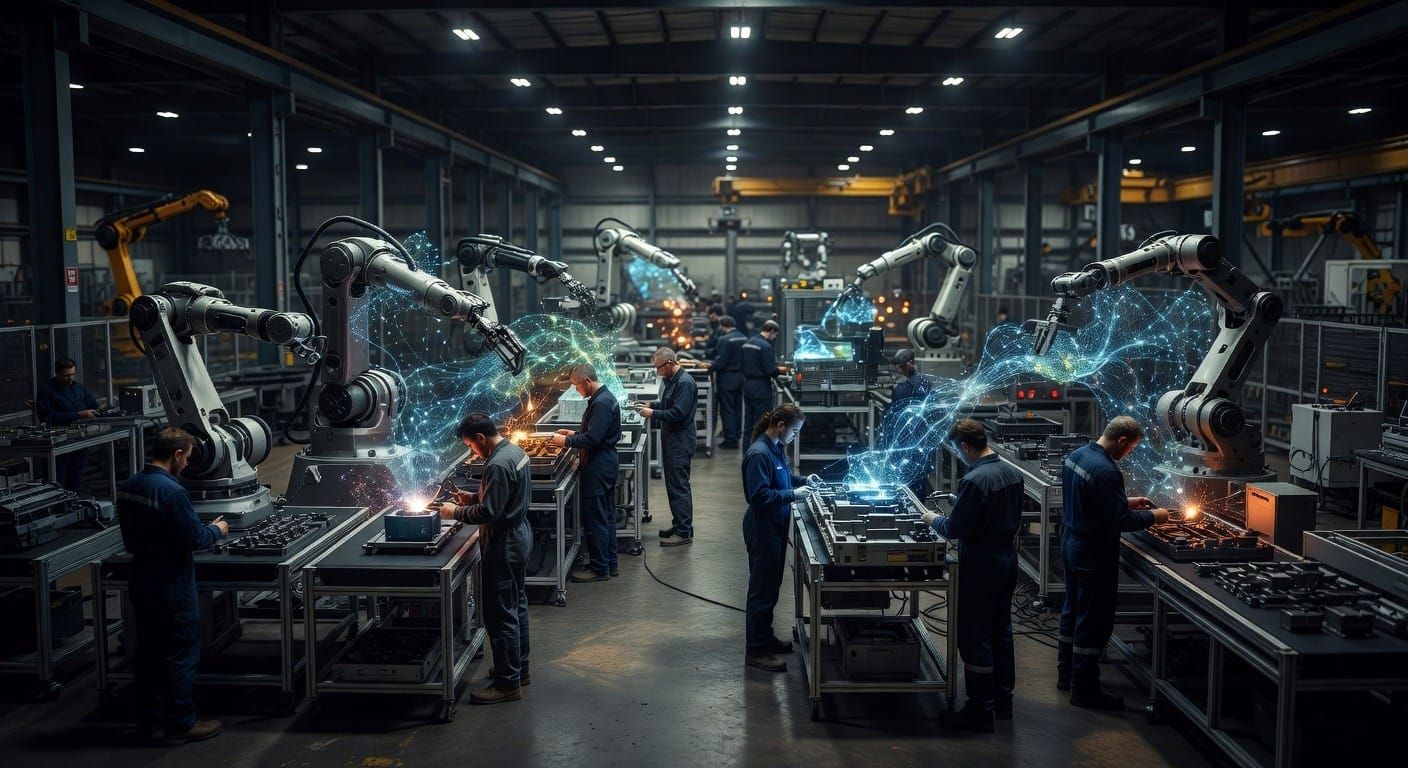
The era of physical AI has arrived — not as a distant sci-fi promise, but as a $38 billion industry growing at 34% year-over-year, with humanoid robots now walking off production lines and into warehouses, factories, and soon, your home.
For a decade, the robotics narrative was a punchline — clunky machines falling over at tech demos, perpetually five years away from relevance. That changed in the first half of 2026. A convergence of frontier AI models, massive capital deployment, and genuine commercial traction has transformed robotics from a curiosity into what may be the most consequential investment theme of the next decade.
The numbers tell the story: the humanoid robotics market alone is projected to hit $15–17 billion by 2030, with some analysts forecasting $38 billion by 2036. Venture funding in the space grew 15x between 2022 and 2025 — from $239 million to $3.7 billion — and the capital is accelerating. The question is no longer whether physical AI will matter. It's who will own the platform layer.
The DeepMind Catalyst
Google DeepMind fired the starting gun on physical AI's commercial era with its Gemini Robotics family — a suite of vision-language-action (VLA) models that give robots the ability to perceive, reason, and act in unstructured environments.
The latest release, Gemini Robotics-ER 1.6 (April 2026), represents a step function in embodied reasoning. The model handles spatial and multi-view understanding, decomposes complex goals into executable sub-tasks, reads industrial instruments like gauges and thermometers via what DeepMind calls "agentic vision," and critically — it transfers across robot embodiments. The same AI brain can run a humanoid, a robotic arm, or a quadruped.
This is significant because it attacks the biggest historical bottleneck in robotics: programming. Traditional industrial robots require painstaking task-specific coding. Gemini Robotics replaces that with natural language instruction and autonomous task planning. A factory manager doesn't need to write a single line of code — they tell the robot what to do.
DeepMind has already signed 60+ partners onto its Gemini Robotics SDK, including heavyweight hardware players: Boston Dynamics (CES, January 2026), Agile Robots (March 2026), Apptronik, Agility Robotics, Hyundai, and PAL Robotics.
The Capital Arms Race
The investment landscape in physical AI has entered a phase that mirrors the early cloud wars — massive capital deployment by players betting that platform dominance will generate winner-take-most economics.
Figure AI has raised over $2.34 billion, including a $1 billion+ Series C in September 2025 at a staggering $39 billion post-money valuation. Investors include NVIDIA, Intel Capital, and Microsoft. The company's Figure 02 humanoid is designed for commercial deployment and, eventually, home use.
Agility Robotics secured $400 million in its Series C at a $2.1 billion valuation. Its Digit humanoid is already operating in warehouse environments, making it one of the few companies with genuine commercial traction rather than just demo reels.
Alphabet — DeepMind's parent — is investing up to $40 billion in Anthropic (cash and compute), while simultaneously deploying $180–190 billion in total 2026 CapEx, much of it funding the AI compute infrastructure that underpins both digital and physical AI. Google Cloud revenue hit $20 billion in Q1 alone, up 63% year-over-year, with AI workloads driving the backlog to $460 billion.
Then there's the broader Alphabet picture. Q1 2026 revenue came in at $109.9 billion (+22% YoY), net income surged 81% to $62.6 billion, and the company sits on $127 billion in cash. At a ~$4.3 trillion market cap and a forward P/E of ~32x, GOOGL trades at a premium — but the growth trajectory through cloud and AI monetization justifies institutional conviction.
This is where the analysis gets actionable. AlphaBriefing members get the full investment framework — scenarios, positioning, and the bottom line.
Subscribe to AlphaBriefing — Free, Member, and Paid tiers available.