The Chokepoint Trap: How the Hormuz Crisis Turned the Panama Canal Into the World's Most Dangerous Bottleneck
With Hormuz blockaded and $4 million transit fees, the Panama Canal has become a dual flashpoint — a shipping bottleneck and a US-China battleground that's reshaping global trade.

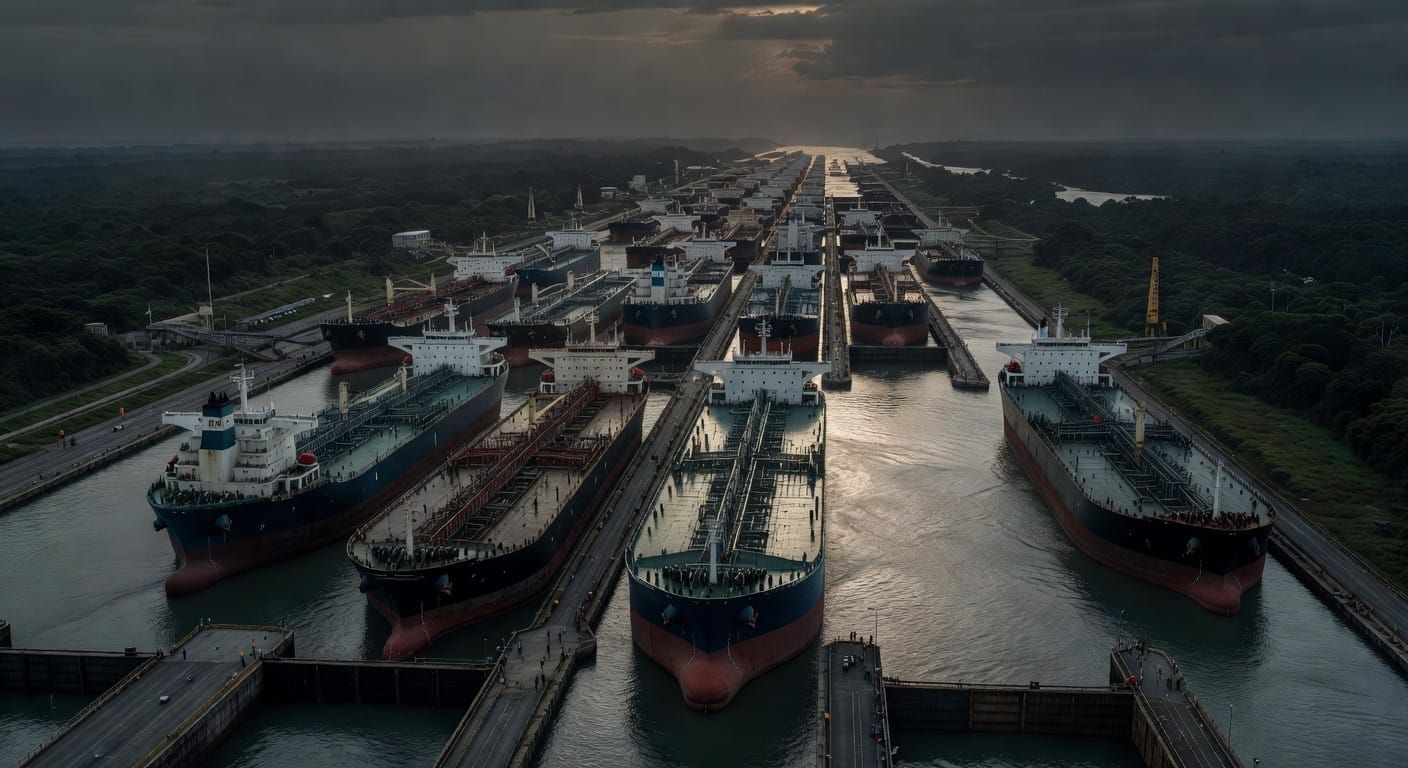
The Strait of Hormuz has been blockaded for over two months. Twenty percent of global oil supply is disrupted. But the aftershock is hitting hardest 13,000 kilometers away — at a 110-year-old canal in Central America that just became the most contested waterway on Earth.
The Panama Canal is experiencing a traffic boom unlike anything in its history. Oil tankers that once sailed through the Persian Gulf are now rerouting around Africa or through the Americas, and the narrow 80-kilometer channel through Panama has become the world's most expensive bottleneck. Transit auction fees have hit $4 million per vessel. Queue times have ballooned to four days. And the geopolitical stakes are rising even faster than the prices.
This isn't just a shipping story. It's a story about how two global chokepoints — one under siege, one under pressure — are reshaping great-power competition, energy markets, and the future of global trade.
The Hormuz Effect
When Iran blockaded the Strait of Hormuz on February 28, 2026, the immediate impact was on oil prices. But the second-order effects have been even more consequential.
Asian refiners in Japan, South Korea, and Singapore — suddenly cut off from Middle Eastern crude — pivoted to U.S. Gulf Coast supply. That shift created a massive new trade route: American crude and fuel oil, loaded at Houston and Louisiana terminals, shipped east through the Panama Canal to feed Asia's energy-starved refineries.
The numbers tell the story. Oil tanker transits through the canal surged to over 200,000 barrels per day in April 2026, a near four-year high. Overall canal traffic rose 4% in the first half of fiscal year 2026, with 6,288 transits and 254 million tons of cargo — a 5% increase driven almost entirely by energy shipments.
The irony is thick: the Panama Canal nearly shut down in 2023-24 due to drought. Now, with water levels stable and capacity at a full 36-40 daily transits, the bottleneck is purely demand-driven. There are too many ships chasing too few slots.
$4 Million to Skip the Line
The Panama Canal Authority operates an auction system for priority transit slots. In normal times, premiums are modest. In May 2026, they are anything but.
One tanker rerouting fuel oil from Europe to Singapore paid a record $4 million auction fee — on top of the standard $300,000-$400,000 base toll. Average auction prices have climbed to $425,000, with multiple vessels paying over $3 million for priority passage.
For context: the entire annual budget of some small shipping companies is less than what one vessel is paying for a single canal transit.
The Canal Authority's revenues are soaring, but the cost is cascading through global supply chains. Every dollar spent on premium canal fees gets passed to consumers in higher fuel, food, and goods prices. The Hormuz crisis isn't just an oil shock — it's a logistics shock, and Panama is where the pressure is building.
The Chokepoint Within a Chokepoint
But the Panama Canal's transformation from shipping corridor to geopolitical flashpoint goes far beyond transit fees. It has become the latest front in US-China competition.
In early 2026, Panama's Supreme Court annulled long-standing port operating contracts held by CK Hutchison Holdings — a Hong Kong-based conglomerate with ties to Beijing — at both entrances to the canal. The ruling came under heavy U.S. pressure, with Washington framing Chinese control of canal-adjacent ports as a national security threat.
China's response was swift and punishing. Beijing detained nearly 70 Panamanian-flagged vessels in Chinese waters, imposed trade restrictions, and threatened further economic retaliation. The U.S. State Department called it "a violation of Panamanian sovereignty." Panama's president acknowledged the country was "caught in the crossfire" of great-power competition.
The backdrop makes this confrontation far more dangerous than it would have been a year ago. With Hormuz effectively closed, the Panama Canal isn't just a convenient trade route — it's an essential one. Any disruption to canal operations would compound the energy crisis exponentially.
Why This Matters for Markets
The convergence of the Hormuz blockade and the Panama Canal crisis creates a dual-chokepoint scenario that global shipping hasn't faced in modern history. The investment implications are significant:
Shipping and logistics stocks are the immediate beneficiaries. Companies operating tanker fleets, canal logistics, and alternative routing services are seeing record earnings. Shipping rate indices have climbed across every category.
Energy prices remain elevated not just because of supply disruption, but because of the cost of moving oil around the disruption. The "Hormuz premium" in crude prices now includes a "Panama premium" — the added cost of routing through the Western Hemisphere.
Insurance costs for maritime cargo have spiked across both chokepoints. Lloyd's of London and major marine insurers have expanded war-risk zones and raised premiums for any vessel transiting contested waters.
Latin American economies adjacent to the canal — Panama, Colombia, Costa Rica — are experiencing both windfalls (from increased canal traffic and spending) and risks (from geopolitical entanglement). Panama's GDP growth is being revised upward on canal revenues alone.
Alternative route investments are accelerating. The Suez Canal, already stretched by Red Sea disruptions, is at capacity. Discussion of a new Central American canal route (a perennial idea in Nicaragua) has resurfaced, alongside Arctic shipping route development and expanded pipeline infrastructure to bypass maritime chokepoints entirely.
The Bigger Picture: A World of Chokepoints
The simultaneous crises at Hormuz and Panama reveal a structural vulnerability in globalization that most investors and policymakers have ignored: the world's $32 trillion annual trade flows depend on a handful of narrow waterways, most of them in geopolitically unstable regions.
Hormuz. Panama. Suez. Malacca. Bab-el-Mandeb. The Turkish Straits. Together, these six chokepoints handle the majority of global maritime trade. When one fails, the others absorb the shock — until they can't.
2026 is testing that system like never before. Hormuz is blockaded. The Red Sea remains dangerous due to Houthi activity. The Panama Canal is congested and contested. Three of the world's six critical maritime chokepoints are under simultaneous stress.
For decades, the assumption was that the global shipping system was resilient enough to absorb isolated disruptions. That assumption is being dismantled in real time. The lesson for investors, policymakers, and supply chain managers is uncomfortable but clear: chokepoint risk is no longer a tail event. It's a baseline condition.
The countries, companies, and strategies that adapt to this new reality — by diversifying routes, securing alternative supply, and building redundancy — will outperform. Those that continue to bet on uninterrupted passage through contested narrows are holding a position the market is rapidly repricing.
Get this level of intelligence every day. Subscribe to AlphaBriefing — free, member, and paid tiers available.
Sources & Further Reading
- Fortune — Panama Canal Surge Pricing Hits $4 Million as Hormuz Remains Closed
- OilPrice.com — Hormuz Blockage Boosts Panama Canal Oil Tanker Traffic
- Reuters — Panama President Says Port Caught in US-China Dispute
- Al Jazeera — US and Latin America Countries Criticize China's Retaliation Over Panama Canal
- France 24 — Port Dispute Thrusts Panama Canal Back Into Heart of US-China Rivalry
- DW — How the Hormuz Crisis Fuels US-China Rivalry at the Panama Canal
- Container News — Panama Canal Sees Rising Demand and Higher Traffic in First Half of FY2026
Disclaimer
AlphaBriefing is an independent intelligence publication. The content in this article is produced for informational and educational purposes only. Nothing published by AlphaBriefing constitutes financial, investment, legal, tax, or regulatory advice, nor should it be construed as a solicitation or recommendation to buy, sell, or hold any security, asset, or financial instrument.
All views expressed are those of the author at the time of writing and are subject to change without notice. Markets are volatile and unpredictable; past performance is not indicative of future results. Any investment involves risk, including the possible loss of principal.
AlphaBriefing and its principals, employees, or contributors may hold positions in securities or assets mentioned in this article. This should be considered a potential conflict of interest. No material relationship with any company referenced exists unless explicitly disclosed. Readers should conduct their own due diligence and consult qualified financial, legal, and tax advisors before making any investment decisions.
Information in this article is drawn from public sources believed to be reliable at the time of publication. AlphaBriefing makes no warranty, express or implied, as to the accuracy, completeness, or timeliness of any information herein. AlphaBriefing accepts no liability for any loss or damage arising from reliance on this content.
© AlphaBriefing. All rights reserved. Unauthorized reproduction or distribution is prohibited.