The Lithium Trap: Bolivia Has the World's Biggest Reserve — and It's Tearing Itself Apart

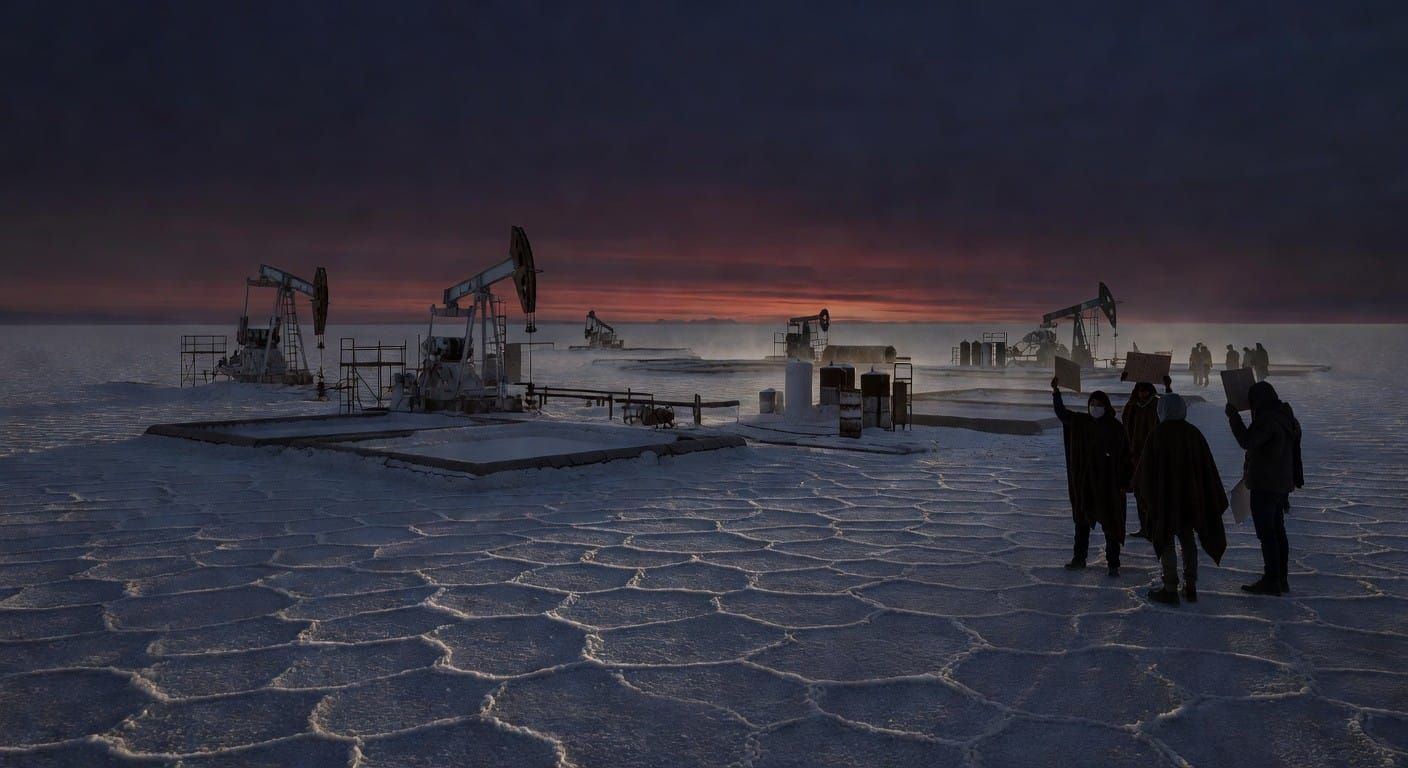
Bolivia is on fire — not literally (though that's happened too), but economically, politically, and strategically. The country sitting on the world's largest lithium reserves just entered an indefinite general strike, its eighth state of economic emergency in two years, and a full-blown confrontation between a new pro-Western government and the labor unions that helped topple the last one.
For anyone tracking the global energy transition, this matters. Bolivia's Salar de Uyuni contains an estimated 23 million metric tons of lithium — the single largest identified reserve on Earth. That's enough to power the EV revolution for decades. And right now, the country is tearing itself apart over who benefits from it.
The Strike That Could Shake Supply Chains
On May 1, Bolivia's largest trade union federation — the Central Obrera Boliviana (COB) — declared an indefinite general strike after a massive open-air assembly in El Alto, the highland city overlooking La Paz. By May 2, the country was paralyzed: public transport halted, factories shuttered, roads blockaded in La Paz, El Alto, and Santa Cruz.
The demands are straightforward: a 20% minimum wage increase, pension hikes, repeal of recent tax reforms hitting small businesses, and resolution of chronic fuel shortages that have plagued the country since subsidy cuts in late 2025. COB Secretary Executive Mario Argollo framed it in stark terms — the strike continues until the government meets demands or "steps aside."
President Rodrigo Paz, the centrist who took office in late 2025, dismissed the strike as a "capricho" — a whim — and called for national dialogue. The unions rejected the invitation. The standoff is escalating.
The Backstory: How Bolivia Got Here
Bolivia's current crisis didn't materialize overnight. It's the culmination of a decade-long economic unraveling that traces directly back to the country's natural gas bonanza — and its collapse.
For years, Bolivia rode high on natural gas exports, primarily to Brazil and Argentina. Gas revenues funded generous social spending, fuel subsidies, and a period of relative stability under Evo Morales and his Movement for Socialism (MAS). But production peaked and began declining as fields matured and investment dried up under protectionist policies that spooked international energy companies.
By 2024, the gap between subsidized domestic fuel prices and the cost of imports was unsustainable. Foreign reserves — once $15 billion — cratered to under $2 billion. Dollar shortages became chronic, creating a parallel black market rate that spiraled. When the government finally cut fuel subsidies in December 2025 (the so-called "gasolinazo"), it triggered nationwide protests that forced partial reversals but solved nothing structurally.
Bolivia now faces what economists call a "triple squeeze": collapsing gas revenue, depleted reserves, and a population that has been conditioned to expect subsidized prices on everything from gasoline to bread.
The Lithium Paradox
Here's where it gets interesting for investors. Bolivia is simultaneously the world's most lithium-rich nation and one of the least productive. Despite sitting on roughly 30% of global identified reserves, the country has produced virtually zero commercial lithium. For years, socialist governments insisted on state-controlled extraction, rejected foreign investment, and watched as neighbors Argentina and Chile captured the market.
President Paz has reversed course dramatically. Since taking office, his government has:
- Offered a three-year profit tax holiday for new mining projects
- Fast-tracked approval processes and proposed independent resource certification
- Restored full U.S. diplomatic relations after a 17-year rupture
- Begun negotiating a Critical Minerals Agreement with Washington to qualify Bolivian lithium under U.S. Inflation Reduction Act incentives
- Showcased seven strategic mining projects at the 2026 PDAC convention in Toronto
Foreign commitments now approach $2.5 billion: Chinese firms CBC Investments ($1 billion for lithium plants) and CATL hold existing contracts. Russia's Rosatom has a $600 million joint venture for direct lithium extraction at Uyuni. And the U.S. is circling aggressively, eyeing Bolivia as a counterweight to Chinese dominance of critical mineral supply chains.
The optimistic scenario: Bolivia reaches 37,000 tons per year of extraction capacity by late 2026, scaling to 200,000 tons by 2030. That would make it a top-three global producer virtually overnight.
The problem: none of this works if the country is on strike.
Why This Matters for Markets
The lithium market is already tight. Global demand is projected to hit 1.5 million tons of lithium carbonate equivalent by 2030, driven by EV adoption in China, Europe, and increasingly the United States. Supply has struggled to keep pace even without Bolivian disruption.
Bolivia's crisis introduces three distinct risk vectors:
1. Supply concentration risk. The "Lithium Triangle" — Bolivia, Argentina, Chile — holds over 60% of global reserves. If Bolivia remains politically unstable, the world's largest reserve stays locked underground, concentrating production in Chile (where water conflicts threaten mining) and Argentina (where new president Milei's reforms face their own resistance). Supply diversity gets worse, not better.
2. Great power competition. Bolivia's lithium has become a proxy battleground. China has first-mover advantage through CBC and CATL contracts. Russia holds the Rosatom JV. The U.S. is trying to muscle in through diplomatic normalization and IRA incentives. An unstable Bolivia that can't deliver on any of these commitments frustrates everyone — but benefits existing producers (Australia, Chile) by keeping prices elevated.
3. Contagion to the Andean corridor. Bolivia's strike comes alongside Ecuador's eighth state of emergency (nighttime curfews across nine provinces, a trade war with Colombia at 100% reciprocal tariffs) and Colombia's deadliest election campaign in decades (May 31 vote). The Andean region — home to critical minerals, energy resources, and agricultural commodities — is simultaneously unstable across three countries. That's not a coincidence; it's a pattern investors should be pricing.
The Investment Angle
For lithium-exposed investors, Bolivia's crisis is paradoxically bullish in the short term. Every month that Bolivian production stays near zero is a month that existing producers — Albemarle, SQM, Pilbara Minerals, Arcadium Lithium — operate in a tighter market. Lithium carbonate prices, which bottomed in early 2025, have been climbing steadily as EV demand reaccelerates.
But the longer-term picture is more nuanced. If Paz can survive the current political storm and deliver on his pro-investment agenda, Bolivia could become the most significant new entrant in the lithium market this decade. That means early-stage exposure to Bolivian-linked exploration and development companies — currently trading at steep discounts to assets — could offer asymmetric upside.
The key variable: can a centrist government hold together a deeply polarized country long enough to get lithium out of the ground? History suggests it's a coin flip. Bolivia has had 37 coups since independence. Political stability has never been the country's strong suit.
What to Watch
-
The strike timeline. If COB and the government reach a deal within days, markets will shrug. If blockades persist for weeks, supply chain disruptions to mining operations (not just lithium — Bolivia produces tin and zinc too) could move commodity prices.
-
The May 31 Colombia election. A right-wing victory would realign Colombia toward the U.S. on security and trade, potentially easing the Ecuador-Colombia trade war and stabilizing the broader Andean corridor. A leftist win extends the uncertainty.
-
U.S.-Bolivia Critical Minerals Agreement. If signed, this would unlock IRA incentives for Bolivian lithium and could accelerate Western investment by billions. Watch for movement in June.
-
Chinese and Russian contract execution. Whether CATL, CBC, and Rosatom can advance their projects amid political turmoil will signal whether Bolivia's lithium future is real or perpetually deferred.
The Bottom Line
Bolivia is the most resource-rich country that can't get out of its own way. It holds the world's largest lithium reserve at a moment when the world desperately needs lithium. But between an indefinite general strike, a government under siege, depleted foreign reserves, and a fuel crisis, the gap between potential and reality has never been wider.
For the global energy transition, Bolivia is the wild card. For investors, it's a risk-reward calculation that just got more volatile. And for the great powers competing to secure critical mineral supply chains, it's a reminder that geology is meaningless without political stability.
The lithium is in the ground. The question is whether Bolivia can keep it together long enough to dig it out.
Get this level of intelligence every day. Subscribe to AlphaBriefing — free, member, and paid tiers available.
Sources & Further Reading
- Reuters — Bolivia Pledges to Honor Energy, Lithium Deals to Reassure Investors
- Reuters — Colombia-Ecuador Trade Collapsing as Tariff War Intensifies
- Mining.com — Mining, Power, and a New US Strategy in Latin America
- EQS News — Critical Mineral-Rich Bolivia at a Turning Point
- Mine Magazine — Bolivia's Shift Against Lithium Protectionism
- Al Jazeera — Ecuador Hikes Tariffs to 100% in Feud With Colombia
- Rio Times — Latin America Pulse: Ecuador Curfew, Bolivia Protests
Disclaimer
AlphaBriefing is an independent intelligence publication. The content in this article is produced for informational and educational purposes only. Nothing published by AlphaBriefing constitutes financial, investment, legal, tax, or regulatory advice, nor should it be construed as a solicitation or recommendation to buy, sell, or hold any security, asset, or financial instrument.
All views expressed are those of the author at the time of writing and are subject to change without notice. Markets are volatile and unpredictable; past performance is not indicative of future results. Any investment involves risk, including the possible loss of principal.
AlphaBriefing and its principals, employees, or contributors may hold positions in securities or assets mentioned in this article. This should be considered a potential conflict of interest. No material relationship with any company referenced exists unless explicitly disclosed. Readers should conduct their own due diligence and consult qualified financial, legal, and tax advisors before making any investment decisions.
Information in this article is drawn from public sources believed to be reliable at the time of publication. AlphaBriefing makes no warranty, express or implied, as to the accuracy, completeness, or timeliness of any information herein. AlphaBriefing accepts no liability for any loss or damage arising from reliance on this content.
© AlphaBriefing. All rights reserved. Unauthorized reproduction or distribution is prohibited.