The Mineral Wars: Inside the $35 Billion US-Uzbekistan Gambit to Break China's Grip on Critical Resources
Washington just bet $35 billion on Central Asia's mineral wealth. Inside the great power scramble for the raw materials that will define the next century — and how investors can position.

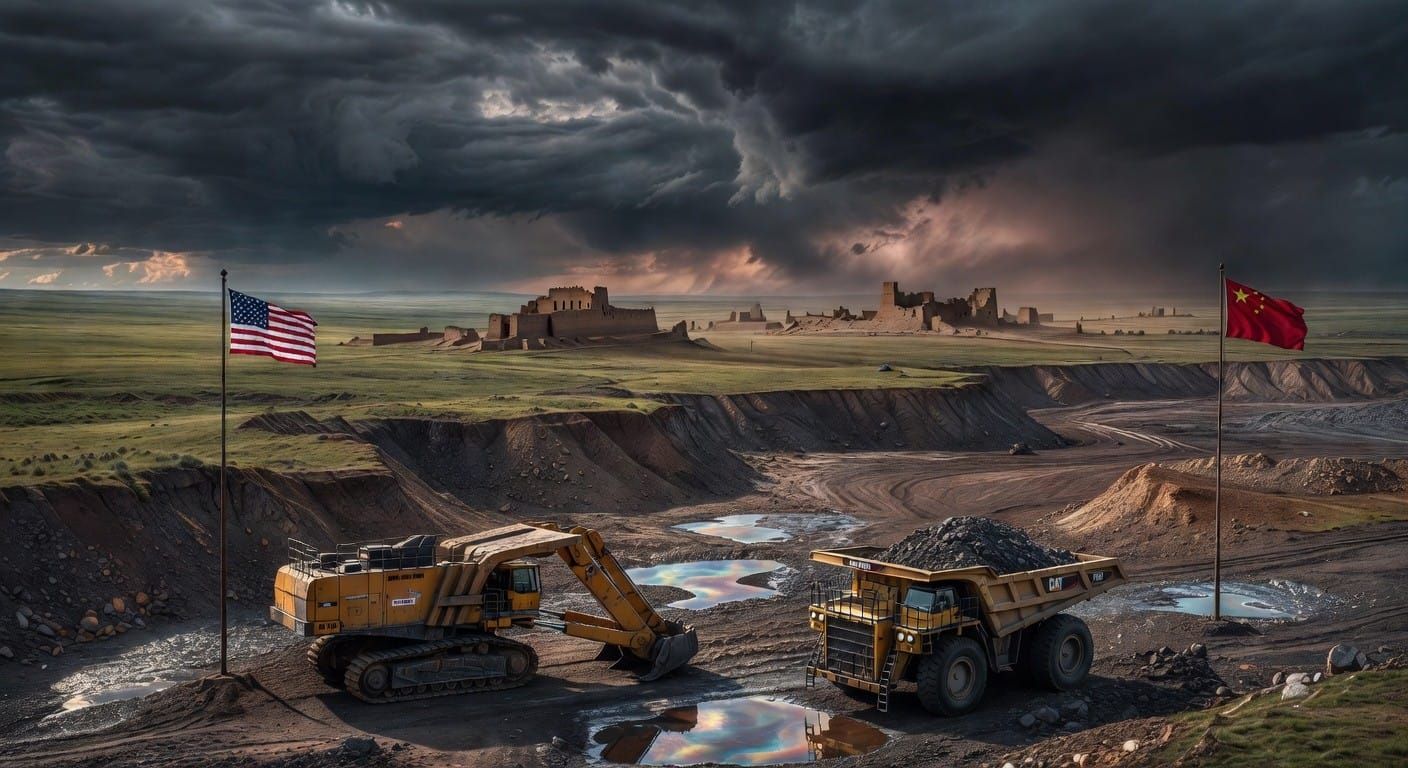
The most important geopolitical chess match of the decade isn't playing out in the South China Sea or the skies over the Persian Gulf. It's unfolding in the arid steppes of Central Asia — specifically, in the mineral-rich republics of Uzbekistan and Kazakhstan — where Washington and Beijing are locked in a high-stakes scramble for the raw materials that will power the next century of technology, defense, and energy.
In February 2026, the United States and Uzbekistan signed a landmark critical minerals pact worth up to $35 billion over three years — a deal that represents Washington's most aggressive foray into Central Asia since the early days of the War on Terror. The agreement, brokered through the US Development Finance Corporation (DFC) and Export-Import Bank (EXIM), covers rare earth elements, lithium, tungsten, and a portfolio of strategic minerals that currently flow overwhelmingly through Chinese-controlled supply chains.
This isn't charity. It's industrial warfare by checkbook.
The Strategic Equation
Central Asia sits on an estimated $3 trillion in underground mineral wealth. Uzbekistan alone hosts over 30 critical mineral types across 71 identified deposits, with the government launching a $2.6 billion, three-year program to develop 76 extraction and processing projects across 28 elements. Kazakhstan, meanwhile, holds proven rare earth reserves that rank among the world's largest and has begun collaborating with Tashkent on joint REE development as of April 2026.
The math is straightforward: China currently controls 60-90% of global rare earth mining and processing. Every electric vehicle, every fighter jet, every semiconductor, every wind turbine depends on materials that flow primarily through Chinese hands. Beijing has already demonstrated its willingness to weaponize this leverage — restricting gallium and germanium exports in 2023 and tightening rare earth controls further in 2025.
For Washington, the Central Asian corridor represents the most viable pathway to breaking that dependency without waiting a decade for domestic mining permits to clear environmental review.
Why Uzbekistan, Why Now
Uzbekistan's transformation from post-Soviet backwater to reform darling is one of the most underappreciated stories in emerging markets. Under President Shavkat Mirziyoyev, the country has executed a sweeping modernization program since 2017 that has attracted $43 billion in foreign investment in 2025 alone.
The numbers speak for themselves:
- Q1 2026 GDP growth: 8.7% year-over-year
- IMF full-year forecast: 6.8% (upgraded from 6.2%)
- Foreign investment target for 2026: $50.4 billion
- Unemployment: 4.8% — remarkably low for a frontier economy
- Exports: Up 28% to $29 billion, reaching 210 countries
The Tashkent International Financial Center (TIFC) is positioning itself as Central Asia's answer to Dubai — a liberalized financial hub designed to channel global capital into the region's extractive and industrial sectors. In April 2026, Uzbekistan announced it would sell a 30% stake in its National Investment Fund via dual IPOs in London and Tashkent, signaling a level of capital market ambition virtually unheard of in the region.
Perhaps most significantly for US investors: Washington lifted investment restrictions on Uzbekistan in 2026, clearing a regulatory pathway that had previously kept American capital on the sidelines.
The Great Power Contest
The US-Uzbekistan minerals pact didn't happen in a vacuum. It's part of a broader C5+1 diplomatic framework — the five Central Asian republics plus Washington — that the Trump administration has turbocharged with the $12 billion "Project Vault" strategic minerals stockpiling initiative.
But China isn't standing still. Beijing already controls significant mineral leases in Kyrgyzstan and Tajikistan and maintains a processing edge that years of American investment can't replicate overnight. Russia remains the dominant security partner in Kazakhstan, complicating any simple narrative of Western encirclement.
What's emerging is a classic multi-alignment play: Tashkent is hedging between Washington, Beijing, and Moscow, extracting maximum concessions from each while committing fully to none. It's the textbook strategy for a resource-rich developing state caught between great powers — and so far, it's working.
This is where the analysis gets actionable. AlphaBriefing members get the full investment framework — scenarios, positioning, and the bottom line.
Subscribe to AlphaBriefing — Free, Member, and Paid tiers available.