The Port Empire: Inside China's Quiet Conquest of Global Shipping Infrastructure — and the $200 Billion Scramble to Respond
Chinese state enterprises now control or hold stakes in over 100 port terminals spanning every major shipping lane on Earth. The West is finally waking up — and the investment implications are enormous.

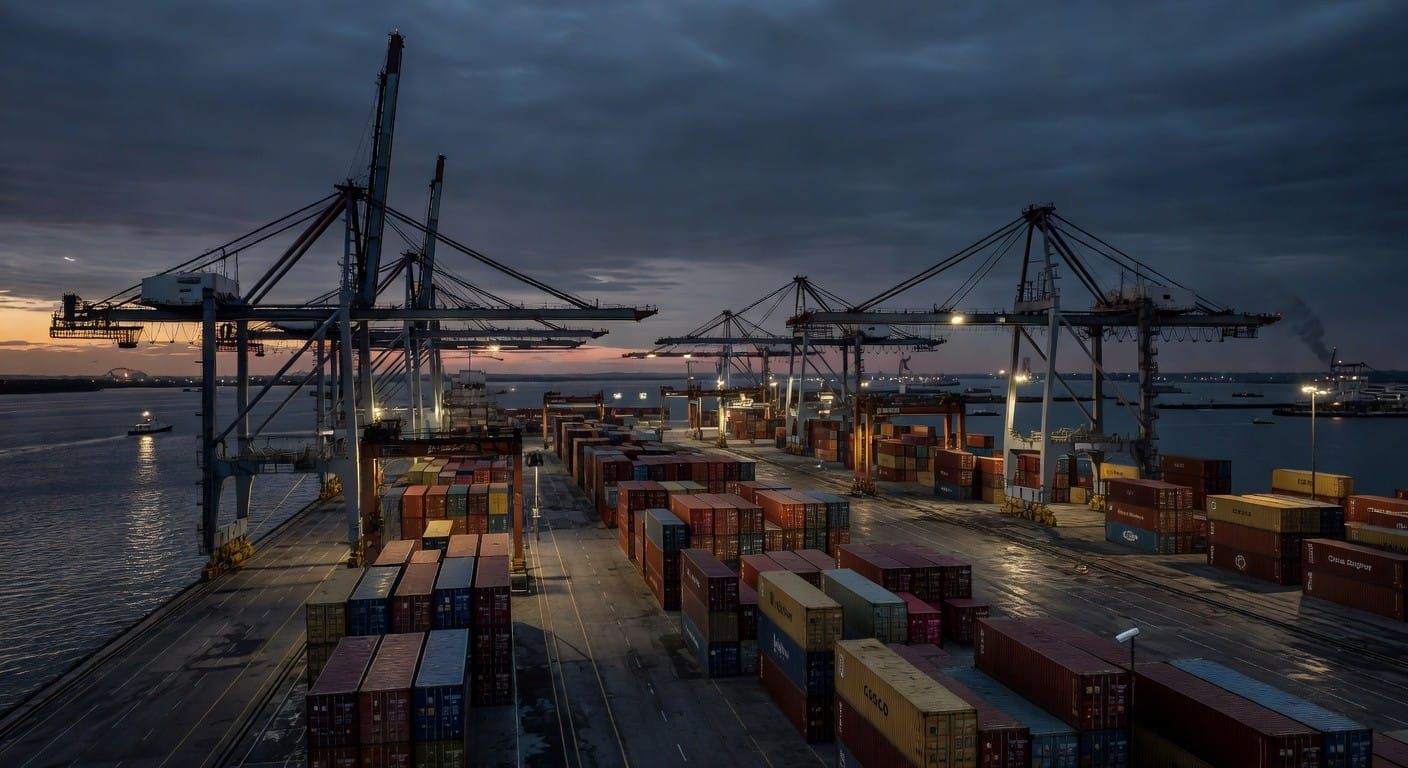
The most consequential infrastructure contest of the 21st century is not unfolding in space or cyberspace. It is happening at sea level — in the container terminals, dry docks, and logistics corridors that move 80% of global trade by volume. And one country has spent two decades quietly assembling a portfolio of port assets that now spans every major shipping lane on Earth.
Chinese state-owned and state-linked enterprises — principally COSCO Shipping Ports and China Merchants Port Holdings (CMPort) — hold equity stakes or operating concessions in over 100 port terminals across six continents. From Piraeus to Chancay, from Colombo to Djibouti, Beijing's port network has grown from a handful of commercial investments into something far more strategically significant: a global chokepoint architecture that gives China unprecedented leverage over the arteries of world trade.
For years, Western governments treated these acquisitions as routine commercial transactions. That era is over.
The Scale of the Network
The numbers alone tell a story. COSCO Shipping Ports, the terminal arm of China's largest state-owned shipping conglomerate, operates or holds stakes in terminals handling roughly 130 million TEU (twenty-foot equivalent units) annually — making it one of the three largest port operators on Earth. CMPort, a subsidiary of the state-owned China Merchants Group, operates a complementary network of over 50 ports in 26 countries.
Combined, these two entities touch virtually every critical shipping corridor:
- Europe: Piraeus (Greece, 67%), Valencia and Bilbao (Spain), Zeebrugge (Belgium), Hamburg (Germany, 24.99%), Le Havre (France)
- South Asia: Colombo (Sri Lanka), Hambantota (Sri Lanka, 99-year lease), Gwadar (Pakistan)
- Southeast Asia: Multiple terminals across Malaysia, Singapore, Indonesia, Myanmar
- Africa: Djibouti, Lamu (Kenya), Maputo (Mozambique), Abidjan (Côte d'Ivoire)
- Latin America: Chancay (Peru, 60%), São Luís (Brazil), Kingston (Jamaica)
- Middle East: Abu Dhabi, Haifa (Israel — since divested under US pressure), Khalifa Port (UAE)
This is not a trade route. It is a trade network — one designed to give Beijing commercial intelligence, logistical advantage, and in extremis, the ability to disrupt flows at critical nodes.
The Strategic Logic
Beijing's port strategy did not emerge in a vacuum. It is the maritime extension of the Belt and Road Initiative (BRI), launched in 2013, which has deployed an estimated $1 trillion in infrastructure financing across more than 140 countries.
But ports occupy a unique position within BRI. Unlike railways or power plants, a port is both a commercial asset and a strategic one. A Chinese-operated terminal generates revenue through container throughput. It also provides:
- Commercial intelligence: Real-time visibility into trade flows, shipping manifests, and commodity movements
- Logistical staging: Pre-positioned infrastructure that can support naval logistics in a contingency
- Political leverage: The ability to slow-walk customs, delay permits, or restrict access in a crisis
- Debt diplomacy: In cases like Hambantota (Sri Lanka), financial distress converted a commercial loan into a 99-year strategic lease
The playbook varies by region. In Europe, COSCO targeted privatizations during the sovereign debt crisis — acquiring Piraeus at fire-sale prices from a desperate Greek government. In Africa, Chinese firms often build ports from scratch under turnkey BRI contracts, securing long-term operating concessions as part of the deal. In Latin America, the strategy targets Pacific-facing terminals that could reroute supply chains away from US-dominated logistics corridors.
The Western Awakening
The strategic implications went largely unnoticed until the mid-2020s. Three developments changed the calculus:
1. The Piraeus Precedent. After acquiring a controlling stake in Piraeus, Beijing used Greece as a wedge within the EU. In 2017, Greece vetoed an EU statement criticizing China's human rights record at the UN — a direct consequence, analysts argued, of Chinese economic leverage through the port. The incident became a case study in how commercial infrastructure translates into political influence.
2. The Hamburg Controversy. In 2022, German Chancellor Olaf Scholz overrode objections from six federal ministries to approve COSCO's acquisition of a 24.99% stake in Hamburg's Tollerort terminal. The backlash was severe — fueling Germany's subsequent "de-risking" policy and accelerating EU-wide reforms to FDI screening in critical infrastructure.
3. US Pressure Campaign. By 2025, Washington began actively pressuring European allies to review and potentially reverse Chinese port stakes. The US framed these as "Trojan horses" — commercial assets that could be weaponized in a Taiwan contingency or broader great-power confrontation. In 2025, the US urged Greece to reduce Chinese control at Piraeus, triggering diplomatic friction with Beijing.
This is where the analysis gets actionable. AlphaBriefing members get the full investment framework — scenarios, positioning, and the bottom line.
Subscribe to AlphaBriefing — Free, Member, and Paid tiers available.