The Ghost Armada: Europe Is Seizing Russia's Shadow Fleet — and It's Reshaping the Global Oil Market
Europe's navies are hunting hundreds of aging, uninsured tankers that move Russia's sanctioned crude. The crackdown is tightening tanker supply, spiking shipping rates, and creating a structural windfall for compliant fleet operators.

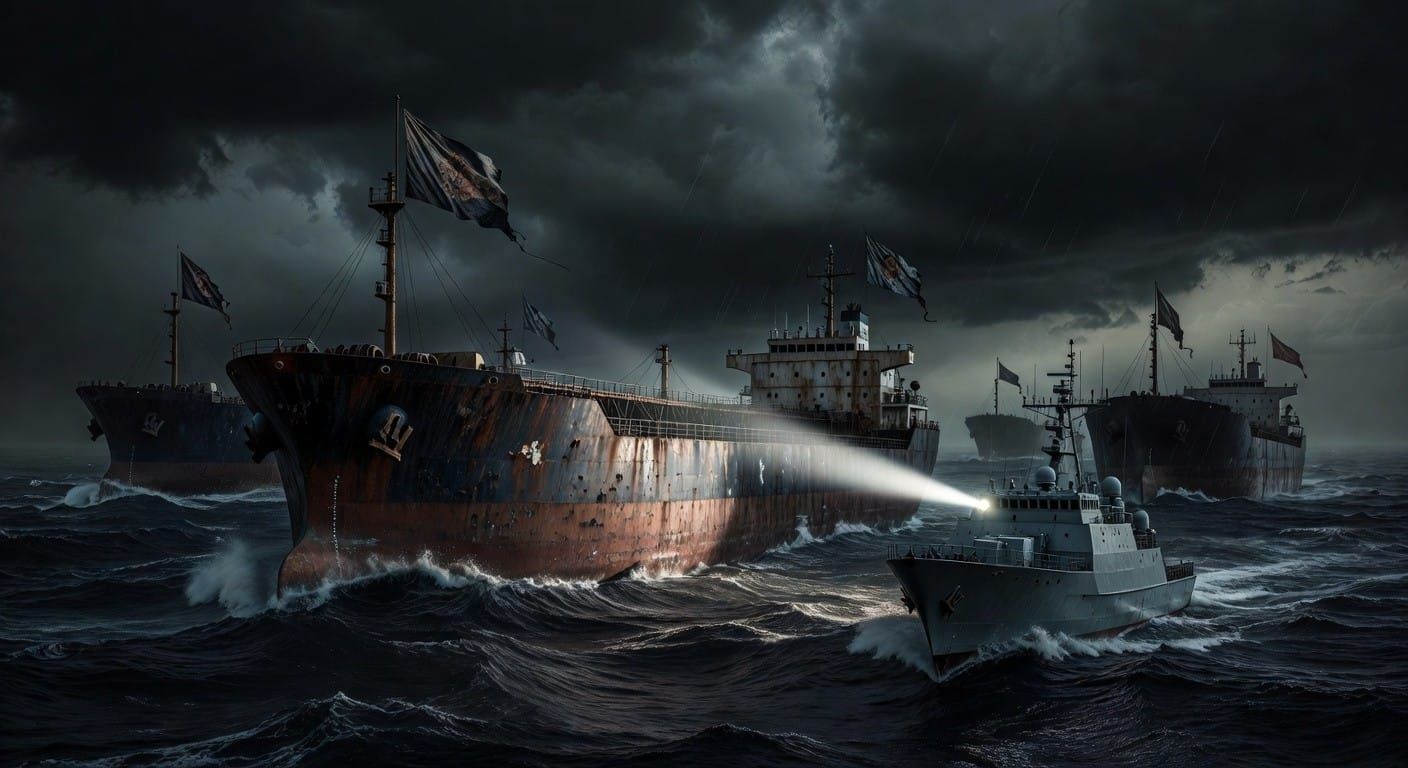
Europe's navies are hunting ghost ships.
Over the past six months, a quiet but escalating campaign has unfolded across European waters. Belgium, France, Finland, Sweden, Latvia, and others have boarded, detained, and in some cases seized aging oil tankers linked to Russia's so-called "shadow fleet" — a clandestine armada of hundreds of vessels designed to circumvent Western sanctions on Russian crude exports.
On April 29, Swedish prosecutors announced the formal confiscation of the Caffa, a false-flagged vessel seized in the Baltic Sea in March. Days earlier, the EU finalized its 20th sanctions package against Russia, adding 46 more shadow fleet tankers to its blacklist — bringing the total to over 630 sanctioned vessels.
This is no longer a cat-and-mouse game. It's becoming a naval blockade in all but name. And the investment implications are enormous.
What Is the Shadow Fleet?
The shadow fleet is a network of approximately 900 to 1,400 tankers — estimates vary — used primarily by Russia, but also Iran and Venezuela, to move sanctioned crude oil to willing buyers in China, India, and elsewhere. These vessels typically share a set of characteristics:
- Aging hulls: Many are 15-25+ years old, well past normal retirement age
- Opaque ownership: Registered through layers of shell companies in jurisdictions like the UAE, Cameroon, and Gabon
- False or rotating flags: Ships frequently switch registry to dodge enforcement
- AIS spoofing: Transponder signals are manipulated or turned off entirely to avoid tracking
- Ship-to-ship transfers: Crude is transferred between vessels at sea to obscure origins
- No Western insurance: These ships operate outside the Protection & Indemnity (P&I) club system, meaning any environmental disaster falls on coastal states
The fleet now comprises an estimated 17-27% of global oil tanker capacity — a staggering share of the world's petroleum logistics operating entirely outside the regulated maritime system.
The Crackdown Accelerates
What changed in 2026 is that Europe stopped watching and started seizing.
Finland kicked things off on New Year's Eve 2025, detaining the Fitburg after it damaged a Finland-Estonia telecommunications cable — the latest in a string of suspected infrastructure sabotage incidents. Belgium and France jointly seized the MT Ethera in the North Sea in late February, setting a €10 million bail. France grabbed the Deyna in the Mediterranean in March with Royal Navy assistance. Sweden confiscated the Caffa from the Baltic.
In total, at least eight European coastal states have now boarded or detained shadow fleet vessels in 2026 alone. A legal analysis published in February found that Europe could lawfully halt roughly one-third of the fleet — approximately 500 stateless or falsely flagged vessels — under existing international maritime law.
Across the Atlantic, the U.S. Senate committee advanced the SHADOW Fleet Act (S.2904), which would impose mandatory sanctions on vessels and entities facilitating sanctions evasion. The U.S. has already sanctioned over 50 firms and vessels tied to Iranian and Russian shadow networks in 2026.
Russia's response has been revealing: Moscow announced plans to re-register approximately 80 shadow tankers under the Russian flag itself — a move that simultaneously provides diplomatic protection and openly admits the fleet's existence. The share of Russian-flagged shadow tankers has jumped from 3% to 21% in just nine months.
The Environmental Time Bomb
Beyond geopolitics, the shadow fleet represents one of the world's most acute environmental hazards.
These are decrepit vessels with minimal maintenance, no credible insurance, and skeleton crews operating in some of the world's most ecologically sensitive waters. The Baltic Sea, where many shadow tankers idle while awaiting orders, is a semi-enclosed body of water with limited flushing capacity. A major spill there would be catastrophic and effectively permanent.
The Guardian reported in February that Iran's shadow fleet includes tankers so old and poorly maintained that maritime experts describe them as "floating time bombs." Finland has deployed additional seabed surveillance specifically to monitor idling shadow tankers in the Gulf of Finland after experts warned that a collision or structural failure could release hundreds of thousands of barrels of crude into Baltic waters.
The insurance gap is the critical detail. When a legitimate tanker spills oil, the P&I system covers cleanup costs — often running into billions. When a shadow tanker spills, there is no insurer. The coastal state pays. European taxpayers are, in effect, underwriting the environmental risk of Russia's sanctions evasion.
Why Investors Should Care
The shadow fleet crackdown is creating a structural shift in the tanker market that has direct implications for publicly traded shipping companies.
The mechanism is simple: every shadow tanker seized, sanctioned, or scrapped is one less vessel available to move global crude. As shadow capacity exits the market — whether through enforcement, aging, or risk aversion by port states — the demand for compliant, insured tankers rises.
The numbers tell the story:
- VLCC (Very Large Crude Carrier) day rates have been running at $100,000-$130,000 in early 2026 — highly elevated by historical standards
- Aframax tankers are at multi-year highs, benefiting particularly from Venezuelan crude redirection to the U.S. Gulf and Europe
- Suezmax rates are recovering as Red Sea shipping routes partially normalize
- VLCC utilization is projected to hit 92% in 2026, up from 89.5% — a level that historically produces rate spikes
Public tanker companies — Frontline (FRO), DHT Holdings (DHT), Scorpio Tankers (STNG), Teekay Tankers (TNK), and International Seaways (INSW) — all posted strong gains in early 2026 on the back of this dynamic. Some pulled back in April as Ukraine peace negotiations created uncertainty, but the structural thesis remains intact as long as enforcement continues.
The key variable: persistence of enforcement. If Europe maintains its current posture — seizing vessels, expanding sanctions lists, and tightening maritime law — the compliant fleet's pricing power only grows. If enforcement eases (perhaps as part of a broader diplomatic deal), shadow capacity re-enters the market and rates soften.
There's also a second-order play. The global tanker fleet is aging — 44% of VLCCs are now over 15 years old — and newbuild deliveries, while rising (419 vessels expected in 2026, the most since 2009), take years to hit the water. The shadow fleet crackdown is accelerating the retirement of the oldest, most dangerous ships, tightening supply even further.
The Bigger Picture
What's unfolding in European waters is more than a law enforcement operation. It's a test of whether the Western sanctions architecture — the most ambitious economic warfare campaign in history — can actually be enforced at sea.
The shadow fleet was always the weakest link. For years, Russia, Iran, and Venezuela moved millions of barrels per day through a parallel maritime system that existed in plain sight. Western governments knew about it. They tracked it. They published reports about it. But they didn't stop it.
That's changing. The question now is whether the political will holds. Seizing tankers is operationally simple but legally complex. Russia has threatened retaliation. China and India — the primary buyers of shadow-shipped crude — have shown no interest in cooperating. And every seized tanker becomes a diplomatic incident.
But the trajectory is clear. Europe is moving toward a de facto naval enforcement of energy sanctions. The U.S. is legislating expanded authority. And the market is repricing accordingly.
For investors, the shadow fleet story is a reminder that geopolitics doesn't just create risk — it creates opportunity. The tanker companies that play by the rules are the direct beneficiaries of a world that's finally decided to enforce them.
Get this level of intelligence every day. Subscribe to AlphaBriefing — free, member, and paid tiers available.
Sources & Further Reading
- Reuters — Oil Tanker Rates to Stay Strong Into 2026 as Sanctions Remove Ships for Hire
- Atlantic Council — The Shadow Fleet Is Undermining the Maritime Order More Brazenly Than Ever
- Euronews — Sweden Confiscates False-Flagged Russian Shadow Fleet Ship
- IISS — Europe's Coastal States Tighten Enforcement on Russia's Shadow Fleet
- The Guardian — 'Ticking Time Bomb': Iran Shadow Fleet's Old Tankers Risking Catastrophic Oil Spill
- Kpler — Q1 2026 Tanker Market Outlook: Shadow Fleet Disruption and Mid-Size Strength
- Maritime Executive — Tighter Shadow Fleet Sanctions Set to Boost Legitimate Tanker Owners
Disclaimer
AlphaBriefing is an independent intelligence publication. The content in this article is produced for informational and educational purposes only. Nothing published by AlphaBriefing constitutes financial, investment, legal, tax, or regulatory advice, nor should it be construed as a solicitation or recommendation to buy, sell, or hold any security, asset, or financial instrument.
All views expressed are those of the author at the time of writing and are subject to change without notice. Markets are volatile and unpredictable; past performance is not indicative of future results. Any investment involves risk, including the possible loss of principal.
AlphaBriefing and its principals, employees, or contributors may hold positions in securities or assets mentioned in this article. This should be considered a potential conflict of interest. No material relationship with any company referenced exists unless explicitly disclosed. Readers should conduct their own due diligence and consult qualified financial, legal, and tax advisors before making any investment decisions.
Information in this article is drawn from public sources believed to be reliable at the time of publication. AlphaBriefing makes no warranty, express or implied, as to the accuracy, completeness, or timeliness of any information herein. AlphaBriefing accepts no liability for any loss or damage arising from reliance on this content.
© AlphaBriefing. All rights reserved. Unauthorized reproduction or distribution is prohibited.