The Balkan Powder Keg: Inside Serbia's Election Crisis, Europe's Lithium Gamble, and the $2.4 Billion Mine That Could Reshape the Continent
A generational protest movement, a snap election, and Europe's largest untapped lithium deposit are colliding in Belgrade. The outcome will determine whether Europe achieves critical minerals sovereignty — or cedes another decade to China.

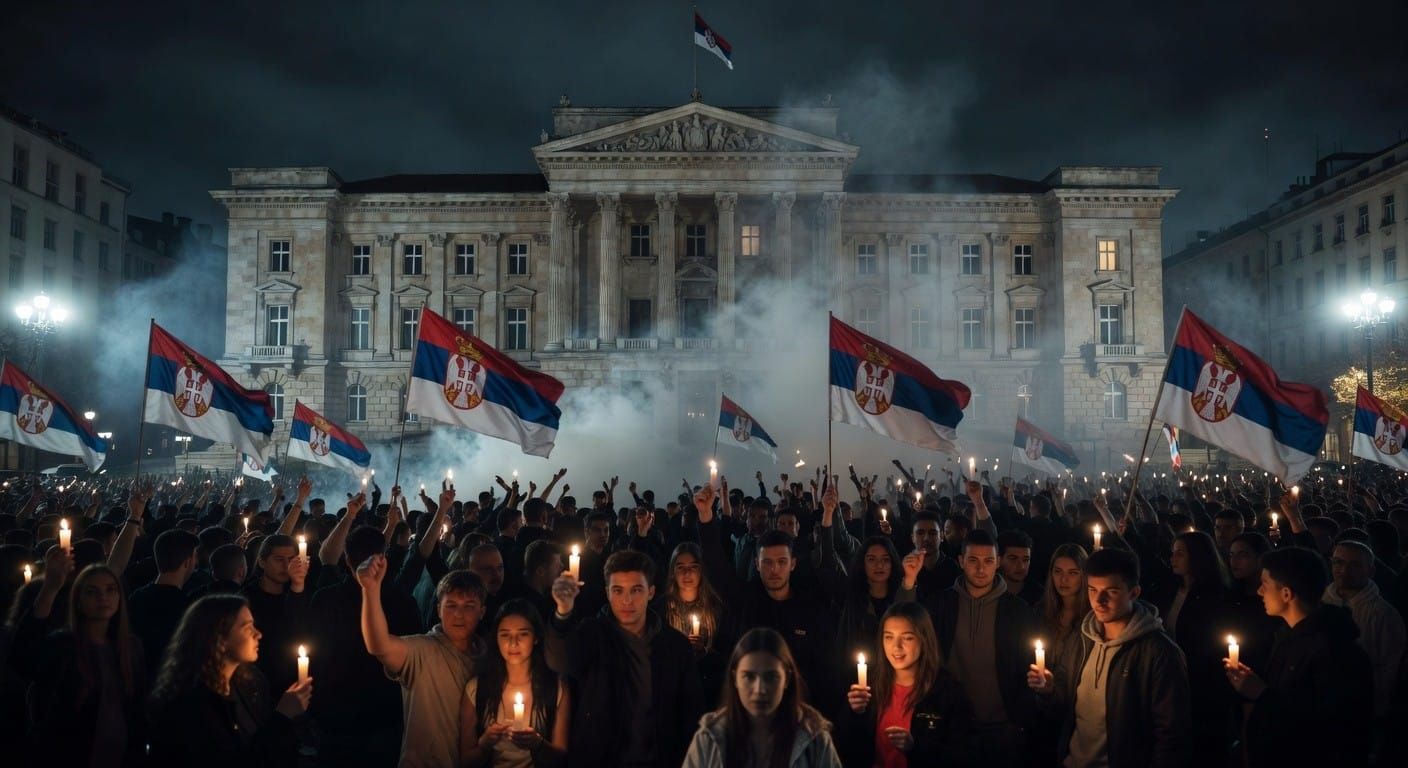
Serbia is cracking. Not in the way maps break — no borders are shifting, no armies are marching. But something arguably more consequential is happening: the most sustained popular uprising in the country's post-Milošević history is colliding with a snap election, a $2.4 billion lithium project in limbo, and a three-way geopolitical tug-of-war between the EU, Russia, and China.
For investors, the Western Balkans rarely register. Serbia's Belgrade Stock Exchange has a domestic market capitalization of roughly $4.7 billion — smaller than a mid-cap American REIT. But what happens in Belgrade over the next six months will shape Europe's critical minerals supply chain, test the EU's strategic credibility, and determine whether one of the continent's last uncommitted nations tilts decisively toward Brussels — or drifts further into Moscow and Beijing's orbit.
This is a story about lithium, legitimacy, and leverage. And it's about to come to a head.
The Uprising That Won't Die
On November 1, 2024, the canopy of a newly renovated railway station in Novi Sad, Serbia's second-largest city, collapsed without warning. Sixteen people were killed. Investigators traced the failure to shoddy construction, negligent oversight, and contracts awarded through opaque procurement processes — the kind of institutionalized corruption that Serbians had tolerated for years under President Aleksandar Vučić's increasingly authoritarian Serbian Progressive Party (SNS).
This time, something snapped.
What began as daily silent vigils in Novi Sad escalated into the largest sustained protest movement in Serbia's modern history. By March 2025, an estimated 275,000 to 325,000 people filled the streets of Belgrade — in a country of 6.6 million. Students occupied university buildings. Faculty joined them. The demonstrations spread to Niš, Kragujevac, and dozens of smaller cities.
The demands went far beyond the train station. Protesters called for full document disclosure on the Novi Sad reconstruction, prosecution of officials with unexplained wealth, independent institutional audits, increased university funding, and — at their core — an end to the systemic corruption that has defined the Vučić era.
Eighteen months later, the movement persists. In March 2026, police clashed with demonstrators in Belgrade, violently evicting students from occupied buildings. In April, authorities at the University of Niš moved to merge and restructure departments seen as protest hotbeds — a tactic that European academic bodies condemned as retaliation. The OSCE has flagged electoral irregularities in local elections held in March 2026, where the ruling coalition swept all ten contested municipalities amid reports of violence against journalists and students.
Vučić's response has been a familiar authoritarian playbook: partial concession mixed with crackdown. He publicly endorsed some protest demands — like wealth-origin disclosure laws — while accusing the student movement of being a foreign-backed destabilization campaign. His government has ramped up pressure on independent media, academic institutions, and civil society organizations.
The question now is whether this pressure cooker detonates at the ballot box.
The Election Gambit
Vučić has committed to holding early parliamentary elections before the end of 2026, with speculation centering on June or the fall. The regular cycle wouldn't require a vote until December 2027, but the president — constitutionally ineligible for a third term — appears to be calculating that an early election, held before protest fatigue sets in further, gives his SNS coalition the best chance of maintaining its parliamentary supermajority.
Recent polling (mid-2025, the most recent available) shows the SNS-led coalition at 46-48% — dominant but no longer commanding. The protest movement has not yet coalesced into a unified political opposition, which is Vučić's greatest structural advantage. Serbia's fragmented opposition parties have historically struggled to coordinate, and the student movement has deliberately distanced itself from formal party politics to maintain credibility.
But the March 2026 local elections revealed cracks. The SNS won all ten municipalities, yes — but in Bor, the industrial city in eastern Serbia, the margin was just 49% to 40%. Turnout hit 67.5%, far higher than typical local elections, suggesting protest energy is translating into electoral engagement.
For investors, the election outcome determines the trajectory of Serbia's most consequential economic asset: its lithium.
The $2.4 Billion Lithium Question
Serbia's Jadar Valley contains one of Europe's largest untapped lithium deposits — enough to produce an estimated 58,000 tonnes annually, sufficient to supply batteries for over a million electric vehicles per year. The deposit also contains significant boron reserves, making it a dual critical-minerals play.
Rio Tinto has held development rights since discovering the deposit in 2004. The project has been a political rollercoaster:
- 2022: The Serbian government revoked Rio Tinto's spatial plan under pressure from massive environmental protests.
- 2024: The government reversed course, reinstating the plan. Serbia signed a strategic partnership with the EU for lithium supply.
- June 2025: The European Commission designated the Jadar project as a strategic critical raw materials project under the EU's Critical Raw Materials Act — a significant regulatory endorsement.
- November 2025: Rio Tinto suspended development indefinitely, citing permitting delays, unresolved local opposition, and a strategic decision to prioritize near-term opportunities elsewhere. The project was placed under "care and maintenance."
The suspension was a body blow to the EU's Critical Raw Materials Act, which was explicitly designed to reduce European dependence on Chinese-controlled lithium processing. China currently controls approximately 65% of global lithium refining capacity. The Jadar project was the single largest near-term prospect for European lithium self-sufficiency.
Vučić has stated that the project's fate will be decided after elections. This makes the snap election not just a domestic political event but a critical juncture for European industrial policy.
This is where the analysis gets actionable. AlphaBriefing members get the full investment framework — scenarios, positioning, and the bottom line.
Subscribe to AlphaBriefing — Free, Member, and Paid tiers available.