The Pentagon Lost the AWACS Fight in Congress. Now It's Winning It in Orbit.
Congress forced the radar planes back into the budget. The Space Force answered with $6.8 billion for satellites — and Rocket Lab just crossed the line from launch company to defense prime.

On August 5, the Space Force announced it had handed $615 million to three companies — Rocket Lab, a Massachusetts sensor house called STR, and a third firm it refuses to name — to build satellites that track aircraft from orbit. On its own, that reads like routine procurement news. It is not. It is the second task order under a program called Space-Based Airborne Moving Target Indicator, and the first one, awarded quietly in May, went to SpaceX for $4.6 billion. Add a separate $1.6 billion SpaceX launch contract for the same sensing-and-targeting push, and the Space Force has committed roughly $6.8 billion in about ninety days to moving one of the most storied missions in air warfare off of airplanes and into orbit.
To understand why that number matters, you have to understand the fight it just ended — a fight most of the market watched as an aviation story, when it was actually a space story the whole time.
The plane that ran out of time
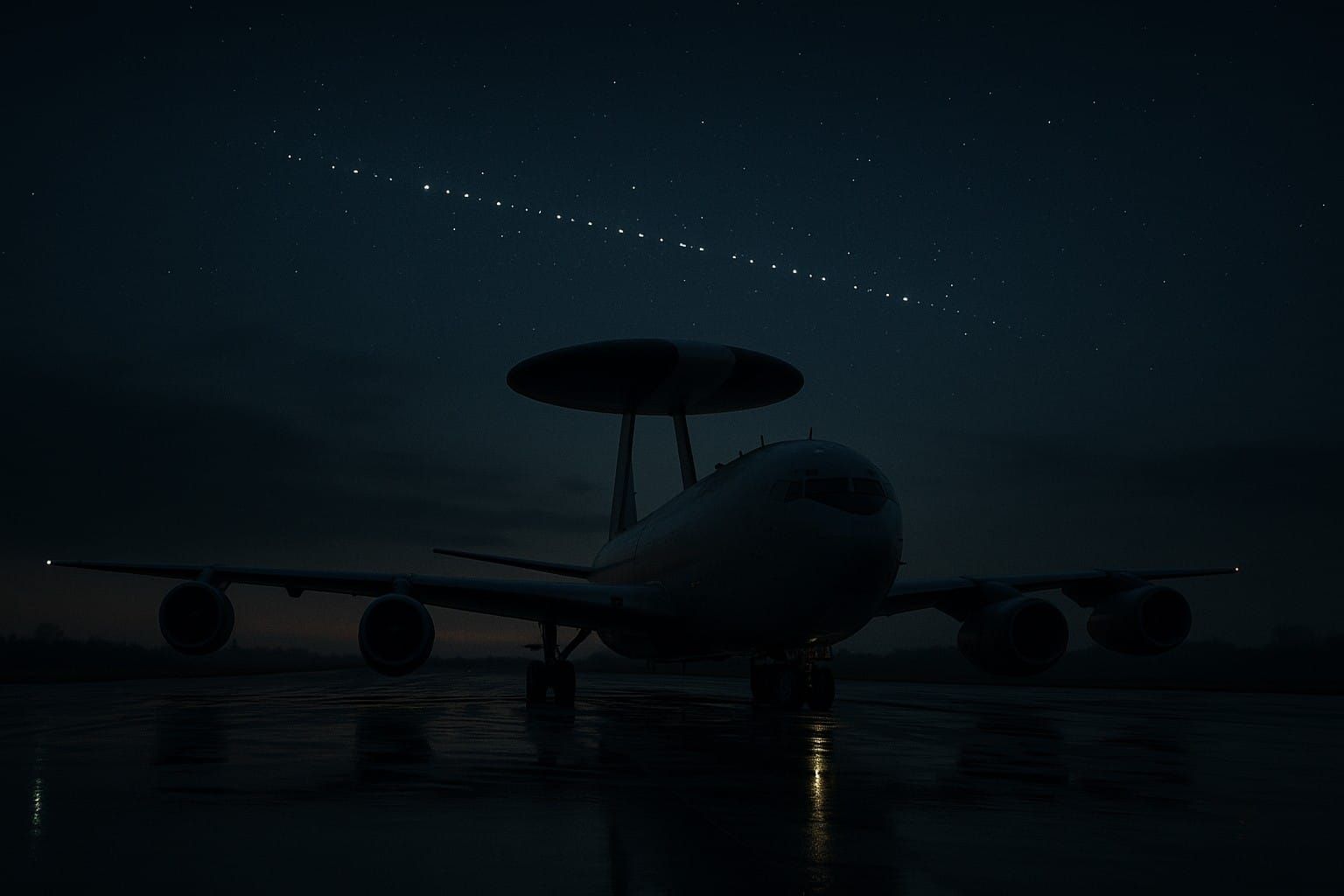
Since 1977, the airborne early warning mission — spotting enemy aircraft and missiles hundreds of miles out and directing the air battle in response — has belonged to the E-3 Sentry, the AWACS, a Boeing 707 with a rotating radar dome bolted to its back. Every American air campaign since Desert Storm has been choreographed from one. The problem is that the 707 stopped rolling off production lines in 1979. The Air Force's remaining E-3s are all more than 40 years old, spare parts come from boneyards, and readiness rates have been sliding for years. In April, the fleet's fragility made headlines again when the Air Force lost one of its E-3s in Saudi Arabia.
The designated successor was the E-7 Wedgetail, a 737-based radar aircraft already flown by Australia and on order for the UK and NATO. Then, in June 2025, the Pentagon abruptly canceled it. The official reasons: per-aircraft cost had ballooned from $588 million to $724 million, and — more importantly — the building doubted a big, slow, unstealthy jet crammed with radar operators would survive against an adversary whose very-long-range missiles are designed specifically to kill tankers and radar planes. The replacement plan: lean on the Navy's smaller E-2D Hawkeyes as a bridge, and shift the mission itself to satellites.
Congress revolted. Lawmakers wrote provisions compelling the Air Force to keep all 16 remaining E-3s flying until enough Wedgetails arrive, and shoved more than $1 billion back into the program. By March 2026, the Air Force had folded, awarding Boeing sole-source contracts to get the E-7 moving again. Headlines called it a congressional victory over the Pentagon, and on the narrow question of whether America buys a radar jet, it was.
While Washington argued, the money moved
But watch the two funding streams side by side. Congress clawed back roughly $1 billion for the airplane. The Space Force, over the same stretch, has pushed roughly $6.8 billion toward the orbital version of the same mission — more than six times as much, with a stated ambition to get capability operational before 2028. Col. Ryan Frazier, who runs the relevant Space Systems Command portfolio, framed the multi-vendor awards as "diversifying our capabilities and ensuring we don't rely on a single technical solution" while exploring "fundamentally different ways to accomplish the airborne moving target indication mission."
Strip the procurement language and the logic is blunt. A satellite constellation doesn't need tankers, doesn't put a crew of twenty inside missile range, and can't be attrited by shooting down one aircraft. Proliferated constellations — dozens or hundreds of cheap, stackable satellites — are the same architectural bet the Pentagon has already made for missile warning and communications. Tracking moving aircraft from orbit is genuinely harder than either, which is exactly why the Space Force is paying four different vendors to attack the problem in parallel rather than betting on one.
Both sides of the Washington fight got their money. Only one side owns the future funding line.
For investors, though, the policy verdict is the easy part. The harder question is where the repricing actually lands. Of the four companies now inside the program, one is private, one is literally unnamed, one is so large this contract is a rounding error — and one is a mid-cap that, with this award, just crossed the line from launch company to defense prime, days before printing record revenue.