America's Largest-Ever Steel Plant Comes From a Company That Went Bankrupt Building Its Last One
Essar-backed Mesabi Metallics just won a White House stage for an $18 billion mine-to-mill steel plan. The last time this group made a promise on this Minnesota ore body, it ended in bankruptcy court.

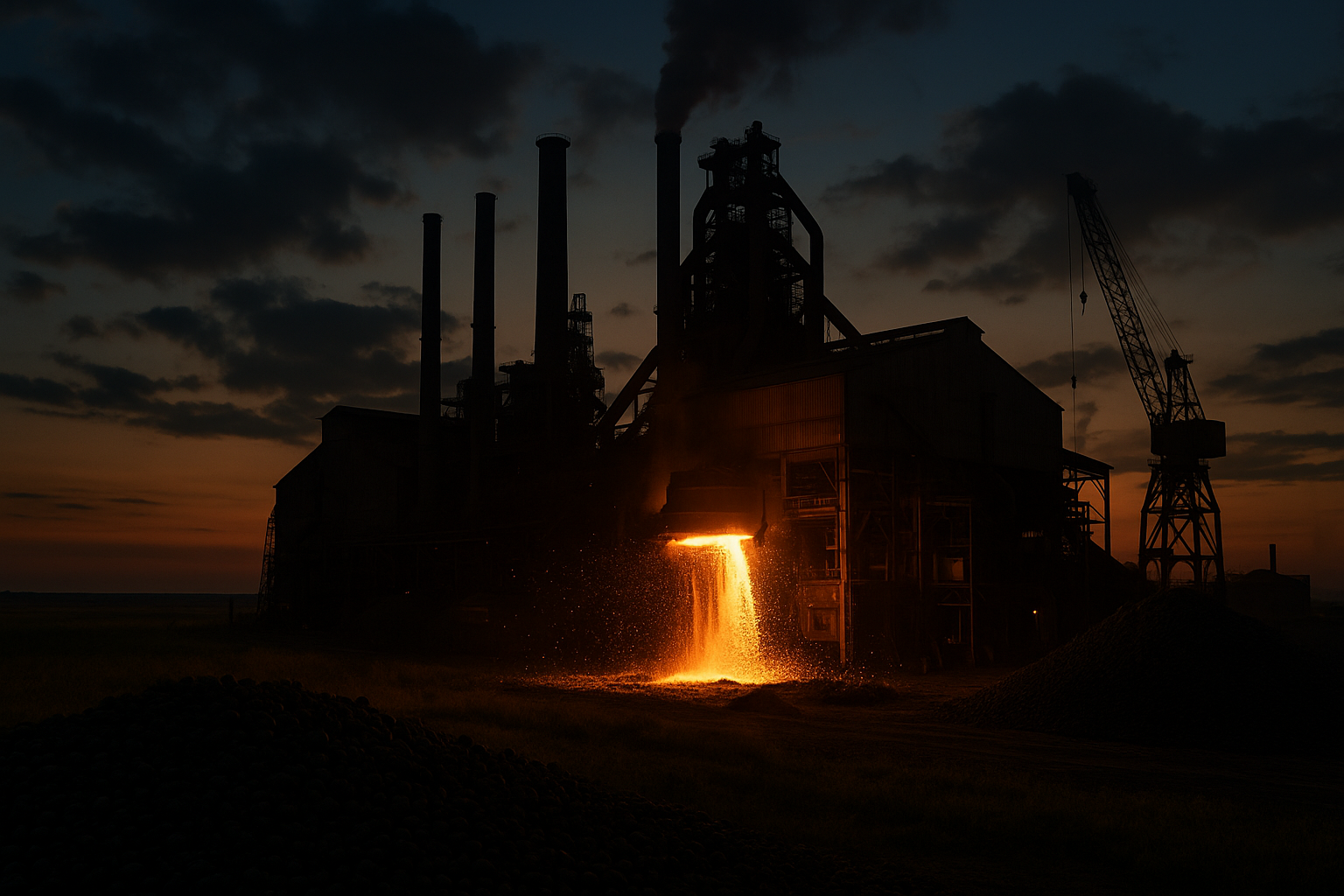
On Monday, President Trump stood in the White House with Iowa Governor Kim Reynolds and announced what the administration is calling the largest steel plant in American history: an $18 billion plan from Mesabi Metallics to mine iron ore in northern Minnesota, pelletize it on site, and ship it to a brand-new $15 billion steel complex in southeast Iowa capable of producing up to 10 million tons of steel a year by around 2030.
The framing was pure industrial-policy triumph — a fully integrated, mine-to-mill, 100% American steel supply chain, backed by tariff walls and blessed from the presidential podium.
What went unmentioned at the podium: the company behind it, and the Indian conglomerate backing it, have made a promise on this exact patch of Minnesota before. It ended in one of the most notorious industrial bankruptcies the Iron Range has ever seen.
What $18 Billion Is Supposed to Buy
The headline number breaks into two pieces. Roughly $3 billion, by the company's count, is the money Mesabi Metallics is already spending at Nashwauk, Minnesota — a new iron ore mine and pellet plant on the Mesabi Iron Range, the first new mine-and-pellet operation built there in decades. The other $15 billion is new: a direct-reduced-iron (DRI) to electric-arc-furnace (EAF) steel complex in southeast Iowa — Lee County, on the Mississippi River, according to Rep. Mariannette Miller-Meeks' office, though the company has not confirmed the exact site.
The logic of the pairing is real. Nashwauk's ore body can produce direct-reduction-grade pellets — the high-purity feedstock DRI furnaces need and that the US mostly lacks domestic supply of. Feed those pellets into DRI modules, melt the result in electric arc furnaces alongside scrap, and you get flat-rolled steel with less energy and lower emissions than a blast furnace, from ore that never left the country.
The company says the Iowa complex will employ 5,000 to 6,000 construction workers and around 1,750 permanent staff, with production targeted for 2030. Mesabi's own press materials go further, claiming more than 8,000 total construction jobs and $95 billion in economic output across construction and the first decade of operation — projections worth treating as marketing until a financing package and a confirmed site say otherwise.
Briefings like this land in members' inboxes before the market prices them in. Join free →
The Ghost of Nashwauk
To understand why Minnesota officials tend to flinch at big promises from this project, you need the history.
Essar Group — the Mumbai-based conglomerate of the Ruia family — broke ground at Nashwauk in 2008 on what was supposed to be a taconite mine, pellet plant, and eventually a DRI facility. What followed was a decade of missed deadlines, unpaid contractors, and half-built structures rusting on the Range. By July 2016, then-Governor Mark Dayton moved to terminate the company's state mineral leases. Essar Steel Minnesota responded by filing for Chapter 11 bankruptcy — a move that froze the lease termination — leaving behind unpaid contractors, a court record that described financial mismanagement, and a skeleton of a plant.
The asset was renamed Mesabi Metallics and sold out of bankruptcy in 2017 to Chippewa Capital Partners, a vehicle led by Virginia nursing-home magnate Tom Clarke. That effort faltered too. And in one of the stranger full circles in American industrial history, a reorganized Essar Group had regained control of the project by 2022 — the same group that lost it in bankruptcy five years earlier.
The intervening years produced a running war with Cleveland-Cliffs, which acquired some of the project's private mineral leases during the bankruptcy and has fought Mesabi in court ever since. Minnesota's Department of Natural Resources revoked 2,600 acres of Mesabi's state leases in 2021 and handed them to Cliffs in 2023. Litigation between the two companies is still working through the courts.
For the full ironic picture: during the same stretch, Essar also lost its flagship Indian steel business. Essar Steel India was taken from the family through India's landmark insolvency process and sold to ArcelorMittal in 2019. The group that is now promising America's largest-ever steel plant spent the late 2010s losing steel plants to creditors on two continents.
Why This Time Might Actually Be Different
Here is the honest counterpoint: the Nashwauk project, left for dead for most of two decades, is finally producing.
Mesabi Metallics completed its first production blast at the mine this year and produced its first iron ore concentrate on September 17. The company says its first pellet — it is branding them "patriot pellets" — is expected in October. Roughly 1,500 contractors are on site. Whatever one thinks of the sponsor's history, the Minnesota half of this story has moved from PowerPoint to physical reality, on the company's stated schedule, for the first time ever.
The policy environment has also been rebuilt in the project's favor. Section 232 steel tariffs now sit at 50%, giving domestic steelmakers a price umbrella that did not exist during Essar's first attempt. A White House announcement is not financing — but it signals permitting and political friction will be lower than at any point in the project's history. Mesabi's CEO had earlier voiced frustration with Minnesota's permitting and incentives while shopping the steel plant location, and Iowa won the site in part on exactly that argument.
The Math Nobody Mentioned at the Podium
The problem is what the announcement ignored: the steel market this plant would enter.
The OECD's 2026 Steel Outlook projects global excess steelmaking capacity will swell toward 745 million metric tons by 2028 — pushing global capacity utilization down toward 74%. Global steel consumption fell 2.6% in 2025 and is expected to be roughly flat in 2026. This is not a market screaming for 10 million new American tons.
And the American buildout is already underway without Mesabi. By one trade-press count, more than 17 million tons of new EAF capacity is currently under construction in the US — including a new Arkansas mill ramping toward 3 million tons a year and Nucor's 3-million-ton West Virginia sheet mill, expected to begin shipments in early 2027. On the same day as the Iowa announcement, Cleveland-Cliffs' Canadian subsidiary Stelco said it would indefinitely idle finishing operations at its Hamilton Works, according to trade reports — a reminder that in the existing North American steel industry, capacity is being switched off, not on.
The tariff wall changes the arithmetic for imports, not for demand. If every announced ton gets built, the American steel market of 2030 will have substantially more melt capacity chasing a demand pool that has grown, at best, modestly. Someone's utilization rate — and someone's margins — will absorb that. The incumbents know it, which is why the loudest applause for new mega-mills tends to come from politicians rather than steel executives.
What to Watch
Three things separate this announcement from a real project. First, financing: $15 billion is more than Essar's entire visible commitment to date by a factor of five, and no debt or equity package has been detailed publicly. Second, the site: Lee County remains unconfirmed by the company, and no ground has been broken. Third, the pellet plant: if Nashwauk ships its first pellets in October as promised and ramps through 2027, the supply-chain half of the story is real; if that date slips, the oldest pattern on the Iron Range is reasserting itself.
The announcement is genuinely significant either way. It is the clearest signal yet that tariff policy is pulling foreign industrial capital into greenfield American heavy industry — not just assembly plants, but primary metal production. Whether it becomes 10 million tons of steel or the Range's most expensive déjà vu will be decided by financing documents, not press conferences.
If this analysis was useful, this is what AlphaBriefing does every day — geopolitics and markets, connected to what it means for your money. Free members get the daily brief in their inbox; paid members get the investment frameworks, scenario pricing, and catalyst calendars behind the paywall.
Get the next briefing free in your inbox: Join AlphaBriefing
Get this level of intelligence every day. Subscribe to AlphaBriefing — free, member, and paid tiers available.
Sources & Further Reading
- CBS News — Trump announces plans for largest steel plant in U.S. history
- KCRG — White House shares details of largest US steel plant coming to Iowa
- KTTC — Mesabi Metallics plans $18 billion project linking Minnesota mine, new Iowa steel plant
- MPR News — Ore from Mesabi Metallics mine will be used for $15 billion steel mill planned for Iowa
- Minnesota Reformer — Good news on the Iron Range: $2 billion Mesabi Metallics is finally happening
- Duluth News Tribune — Mesabi Metallics emerges from bankruptcy; idled Essar Steel project now able to advance
- OECD — Steel Outlook 2026: Global steelmaking capacity reaches new highs
- KAXE — Mesabi Metallics chooses Iowa for $15B steel plant after voicing incentive concerns
Disclaimer
AlphaBriefing is an independent intelligence publication. The content in this article is produced for informational and educational purposes only. Nothing published by AlphaBriefing constitutes financial, investment, legal, tax, or regulatory advice, nor should it be construed as a solicitation or recommendation to buy, sell, or hold any security, asset, or financial instrument.
All views expressed are those of the author at the time of writing and are subject to change without notice. Markets are volatile and unpredictable; past performance is not indicative of future results. Any investment involves risk, including the possible loss of principal.
AlphaBriefing and its principals, employees, or contributors may hold positions in securities or assets mentioned in this article. This should be considered a potential conflict of interest. No material relationship with any company referenced exists unless explicitly disclosed. Readers should conduct their own due diligence and consult qualified financial, legal, and tax advisors before making any investment decisions.
Information in this article is drawn from public sources believed to be reliable at the time of publication. AlphaBriefing makes no warranty, express or implied, as to the accuracy, completeness, or timeliness of any information herein. AlphaBriefing accepts no liability for any loss or damage arising from reliance on this content.
© AlphaBriefing. All rights reserved. Unauthorised reproduction or distribution is prohibited.