The Drug Factory in Orbit Just Became a Unicorn. The Pentagon Pays the Rent.
Varda Space raised $250 million at a $1.6 billion valuation to make drugs in microgravity. For now, Pentagon hypersonics pay the bills — and the public-market map of this trade is stranger than the pitch deck.

Space hardware had a good Wednesday. In-space manufacturing company Varda Space Industries announced a $250 million Series D at a $1.6 billion valuation, led by Lux Capital and Natural Capital, bringing its total raised to $598 million since 2021. The same morning, satellite builder Astranis said the Export-Import Bank of the United States had approved a $468 million credit facility to fund domestic satellite production. Two very different checks — venture equity and government-backed credit — pointing at the same shift: the money is moving past rockets, toward what happens after launch.
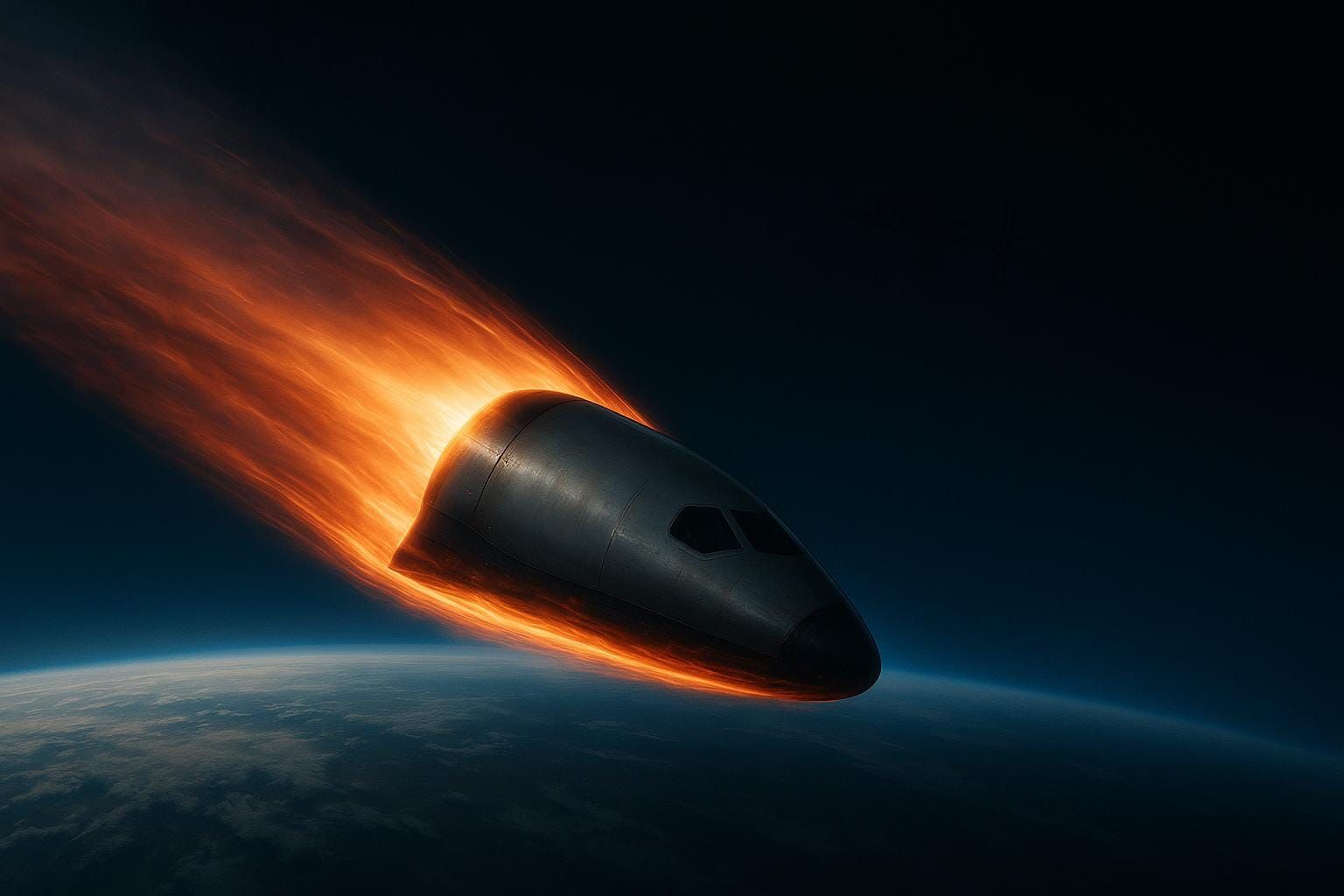
Varda is the purest expression of that shift. The El Segundo, California company doesn't build rockets or operate satellite constellations. It builds autonomous capsules that ride to orbit on SpaceX rideshares, run experiments and manufacturing processes in microgravity, and then fall back through the atmosphere at more than Mach 25 to deliver the product — physically — to a desert landing zone.
A factory that falls out of the sky
The commercial logic rests on a quirk of physics. On Earth, gravity interferes with how molecules assemble: convection stirs solutions, sedimentation drags particles down, and crystals form with defects and inconsistencies. Remove gravity and some drug compounds crystallize into forms — different polymorphs, more uniform particles — that are difficult or impossible to produce on the ground. For the right molecule, that can mean better stability, better solubility, or a drug that can be injected instead of infused.
This isn't theoretical. On its first mission, W-1, Varda grew crystals of Form III of the antiretroviral drug ritonavir in orbit and brought them home — the first time a private company autonomously processed a pharmaceutical in space and recovered it. That same capsule was the first commercial spacecraft to land on U.S. soil and the first approved to reenter under the FAA's modern Part 450 licensing regime.
Since 2023, Varda has flown six missions. Five came home successfully; the fourth was the exception. The first three flights used spacecraft buses built by Rocket Lab; more recent missions fly a vertically integrated bus Varda built in-house for the specific punishment of long-duration orbital processing followed by hypersonic reentry, which completed its first successful return on the W-5 mission. The cadence is accelerating: the company's W-8 and W-9 capsules are slated to fly together — Varda's first dual-capsule launch — on SpaceX's Transporter-18 rideshare in early October, part of a plan to fly three missions within about a month.
Briefings like this land in inboxes before the market catches up. Join AlphaBriefing free →
The customer nobody leads the pitch deck with
Here is the part of the story that doesn't fit the space-pharma headline. Varda's CEO Will Bruey told Reuters that roughly 70% of the company's payload customers next year will be government, not pharmaceutical. The reason is the return trip. Every Varda capsule reenters the atmosphere at 18,000 miles per hour — Mach 25-plus — which makes each commercial flight a free hypersonic flight test. For a Pentagon desperate to accelerate hypersonic weapons development, a reusable capsule that hits those speeds on every single mission is test infrastructure that someone else's balance sheet already paid for.
That's the real structure of this business today: a drug company in the making, currently paying its bills as a defense contractor. Bruey expects the mix to flip toward commercial pharmaceutical work by 2032, with a microgravity-derived formulation targeted for human clinical trials near the end of the decade.
Which raises the questions that matter for investors: how big is the Pentagon's rent check, what happens to it as the hypersonics budget scales, and — since Varda is private — which public names actually touch this trade? The answers are less obvious than they look. One listed company holds the largest hypersonic test contract in its history and has lost half its market value in a year. Another built Varda's first three spacecraft, got replaced, and rose 50% anyway.
Get the next briefing free in your inbox: Join AlphaBriefing
The rest of this briefing is free — it just requires a free AlphaBriefing account: the budget math behind the Pentagon's MACH-TB hypersonic test program, the three public tickers adjacent to this trade (including the prime that halved and the supplier that lost the contract but rose anyway), and the catalyst calendar to watch through year-end.
Create your free account → — 30 seconds, no card.