The Pentagon Just Ordered Seven Years of Missiles. The Market Sold the Stock.
Raytheon just signed the largest AMRAAM contract on record — up to $20.7 billion over seven years — and RTX fell anyway. When committed Pentagon money and market sentiment diverge this hard, one of them is wrong.

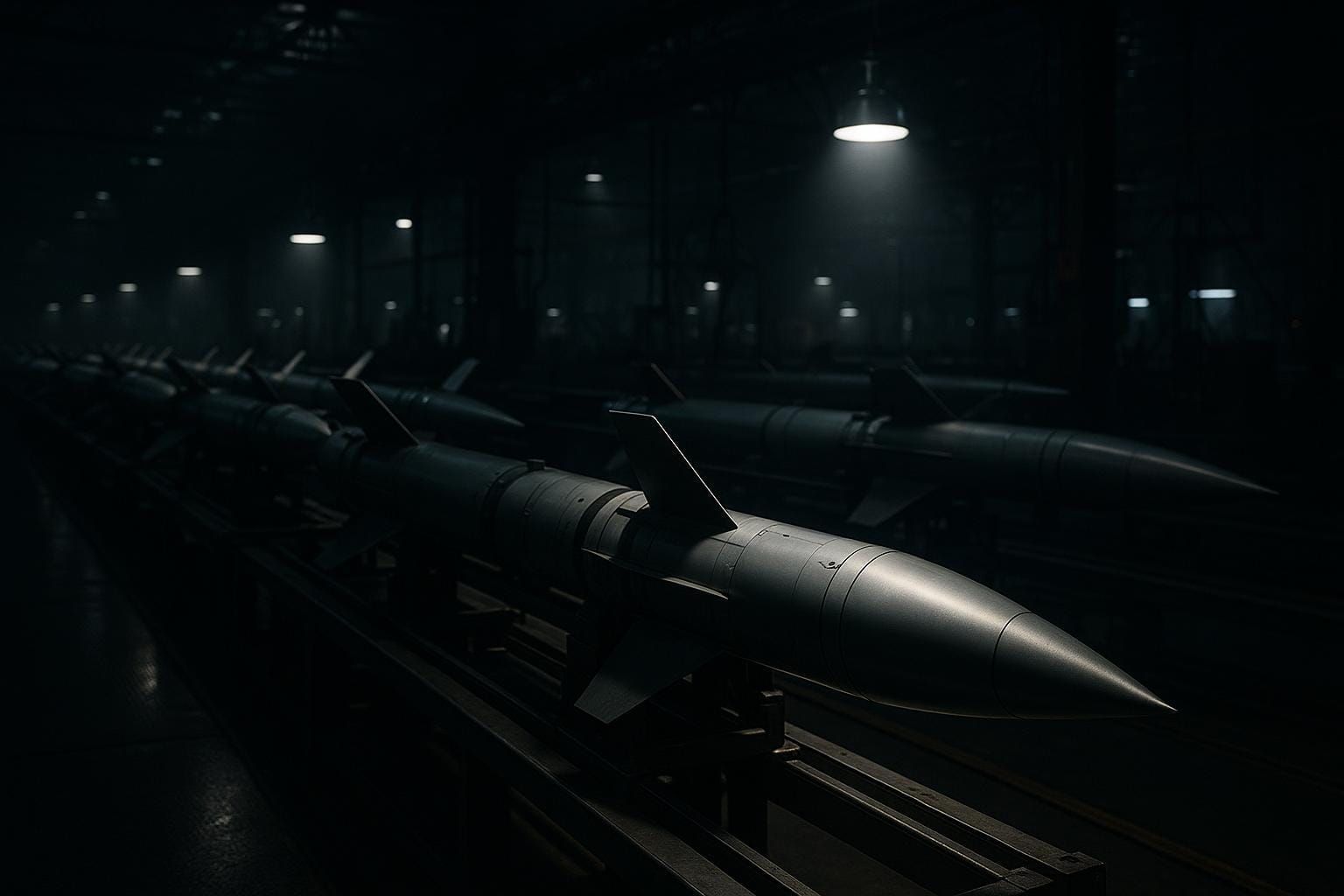
On Friday, September 25, the Pentagon signed the largest contract in the history of its most-fielded missile: a five-year multiyear award with two option years, valued at up to $20.7 billion, for Raytheon to build the Advanced Medium-Range Air-to-Air Missile — the AMRAAM. The ceiling is nearly six times the previous record AMRAAM award, a $3.5 billion contract from July 2025. The Pentagon says the deal will nearly double production of the weapon.
RTX, Raytheon's parent company, announced the contract on Monday. The stock closed lower that day. It closed lower again on Tuesday. By Wednesday afternoon it was trading around $184 — down roughly 2.5% since the award was signed and about 11% over the past month.
A record commitment of Pentagon money, met with a shrug. That gap is the story.
The Biggest AMRAAM Order Ever Written
The contract, executed jointly by the Department of War, the Air Force, the Navy, and Foreign Military Sales allies, is the latest and largest move in the Pentagon's "Arsenal of Freedom" campaign to expand the munitions industrial base. It formalizes what Raytheon and the department sketched out in February, when the two signed five framework agreements setting long-term production targets: more than 1,000 Tomahawks per year, more than 500 Standard Missile-6 interceptors, and at least 1,900 AMRAAMs.
The urgency behind those numbers is not abstract. A Pentagon-commissioned analysis reported by Defense News in May found that U.S. munitions stockpiles depleted by the war with Iran will take years to restore. The AMRAAM sits at the center of that problem: RTX calls it the world's most widely deployed air-to-air missile, operating on 14 platforms and fielded by 44 countries, with more than 7,000 live fires in test and combat — the company's figures. It is also the primary interceptor for the NASAMS ground-based air defense system, which Reuters reports defends the Washington, D.C. area and serves more than a dozen other countries.
Raytheon says it nearly doubled AMRAAM production in 2025 versus 2024 and is now exploring international co-production. The new contract asks it to keep climbing to what the company calls "record-setting levels."
Why the Market Doesn't Care
The selloff is not an RTX problem. Over the past month, the S&P 500 is flat while the iShares Aerospace & Defense ETF (ITA) is down about 9%. Lockheed Martin has lost about 10%, Northrop Grumman about 10%, and RTX about 11%. The whole sector is de-rating at the exact moment the Pentagon is signing its biggest munitions checks.
Three forces are doing the work, and none of them involve the order book. First, peace headlines: defense stocks slid last week after President Trump raised the prospect of an Iran peace deal at the United Nations, as reported by Seeking Alpha. Second, politics: Bloomberg reported in mid-September that the risk of a Democratic "blue wave" in the midterms has left defense stocks out of favor. Third, the fine print: Reuters called the AMRAAM award provisional — Congress has not yet funded the full deal, and the government is running on a stopgap that holds spending at current levels through December 11 while full-year appropriations wait.
So the divergence is real and quantifiable. On one side, a seven-year production commitment at a scale the program has never seen. On the other, a market pricing defense off hourly diplomatic and electoral headlines. One of these signals is telling you something the other is not — and the resolution has a date attached to it.
Get the next briefing free in your inbox: Join AlphaBriefing
The rest of this briefing is for paid members: the contract math on what $20.7 billion actually means for RTX, the three risks already priced into the 11% slide, the December date that turns a ceiling into cash flow, and the scenario-by-scenario read on RTX at $184.
AlphaBriefing Paid gets you every investment thesis, scenario framework, and catalyst brief we publish — the analysis private intel clients pay four figures for, at a fraction of that.