The Colombia Tinderbox: An Election, a Cartel War, and the Most Dangerous Bet in Latin America
Colombia votes in 28 days amid the worst pre-election violence in a generation. The outcome will determine the trajectory of Latin America's third-largest economy — and billions in investor capital.

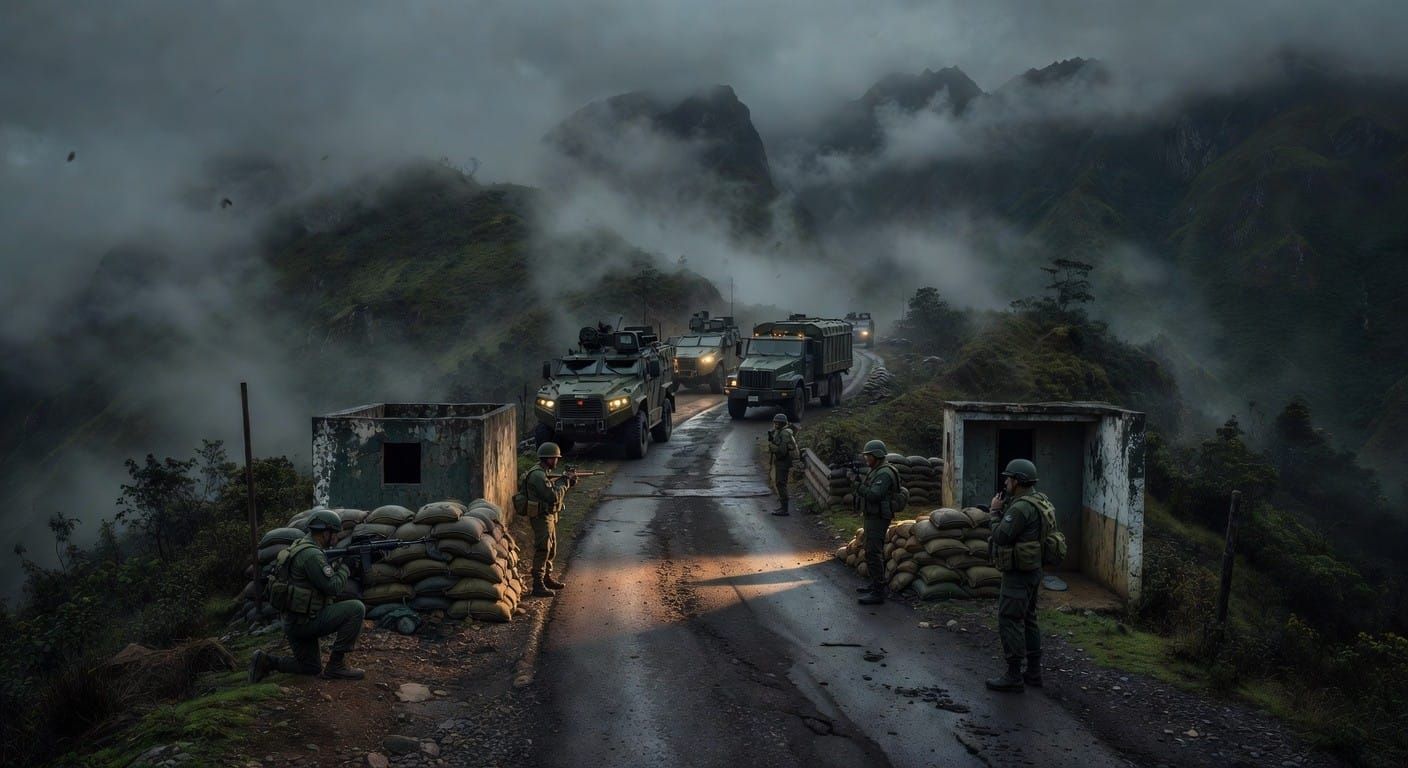
Colombia's presidential election is less than four weeks away. The country is on fire — and the markets know it.
Since April 25, at least 26 coordinated attacks have struck civilian and military targets across southwestern Colombia. A roadside bomb on the Pan-American Highway between Cali and Popayán killed 21 people. Drones and explosives have hit military bases. Candidates have abandoned rural campaign stops entirely, with vast swathes of the country becoming effective no-go zones.
The violence isn't random. It's strategic. Armed groups — principally FARC dissident factions under the warlord Iván Mordisco — are staking territorial claims over Colombia's record coca harvest before a new president takes office. And the election outcome will determine whether Latin America's third-largest economy doubles down on failed peace talks or pivots to a hardline crackdown that could reshape investor access to one of the region's most important markets.
For anyone with exposure to Latin American assets, this is the most consequential vote of 2026.
The Violence: What's Actually Happening
Colombia's "Total Peace" policy — President Gustavo Petro's signature initiative — was supposed to end decades of internal conflict by negotiating simultaneously with every armed group in the country. Four years later, it has achieved the opposite.
Coca cultivation has hit a record 258,000 hectares. The FARC's EMC faction, led by Mordisco (who carries a 5-billion-peso bounty), controls the lucrative Micay Canyon corridor and taxes every stage of the cocaine supply chain from farmer to trafficker. The ELN — Colombia's other major guerrilla force — dominates routes into Venezuela and was responsible for the Catatumbo massacre in January 2025 that killed over 100 people.
What's happening now is a pre-election land grab. Armed groups are exploiting the security vacuum created by stalled peace talks to expand territorial control before a potentially less accommodating president takes office. The attacks in Cauca and Valle del Cauca aren't just terrorism — they're a hostile takeover of Colombia's rural economy.
The human toll is devastating. But the strategic signal is clear: whoever wins on May 31 inherits a country where the state has lost effective sovereignty over significant portions of its own territory.
The Candidates: Three Scenarios for Investors
Fourteen candidates are on the ballot, but only three matter. The first round on May 31 will almost certainly produce a runoff on June 21, and each possible outcome carries dramatically different implications for markets.
Iván Cepeda (Pacto Histórico, leftist — 36-44% in polls)
Petro's ideological heir. A human rights activist and senator, Cepeda would continue the Total Peace framework, maintain interventionist economic policies, and likely pursue labor market reforms that have already spooked foreign capital. His victory would represent policy continuity — which, given Petro's track record, means continued capital flight risk. FDI dropped 14.1% in 2025 under the current government.
Abelardo de la Espriella (far-right independent — 21-29%)
A lawyer-entrepreneur with business interests spanning fashion, wine, and real estate. Self-styled as Colombia's Milei, he advocates shrinking the state, boosting fossil fuel exports, and taking a hardline stance against armed groups. Markets would likely rally on his victory, but his lack of legislative allies could limit his reform capacity.
Paloma Valencia (Centro Democrático, center-right — 13-25% and rising)
An Uribe-aligned senator who won March primaries decisively and is gaining momentum fast. Her platform reads like a private equity pitch deck: tax cuts, deregulation, 10,000 kilometers of rural roads, nuclear and geothermal energy expansion, and aggressive formalization of the informal economy. If she makes the runoff, she could consolidate the entire right-wing vote.
The critical dynamic: Cepeda leads the first round but faces tight runoff margins against either right-wing candidate. Prediction markets give roughly even odds of a right-leaning outcome. That uncertainty is already priced into Colombian assets — but not fully.
The Market Signal: What the Numbers Say
Colombian financial markets are flashing stress signals that go beyond normal election jitters.
The peso is trading around 3,657 to the dollar, having weakened 3-5% in Q2 alone on political risk. Analysts warn a Cepeda victory could push USD/COP past 4,100. A right-wing consolidation would likely reverse recent losses.
The COLCAP index sits at approximately 2,178 — down roughly 5-6% year-to-date and recently touching its 2026 low. The index is technically oversold (RSI around 31.5) with a bearish MACD crossover below the 200-day moving average. A right-wing runoff win could trigger a 5-10% relief rally.
Sovereign bonds tell the most dramatic story. Colombia's 10-year yield has surged to 13.14%, up 45-60 basis points recently. Five-year CDS spreads have widened 35-50 basis points. The government's proactive $4.56 billion external bond buyback — closed just days ago — has capped some of the pressure, but it also signals that Bogotá knows it has a credibility problem.
The credit picture is sobering. Colombia's sovereign rating sits below investment grade at BB (Fitch). Debt-to-GDP is around 55%. Conflict costs the economy an estimated 3% of GDP annually in lost productivity. Capital investment as a share of GDP has fallen to levels not seen since the 1970s.
The bottom line: Colombia's assets are cheap, but they're cheap for a reason. The election is a binary catalyst — and the gap between the best and worst outcomes is enormous.
Why This Matters Beyond Colombia
Colombia isn't just another Latin American election story. It's a test case for three dynamics that should be on every global investor's radar.
First, the narco-state question. If the world's largest coca producer can't establish sovereignty over its own territory, the implications ripple through global cocaine markets, migration flows (Colombia is already a transit country for Venezuelan migrants), and U.S. security policy. Washington has quietly signed a pact with Bogotá to target narco-leaders like Mordisco — and the next president will decide whether that cooperation deepens or collapses.
Second, the Latin American political cycle. Colombia's election is the second in a 2026 trifecta that includes Peru's chaotic runoff (June) and Brazil's November vote. A right-wing victory in Colombia would accelerate the continent's rightward shift — following Argentina's Milei revolution — and could trigger a broader re-rating of Latin American risk assets. A Cepeda win would reinforce the region's reputation for policy whiplash.
Third, the resource access question. Colombia sits on significant copper, gold, and coal reserves. Under Petro, mining permits slowed and energy transition rhetoric clashed with fiscal reality. A pro-market successor could unlock billions in mining investment at precisely the moment the world is scrambling for critical minerals. The Lobito Corridor — the U.S.-backed rail project linking DRC and Zambia's minerals to Atlantic ports — runs through the same strategic logic. Colombia could be next.
The Clock Is Ticking
Twenty-eight days. That's how long investors have to position for what could be the most consequential Latin American election since Argentina's 2023 vote.
The violence is escalating, the polls are volatile, and the market is pricing in uncertainty — but not resolution. For those with the risk appetite, Colombia's oversold equity market and sky-high bond yields represent a classic event-driven opportunity. For those without it, the next eight weeks will determine whether Latin America's third-largest economy opens up for business or retreats further into instability.
Either way, nobody should be ignoring Colombia right now.
Get this level of intelligence every day. Subscribe to AlphaBriefing — free, member, and paid tiers available.
Sources & Further Reading
- AP News — Colombia Attacks Before Election
- NPR — Colombia's Election Takes a Tense Turn
- Americas Quarterly — Colombia: Meet the Candidates
- AS/COA — Colombia Elects 2026
- Bloomberg — Colombia Bond Buyback
- Reuters — BanRep Rate Decision
- Financial Post — Candidates Retreat Amid Violence
Disclaimer
AlphaBriefing is an independent intelligence publication. The content in this article is produced for informational and educational purposes only. Nothing published by AlphaBriefing constitutes financial, investment, legal, tax, or regulatory advice, nor should it be construed as a solicitation or recommendation to buy, sell, or hold any security, asset, or financial instrument.
All views expressed are those of the author at the time of writing and are subject to change without notice. Markets are volatile and unpredictable; past performance is not indicative of future results. Any investment involves risk, including the possible loss of principal.
AlphaBriefing and its principals, employees, or contributors may hold positions in securities or assets mentioned in this article. This should be considered a potential conflict of interest. No material relationship with any company referenced exists unless explicitly disclosed. Readers should conduct their own due diligence and consult qualified financial, legal, and tax advisors before making any investment decisions.
Information in this article is drawn from public sources believed to be reliable at the time of publication. AlphaBriefing makes no warranty, express or implied, as to the accuracy, completeness, or timeliness of any information herein. AlphaBriefing accepts no liability for any loss or damage arising from reliance on this content.
© AlphaBriefing. All rights reserved. Unauthorized reproduction or distribution is prohibited.