The Kill Decision: Inside the $75 Billion Race to Build Autonomous Weapons — and How to Invest
The Pentagon just admitted it's losing the autonomous weapons race to China and Russia. A $75 billion spending surge is coming — and three companies are positioned to capture it.

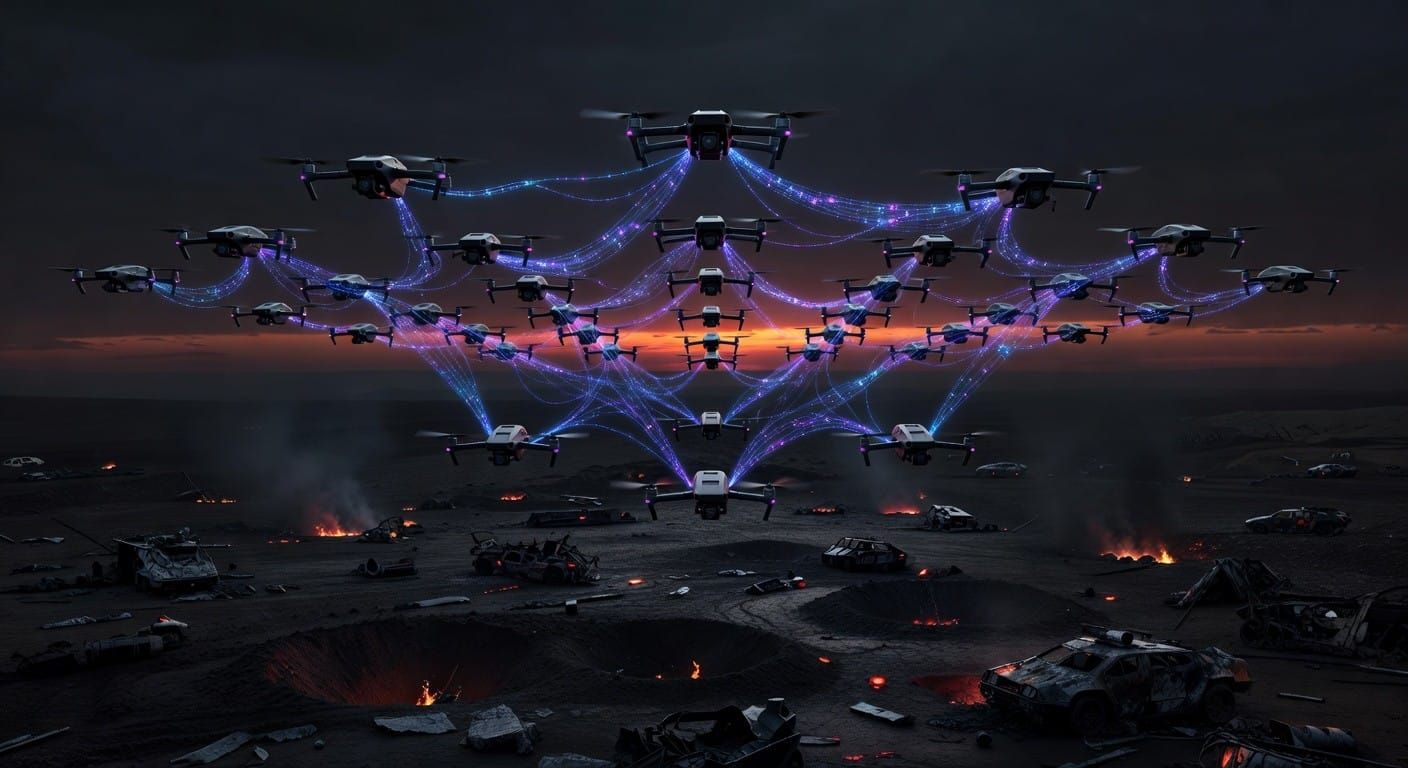
The Pentagon just admitted what defense analysts have warned about for years: the United States is losing the autonomous weapons race.
In an April 2026 New York Times report, senior Pentagon officials conceded that both China and Russia now lead the U.S. in key unmanned AI combat capabilities — a stunning acknowledgment from the world's largest defense establishment. China's Atlas Drone Swarm System, unveiled in March, deploys 96 coordinated attack drones in seconds. Russia's Lancet kamikaze drones have executed over 4,000 autonomous strikes in Ukraine. And the global autonomous weapons market has surged past $19 billion, racing toward $30 billion.
This isn't science fiction. This is the new arms race — and it's moving faster than any treaty can contain it.
Welcome to the age of autonomous warfare: where AI decides who lives and dies, where $500 drones neutralize $50 million jets, and where the countries that master machine combat will dominate the next century of geopolitics.
For investors, this represents one of the most consequential — and actionable — defense technology shifts since the dawn of precision-guided munitions.
The Kill Chain Goes Autonomous
The concept is deceptively simple: remove the human from the loop. Instead of a pilot steering a drone via satellite link, AI systems identify targets, calculate engagement parameters, and strike — all in milliseconds. What the Pentagon calls "autonomous engagement authority" is what critics call the beginning of killer robots.
The technology has evolved in three waves.
Wave 1: Remote Control (2001–2015). Human operators controlled every aspect of drone strikes. The MQ-9 Reaper, workhorse of the War on Terror, required a pilot and sensor operator thousands of miles away.
Wave 2: Semi-Autonomous (2015–2024). Drones gained AI-assisted target recognition, navigation, and loitering capability. Israel's Harop and Turkey's Bayraktar TB2 could identify and engage targets with minimal human input.
Wave 3: Full Autonomy (2024–present). AI makes independent combat decisions. Drone swarms coordinate without human oversight. Russia's Lancet-3M uses onboard neural networks to hunt targets across GPS-denied environments. China is testing systems where AI makes battlefield decisions entirely on its own.
The implications are staggering. Autonomous weapons compress the kill chain from minutes to milliseconds. They can operate in communications-denied environments where human control is impossible. And they scale infinitely — a single operator can theoretically command thousands of autonomous platforms simultaneously.
The $75 Billion Scramble
The Pentagon's response has been massive but late.
The Replicator program, launched in 2023 to field "thousands of attritable autonomous systems," has expanded into Replicator 2. In January 2026, the Joint Interagency Task Force awarded its first Replicator 2 contracts for counter-drone systems, including Fortem Technologies' DroneHunter F700. The program aims to mass-produce cheap, AI-powered drones that can be lost in combat without breaking the budget.
In April 2026, U.S. Southern Command established a dedicated autonomous warfare unit — the first of its kind — integrating drones, AI, and unmanned systems into a single operational command. The proposed fiscal 2026 defense budget includes a staggering $75 billion earmarked for drone and autonomous weapons programs.
But the money is chasing a lead that may already be insurmountable.
China's approach is fundamentally different. Where the U.S. builds expensive, exquisite platforms, China mass-produces cheap, attritable drones at industrial scale. The Atlas system — 96 drones launched from a single truck in under 30 seconds — represents a philosophy of overwhelming quantity over individual quality. At roughly $1,000 per unit, a full Atlas swarm costs less than a single Javelin missile.
Russia, meanwhile, has turned Ukraine into the world's largest autonomous weapons testing ground. The Lancet series has evolved through combat iteration at a pace peacetime R&D cannot match, with each variant incorporating lessons from thousands of real-world engagements. Moscow's stated goal: 30% automated combat power by 2028.
The Regulatory Void
International efforts to control autonomous weapons are failing.
At the UN Convention on Certain Conventional Weapons in Geneva, March 2026 talks produced familiar exhortations for "urgent progress" on prohibitions — and familiar inaction. No binding treaty exists. No enforcement mechanism has been proposed. Twelve countries, including the United States, United Kingdom, Israel, and Russia, actively oppose a full ban on lethal autonomous weapons systems, citing strategic necessity.
The EU AI Act carves out national security exemptions that effectively exclude military AI from regulation. The result: a global regulatory void in which the most consequential weapons technology since nuclear fission is being developed, deployed, and proliferated with virtually no international oversight.
This vacuum benefits first movers and punishes late adopters. Countries that hesitate on ethical grounds cede the battlefield to those that don't.
This is where the analysis gets actionable. AlphaBriefing members get the full investment framework — scenarios, positioning, and the bottom line.
Subscribe to AlphaBriefing — Free, Member, and Paid tiers available.