The $12.7 Billion AI Pilot: Inside Shield AI's Bid to Become the Brain of American Air Power
Shield AI just raised $2 billion and flew its Hivemind AI pilot on the Pentagon's most important drone program. At $12.7 billion, it's either the most important defense startup in a generation — or the most overvalued.

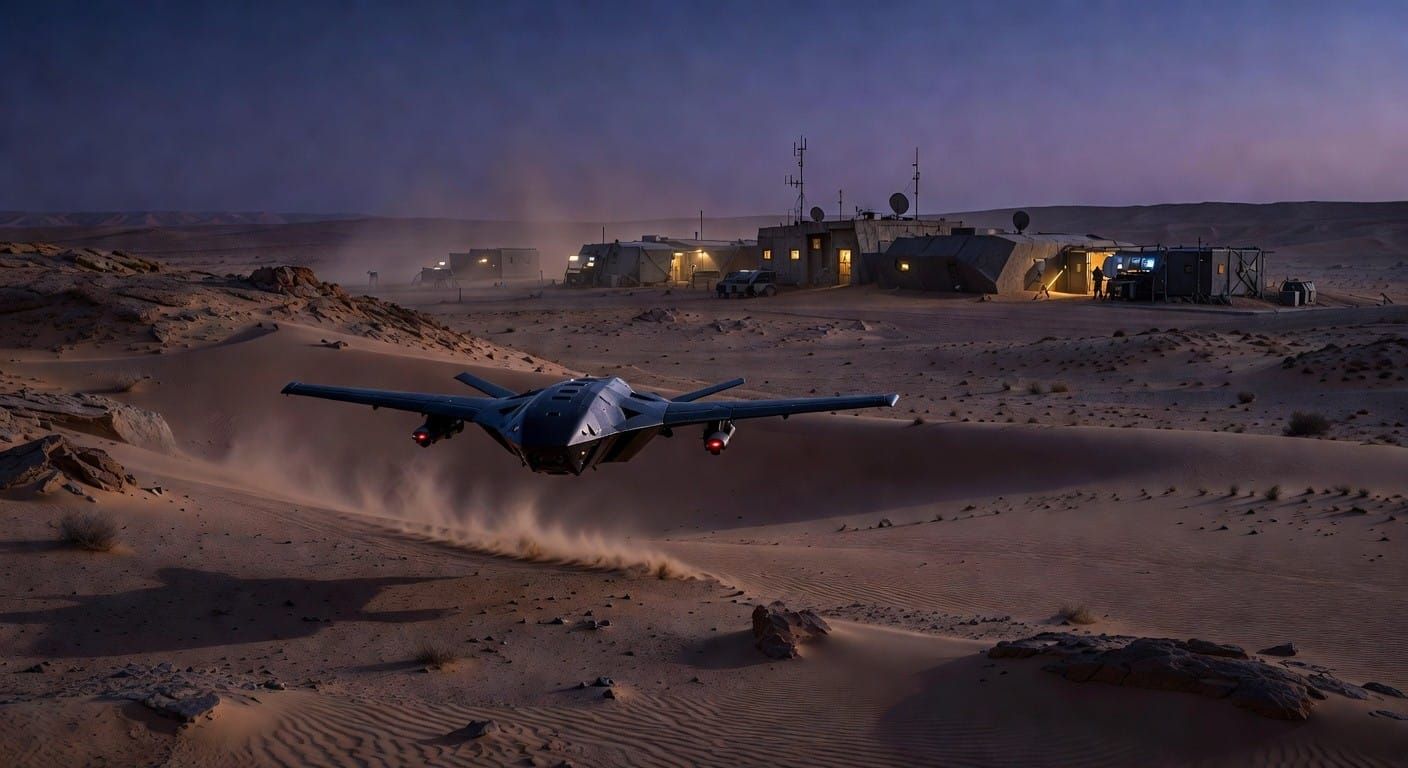
The Pentagon is betting its future air superiority on a San Diego startup most investors have never heard of. In February, Shield AI's Hivemind — an autonomous AI pilot — flew Anduril's YFQ-44A drone wingman at Edwards Air Force Base, completing takeoff, navigation, tasking, and landing without a human at the controls. A month later, the company raised $2 billion at a $12.7 billion valuation, a 140% jump from 2025.
This is not a prototype. This is the beginning of autonomous air combat at scale.
Shield AI sits at the center of the Pentagon's most consequential aviation program in a generation: the Collaborative Combat Aircraft (CCA) initiative, which aims to pair next-generation manned fighters with swarms of AI-piloted wingmen. The Air Force has requested roughly $1 billion in FY2027 procurement funding. Increment 1 winner selection is expected by year-end. And Hivemind just proved it can fly the leading airframe.
For investors tracking the defense technology revolution, this is the company to understand right now.
The Hivemind Thesis
Shield AI was founded in 2015 by brothers Brandon and Ryan Tseng, along with Andrew Reiter, after Brandon's deployment in Afghanistan revealed a critical gap: troops entering buildings blind, with no way to reconnoiter rooms before risking lives. The company's first product was Nova, a small quadcopter capable of autonomous indoor mapping in GPS-denied environments.
That origin story matters because it defined Shield AI's core technical DNA. Unlike competitors building drones as hardware platforms, Shield AI built itself as a software company that happens to fly aircraft. Hivemind, the company's flagship AI pilot, is platform-agnostic — meaning it can be loaded onto virtually any airframe, from small quadcopters to jet-powered combat drones.
This is a critical architectural distinction. The Pentagon doesn't want to be locked into a single vendor's hardware. It wants interchangeable autonomy software that can upgrade across fleets. Hivemind was purpose-built for this.
The software operates in GPS-denied, communications-degraded environments — exactly the conditions expected in a near-peer conflict with China or Russia. It handles perception, planning, and decision-making in real time, enabling collaborative swarming behavior across multiple aircraft without continuous human oversight.
The CCA Program: Why It Matters
The Collaborative Combat Aircraft program is the Air Force's answer to a math problem it cannot solve with manned fighters alone. An F-35 costs roughly $80 million per unit. Training a pilot takes years and millions more. In a contested environment against adversaries with advanced air defenses, the calculus of risking $100 million platforms and irreplaceable human pilots becomes untenable.
CCAs change the equation. These are autonomous drones — attritable by design, meaning the military accepts they may be lost in combat — that fly alongside manned aircraft as AI wingmen. They perform scouting, electronic warfare, weapons delivery, and decoy missions, multiplying the combat power of every manned fighter they accompany.
Two airframes lead the competition: Anduril's YFQ-44A (Fury) and General Atomics' YFQ-42A. Both completed first flights in late 2025. Shield AI's Hivemind has been selected as the mission autonomy provider and has already demonstrated mid-flight software switching with Anduril's own Lattice AI platform — a capability the Air Force explicitly demanded.
Anduril began low-rate production of the YFQ-44A at its Arsenal-1 manufacturing facility in March 2026. If the Fury wins the Increment 1 contract, Hivemind goes to production with it.
The Contract Pipeline
Shield AI's revenue trajectory tells the story of a company crossing from startup to defense prime. The company projects over $540 million in revenue for 2026, up dramatically from previous years, and has raised approximately $3.2 billion in total funding.
The contract pipeline is global and accelerating:
- US Air Force CCA Program (Feb 2026): Selected as mission autonomy provider for the collaborative combat aircraft program — potentially the largest autonomous aviation procurement in history.
- US Navy ISR Services (Apr 2026): Competing for an $800 million contract to provide V-BAT unmanned ISR services.
- US Coast Guard ($198 million): Maritime UAS services using V-BAT.
- Indian Army (Jan 2026): V-BAT drones and Hivemind SDK licenses for reconnaissance from the Himalayas to contested border regions.
- Taiwan's NCSIST (Feb 2026): Contract to accelerate indigenous AI pilot development — a strategically significant deal given cross-strait tensions.
- Armenia: Procurement of V-BAT systems for national defense.
The Taiwan and India contracts are particularly noteworthy. These are not charity sales to minor allies — they represent Shield AI embedding its autonomy stack into the defense infrastructure of nations on the front lines of potential great-power conflict.
This is where the analysis gets actionable. AlphaBriefing members get the full investment framework — scenarios, positioning, and the bottom line.
Subscribe to AlphaBriefing — Free, Member, and Paid tiers available.