The Uranium Pivot: Inside Kazakhstan's Bid to Become the Most Important Country in Global Energy — and How to Invest
Kazakhstan controls 40% of global uranium production at the exact moment the world is scrambling for nuclear fuel. A $3.3 billion trade corridor and great-power competition are turning Central Asia into the investment opportunity nobody is watching.

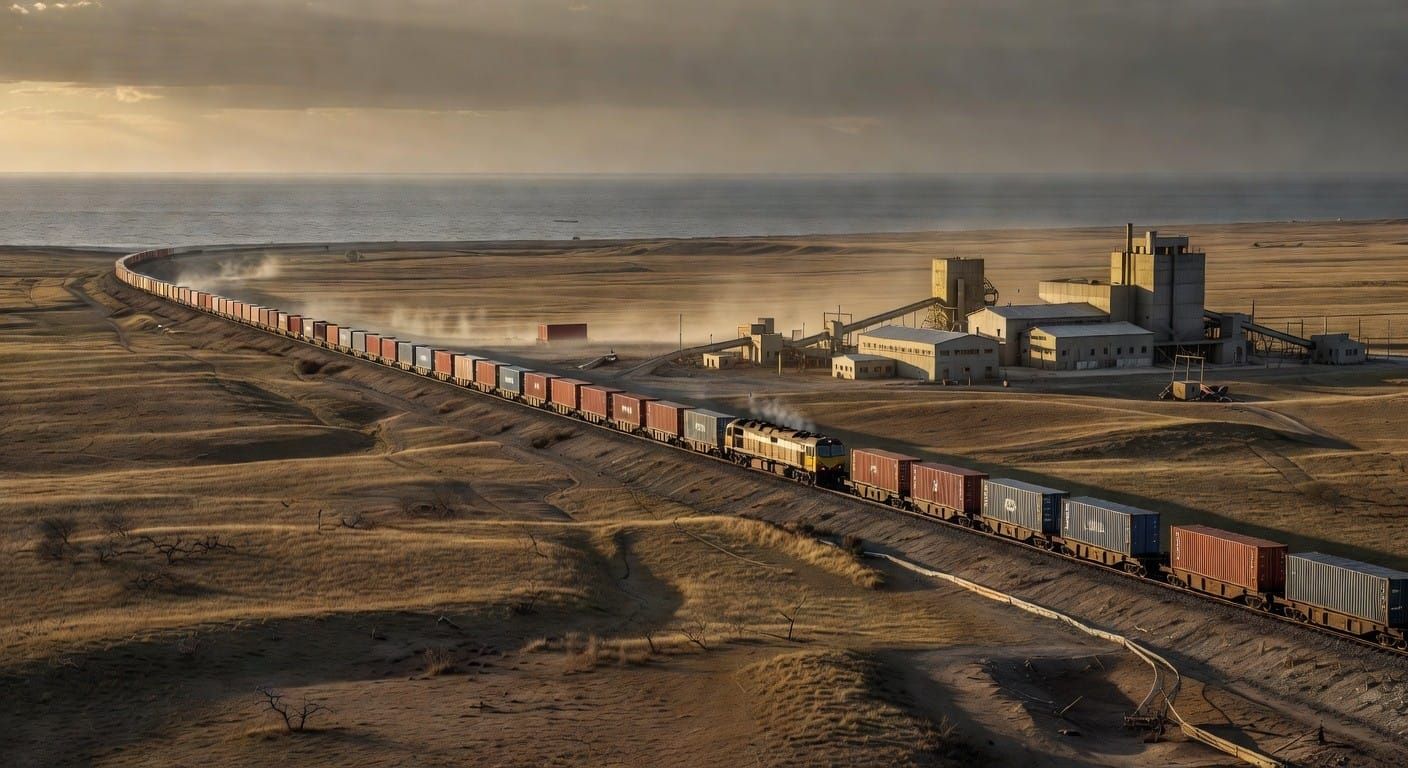
Kazakhstan is the world's most important country you've never thought about investing in.
Sitting at the geographic crossroads of Russia, China, and the broader Middle East, this Central Asian republic of 20 million people controls 40% of global uranium production — the single most critical fuel input for the nuclear renaissance now sweeping the planet. It sits atop newly discovered rare earth deposits rivaling those of any nation outside China. And as of this month, it is the anchor point for a $3.3 billion international infrastructure corridor that the World Bank, the European Union, and the United States are betting will reshape Eurasian trade for the next half-century.
The story isn't new. But the money is. And the geopolitical stakes have never been higher.
The Uranium Superpower
Kazakhstan's dominance in uranium is not a recent development — Kazatomprom, the state-owned nuclear fuel giant, has been the world's largest uranium producer for over a decade. But in 2026, that dominance has taken on an entirely different strategic significance.
Global uranium spot prices have surged above $87 per pound, with long-term contract prices hitting $91.50. Analysts at Sprott, William Blair, and S&P Global are calling it a structural bull market, driven by a supply deficit projected at 15 million pounds this year alone — roughly 8% of total global demand. The cumulative shortfall through 2045 could reach 3.1 billion pounds.
The demand side is relentless. There are 436 operable nuclear reactors worldwide, with 66 under construction — 32 of them in China alone. The AI data center buildout is accelerating power demand far beyond what renewables can deliver. COP30's goal of tripling nuclear capacity by 2050 has turned from aspiration to policy across dozens of nations.
Kazakhstan produces between 50 and 53 million pounds of uranium oxide (U3O8) annually — more than Canada, Australia, and Namibia combined. Kazatomprom's GDR trades at $83.80 on the London Stock Exchange, up from a 52-week low of $32.70. Cameco (NYSE: CCJ), the Western world's closest comparable, has surged 152% over the past year to $114 per share, with analysts setting price targets as high as $175.
The structural thesis is straightforward: the world needs dramatically more nuclear fuel, and Kazakhstan has more of it than anyone else.
The Middle Corridor: A New Silk Road That Actually Matters
For decades, Eurasian trade moved through one of two channels: northward via the Trans-Siberian Railway through Russia, or southward through the Suez Canal and Strait of Hormuz. Russia's invasion of Ukraine compromised the first. The ongoing conflict in the Persian Gulf and Hormuz tensions have periodically threatened the second.
Enter the Middle Corridor — officially the Trans-Caspian International Transport Route (TITR). The route runs from China through Kazakhstan, across the Caspian Sea to Azerbaijan and Georgia, through Turkey, and into Europe. It bypasses Russia entirely. It avoids the Middle East chokepoints. And as of April 2026, it is receiving the most significant infrastructure investment in its history.
On April 14-15, the World Bank and its partners committed $3.3 billion to close critical infrastructure gaps along the corridor. The breakdown: $1.9 billion for Turkey's Istanbul North Rail Crossing and $1.4 billion for the reconstruction of Kazakhstan's Karagandy-Zhezkazgan highway. This follows a February 2026 World Bank guarantee of $846 million mobilizing $1.41 billion for Kazakh rail connectivity.
Cargo volumes across the Caspian surged 63% year-on-year in 2024, reaching 4.1 million tons. The 2026 action plan approved by corridor nations targets 10 million tons annually, with digitalized customs and expanded container capacity.
For uranium specifically, the corridor has been transformative. Kazatomprom shipped its first batch to Canada via the Middle Corridor in late 2022, bypassing Russian ports hit by sanctions. Subsequent deliveries have reached Europe and North America through the same route. In a world where supply chain security is a matter of national defense, Kazakhstan now has the logistics to match its geological endowment.
This is where the analysis gets actionable. AlphaBriefing members get the full investment framework — scenarios, positioning, and the bottom line.
Subscribe to AlphaBriefing — Free, Member, and Paid tiers available.