The $15 Billion Quarter: Inside Vietnam's Manufacturing Explosion — and What It Means for Investors
Vietnam attracted $15.2 billion in FDI in a single quarter — a 43% surge that's reshaping global supply chains. Here's the investment case, the risks, and how to position.

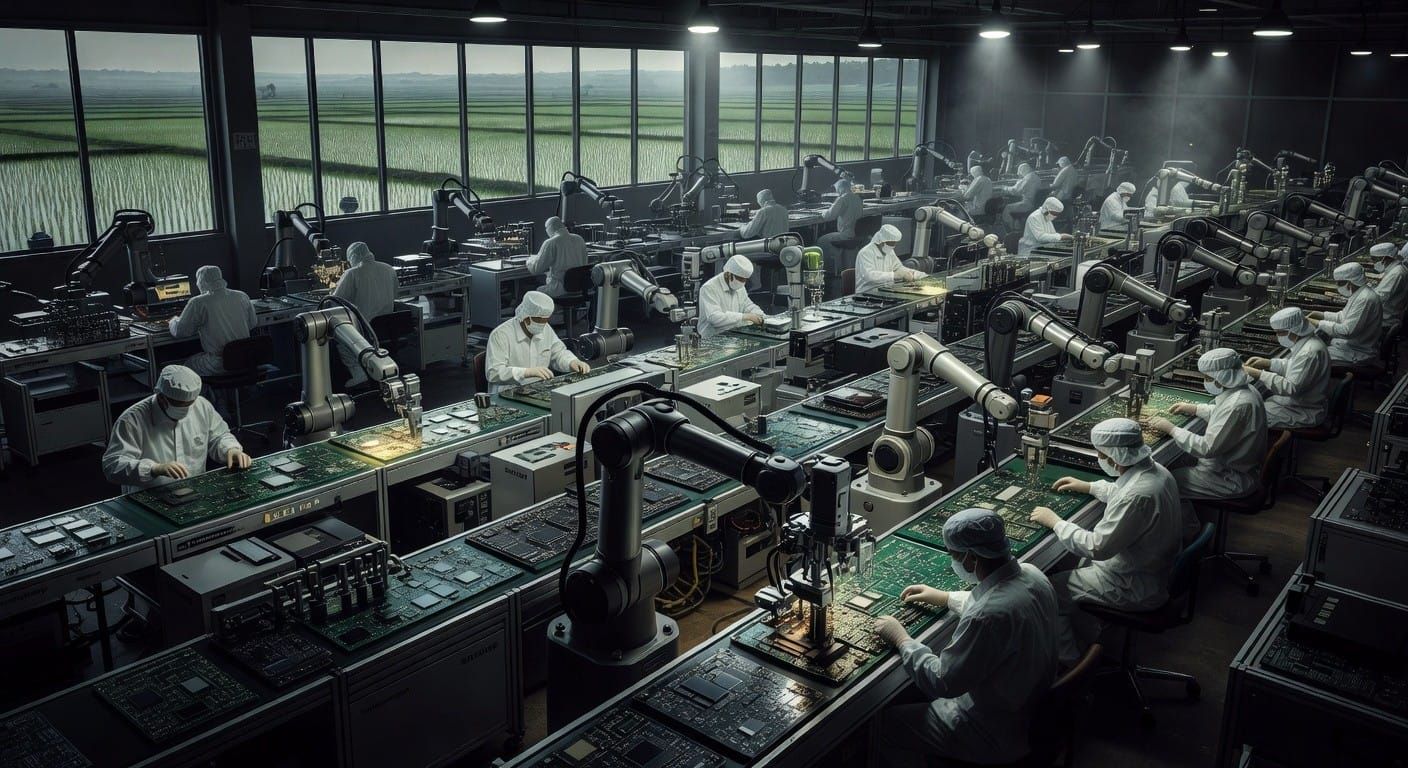
Vietnam is having a moment. In Q1 2026, the country pulled in $15.2 billion in registered foreign direct investment — a 42.9% year-on-year surge that catapulted it past every major competitor in Southeast Asia. GDP grew 7.8% in the same quarter, the strongest on record. Samsung, Foxconn, Intel, LG, Canon, and Panasonic are all expanding capacity. Electronics imports have spiked as global manufacturers ramp production lines from Bac Ninh to Hai Phong.
The narrative writes itself: Vietnam is the next China. The factory floor of the free world. The Great Decoupling's biggest winner.
But the smarter question — the one that separates informed investors from tourists — is whether Vietnam can absorb what's coming. Because $15 billion in a single quarter isn't just a vote of confidence. It's a stress test.
The $15 Billion Quarter
The numbers are staggering by any measure. Vietnam attracted more FDI in Q1 2026 than most mid-sized economies attract in a year. The Asia Manufacturing Index named it a leading FDI destination for 2026. Manufacturing and processing — overwhelmingly electronics — accounted for the bulk of inflows, continuing a trend that saw $27.62 billion in FDI disbursements across all of 2025, the highest of the 2021–2025 planning period.
This isn't new. Vietnam has been climbing the manufacturing ladder for a decade. What's new is the velocity. The combination of US-China tariff escalation, Hormuz-driven supply chain anxiety, and the AI hardware boom has turned Vietnam from a promising alternative into an urgent necessity. Companies aren't choosing Vietnam because it's cheap anymore. They're choosing it because they don't have a choice.
Samsung alone operates a constellation of facilities across Thai Nguyen and Bac Ninh that produce roughly half the world's Samsung smartphones. Foxconn — Apple's primary manufacturing partner — has been expanding aggressively since 2023. Intel maintains its largest global assembly and test facility in Ho Chi Minh City. And now, with $11.6 billion in semiconductor FDI committed in late 2025, Vietnam is moving up the value chain from assembly to fabrication.
Why Vietnam, Why Now
Three structural forces are converging.
The China exit accelerates. Tariffs, sanctions risk, and the geopolitical imperative to diversify away from Chinese manufacturing have shifted from boardroom conversation to C-suite mandate. The companies that waited are now scrambling. Vietnam — with its political stability, young workforce, coastal geography, and existing supplier ecosystems — is the path of least resistance.
The AI hardware boom demands capacity. The explosion in demand for semiconductors, advanced packaging, and electronic components has every major chipmaker and OEM hunting for production floor space. Vietnam's $11.6 billion semiconductor FDI wave isn't a coincidence — it's a direct consequence of the AI capex cycle overwhelming existing capacity in Taiwan, South Korea, and even Malaysia.
The Hormuz crisis resharpened supply chain thinking. The ongoing disruption in the Strait of Hormuz has reminded every CFO on earth that concentrated supply chains are existential risks. Vietnam's position on the South China Sea — while not without its own risks — offers a Pacific-facing alternative that bypasses the Middle Eastern chokepoints entirely.
The Investment Landscape
Vietnam's story isn't just about factories. It's increasingly about capital markets.
The VN-Index, Vietnam's benchmark stock index, has been one of Asia's best performers in early 2026, buoyed by FDI inflows and domestic consumption growth. But for most international investors, direct access remains challenging — Vietnam's market is still classified as a frontier market by MSCI, though an upgrade to emerging market status has been rumored for years and may finally materialize in the 2026–2027 cycle.
ETF access: The VanEck Vietnam ETF ($VNM) remains the most liquid US-listed vehicle for Vietnam exposure. It trades on NYSE Arca and holds a concentrated portfolio of Vietnamese equities weighted toward financials, real estate, and industrials. For broader Southeast Asia exposure that captures Vietnam's rise, the iShares MSCI Frontier and Select EM ETF ($FM) and the VanEck Vietnam ETF both offer entry points.
Proxy plays: Many investors are gaining Vietnam exposure through the multinationals building there. Samsung Electronics ($005930.KS), Foxconn/Hon Hai ($2317.TW), and Intel ($INTC) all have massive and growing Vietnamese operations. Amkor Technology ($AMKR) — a major semiconductor packaging firm — has significant Vietnam capacity. These aren't pure plays, but they capture the upside without frontier market risk.
Real estate and industrial: Vietnamese industrial real estate is booming. Occupancy rates in key industrial parks exceed 90%. Companies like Becamex IDC and Vingroup's industrial arm are expanding capacity, though most remain accessible only through Vietnamese brokerages.
This is where the analysis gets actionable. AlphaBriefing members get the full investment framework — scenarios, positioning, and the bottom line.
Subscribe to AlphaBriefing — Free, Member, and Paid tiers available.