Renault's Next Model Is a Weapon
Europe's rearmament just hit its real constraint — factory capacity — and the fix is conscripting the dying car industry. Renault will build combat drones at Le Mans, VW may build Iron Dome parts at a plant slated for closure. The conversion trade, mapped.

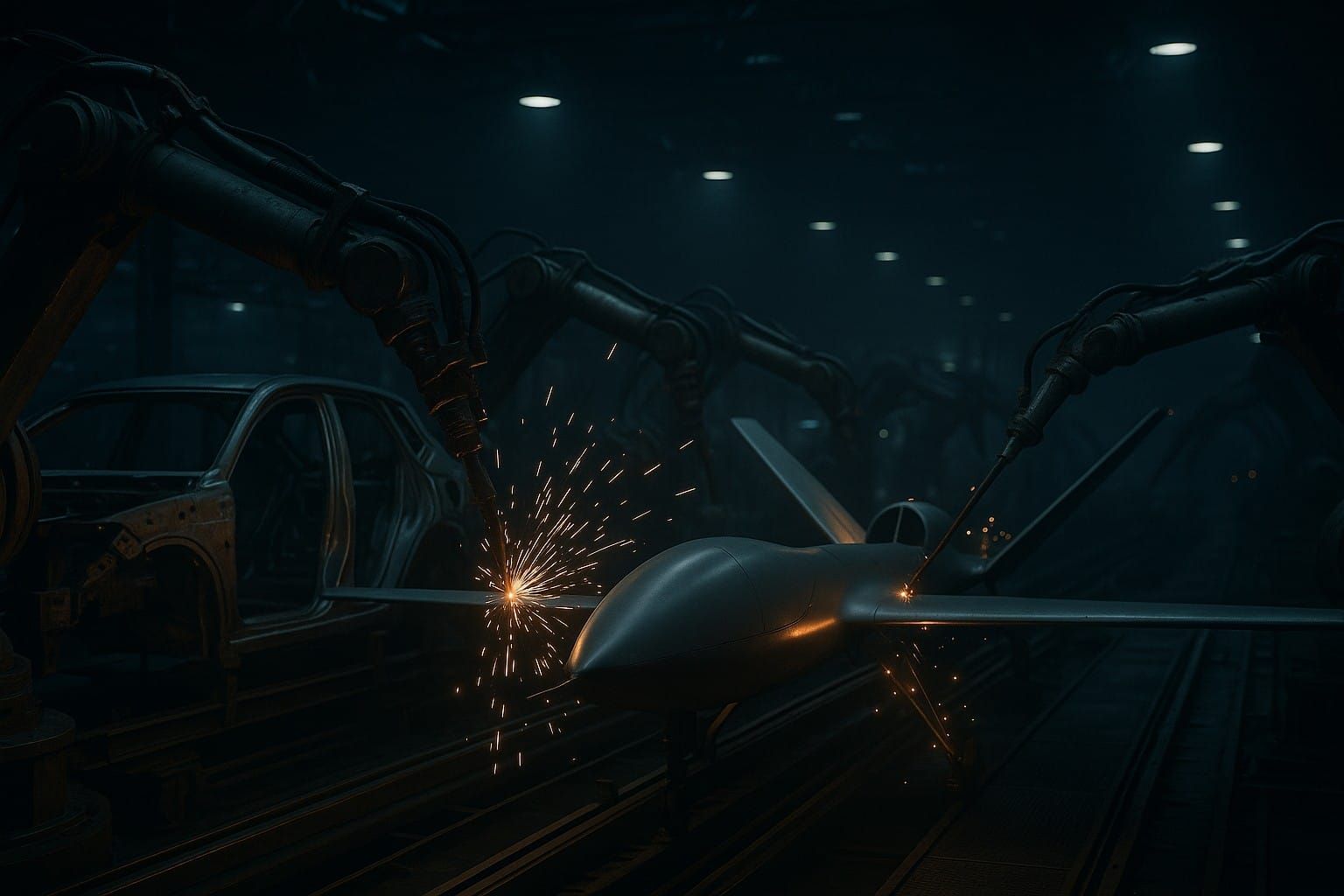
Sometime in early 2027, a new model will start rolling off an assembly line in Le Mans that has spent its working life producing chassis frames for Renault. It has a range of 3,000 kilometers, carries a 500-kilogram payload, and is designed to fly reconnaissance or strike missions. It is a combat drone called Chorus, it costs about €120,000 a unit, and at full rate the line is built to turn out up to 600 of them a month.
Renault — a carmaker that has never built a weapon in its modern history — designed it with the French defense contractor Turgis Gaillard under a 10-year state contract worth roughly €1 billion. The engines will come from Renault's powertrain plant at Cléon, near Rouen, where headcount has been stagnant at about 3,000 for years. The assembly happens in a factory that exists because of the French auto industry's past, and is being kept alive by the French state's fear about Europe's future.
This is not an industrial curiosity. It is the clearest signal yet of where Europe's rearmament has actually arrived: the money is no longer the constraint. The factories are.
The capacity wall
Global military spending hit $2.9 trillion in 2025, and Europe's share of that grew 14 percent in a single year — the fastest sustained buildup since the Cold War. The spending commitments made in 2025 and 2026 are locked in, the order books at the established primes are full, and that is precisely the problem. Rheinmetall, Thales, KNDS, and their peers are quoting delivery dates years out. A continent that decided to rearm in a hurry discovered that you cannot surge production through supply chains built for peacetime replacement rates.
Meanwhile the war that is driving the demand has rewritten what the demand is. Ukraine consumes drones the way twentieth-century armies consumed artillery shells — as ammunition, expendable, by the tens of thousands per month. On July 15, Ursula von der Leyen and Volodymyr Zelensky signed the EU's first bloc-wide defense-industrial agreement with Kyiv: a "Drone Deal" that pairs nine EU companies with nine Ukrainian manufacturers, backed by a fresh €1 billion disbursement from the €90 billion Ukraine Support Loan, with joint production inside EU factories targeted before the end of 2026. The explicit goal is to move wartime drone manufacturing — the highest-iteration-speed weapons production on Earth — into European industrial capacity.
Which raises the obvious question: what capacity? Europe's defense plants are full. But Europe has an entire industrial sector sitting on idle floor space, trained workforces, and dying order books.
The donor industry
Europe's automakers are living through a triple shock: Chinese EV competition eating their export markets, US tariffs suppressing demand, and structurally expensive energy. Stellantis projects European production will shrink by 800,000 vehicles by 2030. Plants built for a 15-million-unit continent are running for a market that no longer exists.
The conversions have already started, quietly, plant by plant:
- Renault — combat drone engines at Cléon, final assembly at Le Mans, first deliveries in early 2027.
- Volkswagen — in talks with Israel's Rafael to build components for the Iron Dome air-defense system at Osnabrück, a 2,300-worker plant that was scheduled to shut down in 2027 when its convertible line ends. Rheinmetall's CEO had already publicly tagged the same site as suitable for armored-vehicle production — if Berlin guarantees roughly 1,000 vehicles of orders over ten years.
- VDL Groep — the Dutch contract manufacturer that lost its BMW production deal in 2024 and laid off 2,000 people has reopened its Limburg plant under a Dutch military contract.
- Mercedes-Benz — CEO Ola Källenius has said publicly the company would consider supporting European defense production.
Notice the pattern. None of these are the defense primes expanding. They are defense demand flowing into distressed automotive assets — because a drone that costs €120,000 and gets expended like a munition is not an aerospace product. It is an automotive product. High-rate assembly, cost discipline, supplier-network management, and design-for-manufacturing are exactly the competencies car companies have and defense primes, structurally, do not. The Pentagon reached the same conclusion from the other direction when it reclassified small drones as ammunition. Europe is now reaching it with factories.
The market has not repriced any of this. Defense investors are still crowded into the same handful of primes at record multiples, while the companies actually inheriting the production role trade as terminal-decline auto stocks. That gap — between where the narrative sits and where the work is going — is the trade.
The rest of this briefing is for paid members: the specific listed names on both sides of the conversion trade and how the exposure actually splits, the contract math on Renault's drone line and why the €1 billion headline understates it, the two-sided skeptic case most coverage skips, and the catalyst calendar through mid-2027.
AlphaBriefing Paid gets you every investment thesis, scenario framework, and catalyst brief we publish — the analysis private intel clients pay four figures for, at a fraction of that.