Not Your Keys, Not Your Coins. Now the Keys Are the Problem.
The first mass remote theft from air-gapped hardware wallets has drained $130 million from bitcoin's safest vaults — and the biggest winner is the Wall Street custody complex self-custody was invented to escape.

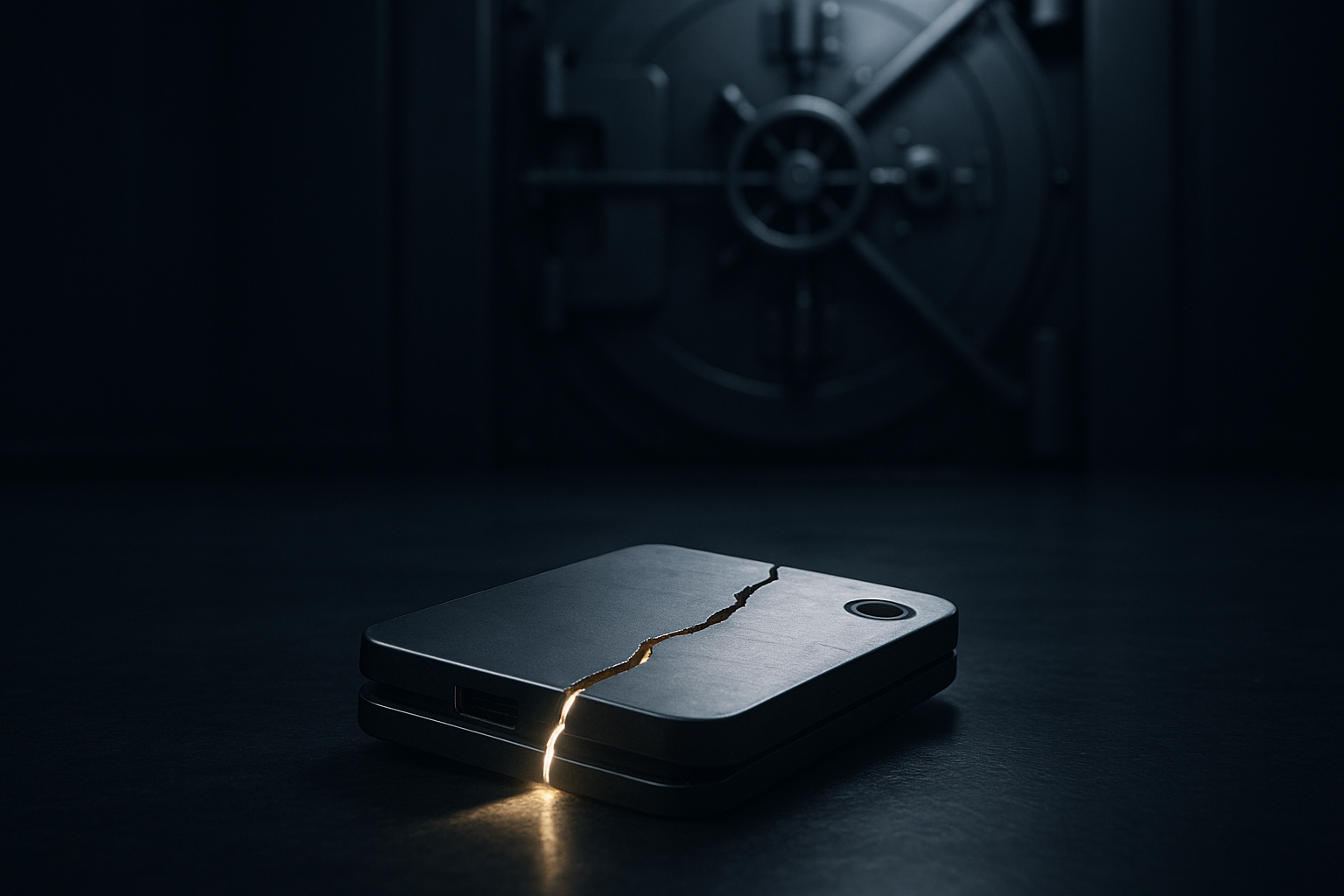
On the morning of July 30, someone began emptying the safest place in bitcoin.
Not an exchange. Not a DeFi bridge. Not a phished retiree clicking a bad link. The coins came out of Coldcard hardware wallets — the air-gapped, tamper-sealed signing devices that security maximalists have spent a decade telling everyone to buy. In the first wave alone, roughly 594 BTC — about $38 million — drained from some 500 wallets in 25 minutes, according to blockchain intelligence firm TRM Labs. The attackers never touched a single device. They never needed to.
By this week, on-chain trackers counted at least four distinct waves of theft, more than 5,200 addresses drained, and losses of $116–130 million — a range Elliptic co-founder Tom Robinson called "roughly correct." Galaxy Research puts the haul near 2,055 BTC. At least 15 separate attackers are now racing each other to sweep whatever vulnerable wallets remain. It is already the third-largest crypto theft of 2026 — in a year that had logged over $1.2 billion in losses across 276 incidents before this one.
The Bug That Waited Five Years
The vulnerability is almost insultingly mundane. A build configuration error in firmware version 4.0.1, shipped by Coldcard maker Coinkite in March 2021, caused some devices to generate seed phrases using a weak software random-number generator instead of the device's hardware entropy source. Effective key strength collapsed from a designed 128 bits to as little as 40 bits — a keyspace small enough to brute-force with rented compute, no physical access required.
Security researchers at Block found the flaw; the public advisory landed August 1. And here is the detail that turns an incident into a structural problem: patching the firmware fixes nothing for existing wallets. Any seed generated on affected firmware is permanently guessable. The only remediation is to generate a fresh seed on patched hardware and move every coin — which means hundreds of thousands of self-custodied bitcoin holders must now perform the single riskiest operation in self-custody, under time pressure, while more than a dozen attackers brute-force their way down the same list.
Why This Hack Is Different From Every Hack Before It
Crypto has absorbed bigger thefts. Mt. Gox, Bybit, Ronin — each was larger in dollar terms. But every major theft until now shared one property: it hit a custodian. An exchange, a bridge, a lending desk. And every one of them ended with the same sermon: not your keys, not your coins. Get your bitcoin off exchanges. Put it on a hardware wallet. Trust no one.
The Coldcard exploit inverts the sermon. This time the coins that were taken were precisely the coins held the "right" way — offline, air-gapped, self-sovereign. The people who lost money were the ones who did everything the culture told them to do. One victim interviewed by TechCrunch lost $1.6 million from a device he believed was the gold standard of cold storage.
Bitcoin's price barely moved — it sits near $64,500, and the market has treated the exploit as a rounding error. That indifference is itself the signal. The coins that were stolen belonged to individuals. The marginal price-setters in bitcoin today — ETFs, corporates, funds — don't hold their keys on consumer devices. They hold them with a very short list of regulated custodians. The market shrugged because the market has already migrated.
Which raises the question self-custody advocates least want asked: if the vault in your desk drawer can be cracked from the other side of the planet by a bug that sat undetected for five years — who actually wins?
The rest of this briefing is for paid members: the custody consolidation trade and the three firms positioned to absorb the migration, the 80.8% concentration figure that is bitcoin's real single point of failure, what the hardware wallet industry's trust collapse means for Coinbase's fee stream, and the on-chain signal to watch over the next 90 days.
AlphaBriefing Paid gets you every investment thesis, scenario framework, and catalyst brief we publish — the analysis private intel clients pay four figures for, at a fraction of that.