The Packaging Bottleneck: Inside Malaysia's $48 Billion Bid to Become the AI Supply Chain's Most Critical Link
Malaysia controls 13% of global chip packaging capacity. With $48 billion in active projects and Intel's advanced packaging complex going live this year, the country is solving the AI supply chain's most underappreciated bottleneck — and the market hasn't priced it in.

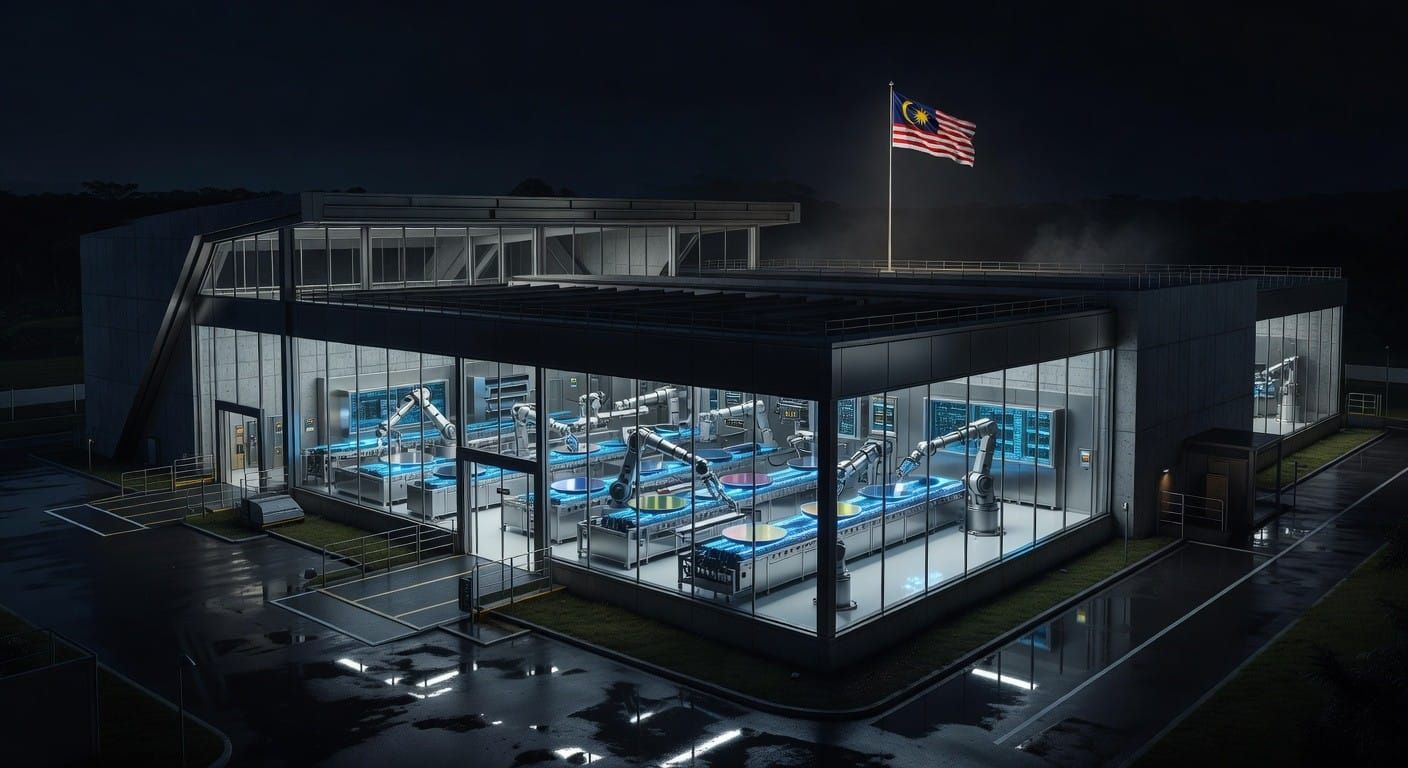
As SEMICON Southeast Asia 2026 opens its doors in Kuala Lumpur today, the global semiconductor industry is staring at a map — and one country keeps getting circled in red.
Malaysia now controls roughly 13% of the world's semiconductor assembly, testing, and packaging (ATP) capacity. It's the sixth-largest chip exporter on the planet. And with over $48 billion in active investment projects concentrated in Penang alone, the country is executing one of the most ambitious industrial upgrades in emerging-market history.
This isn't the Malaysia of cheap labor and back-end assembly lines. This is a country positioning itself as the indispensable middle layer of the AI supply chain — the place where advanced chips get packaged, tested, and prepared for deployment in everything from data centers to autonomous weapons.
For investors, the implications are enormous. And the window to position is narrowing.
The Penang Transformation
Penang — long known as Malaysia's "Silicon Valley" — has undergone a radical metamorphosis. What was once a hub for low-margin chip assembly is now ground zero for one of the most capital-intensive industrial buildouts in Southeast Asia.
The centerpiece: Intel's Project Pelican, a RM12 billion (~$2.9 billion) advanced packaging complex that is 99% complete and scheduled to begin first-phase operations in the second half of 2026. The facility will handle assembly, testing, die sort, and — critically — Intel's most advanced packaging technologies, including EMIB (Embedded Multi-Die Interconnect Bridge) and Foveros 3D stacking.
This is not commodity work. EMIB and Foveros are the technologies that allow chipmakers to combine multiple specialized dies into a single package — the architectural approach that powers AI accelerators, high-performance computing chips, and next-generation processors. Intel's decision to locate this capability in Malaysia, rather than Ireland or the United States, tells you everything about where the value chain is shifting.
And Intel isn't alone. Across 33 active semiconductor projects nationally — valued at approximately $20 billion — Malaysia is pulling in investment from across the chip ecosystem. Inari Amertron and Unisem, the country's largest homegrown OSAT (outsourced semiconductor assembly and test) firms, are expanding capacity specifically for AI and data center demand. TECO Group just broke ground on a RM46 million smart manufacturing plant in Penang. Arm Holdings signed a $250 million, 10-year deal to boost chip design capabilities in-country.
The numbers tell a story of acceleration. In 2025, Malaysia's electrical and electronics sector — dominated by semiconductors — secured RM28.5 billion (~$6.5 billion) in approved investments. Budget 2026 added another RM2 billion in targeted financing, including RM550 million through sovereign funds Khazanah and KWAP for ecosystem partnerships, and RM500 million in R&D loans.
Why Malaysia, Why Now
Three structural forces are converging to make Malaysia's semiconductor play both timely and strategic.
First: the AI packaging bottleneck. The global semiconductor industry is forecast to grow 25-26% in 2026, driven almost entirely by AI demand. But the constraint isn't fab capacity — it's packaging. Advanced packaging is where individual chiplets get assembled into the complex multi-die modules that power AI training and inference. Taiwan's TSMC dominates front-end fabrication, but the back-end — testing, assembly, packaging — is where Malaysia has built a 50-year head start.
Second: supply chain diversification is no longer optional. The US-China chip war has made geographic concentration a strategic vulnerability. With TSMC handling over 60% of global chip fabrication in Taiwan — an island that sits in one of the world's most dangerous geopolitical flashpoints — every major chipmaker is scrambling to diversify. Malaysia offers political stability, established infrastructure, English-speaking engineers, and decades of institutional knowledge in semiconductor operations.
Third: the "China Plus One" strategy has matured. What started as a trickle of manufacturers hedging against China exposure has become a flood. Malaysia's pitch isn't just cost — it's capability. The country is moving decisively from assembly-line economics to design-and-integration economics, backed by government programs like the New Industrial Master Plan (NIMP) 2030 and new institutions like the KESUMA Semiconductor Academy.
This is where the analysis gets actionable. AlphaBriefing members get the full investment framework — scenarios, positioning, and the bottom line.
Subscribe to AlphaBriefing — Free, Member, and Paid tiers available.