Japan Finally Got the Inflation It Wanted. Now Comes the Bill.
After nearly 14 years, the Bank of Japan says its 2% inflation target is reached. With the 10-year JGB at 1996 levels, the yen at 157, and a December hike on the table, the world's cheapest money is going away.

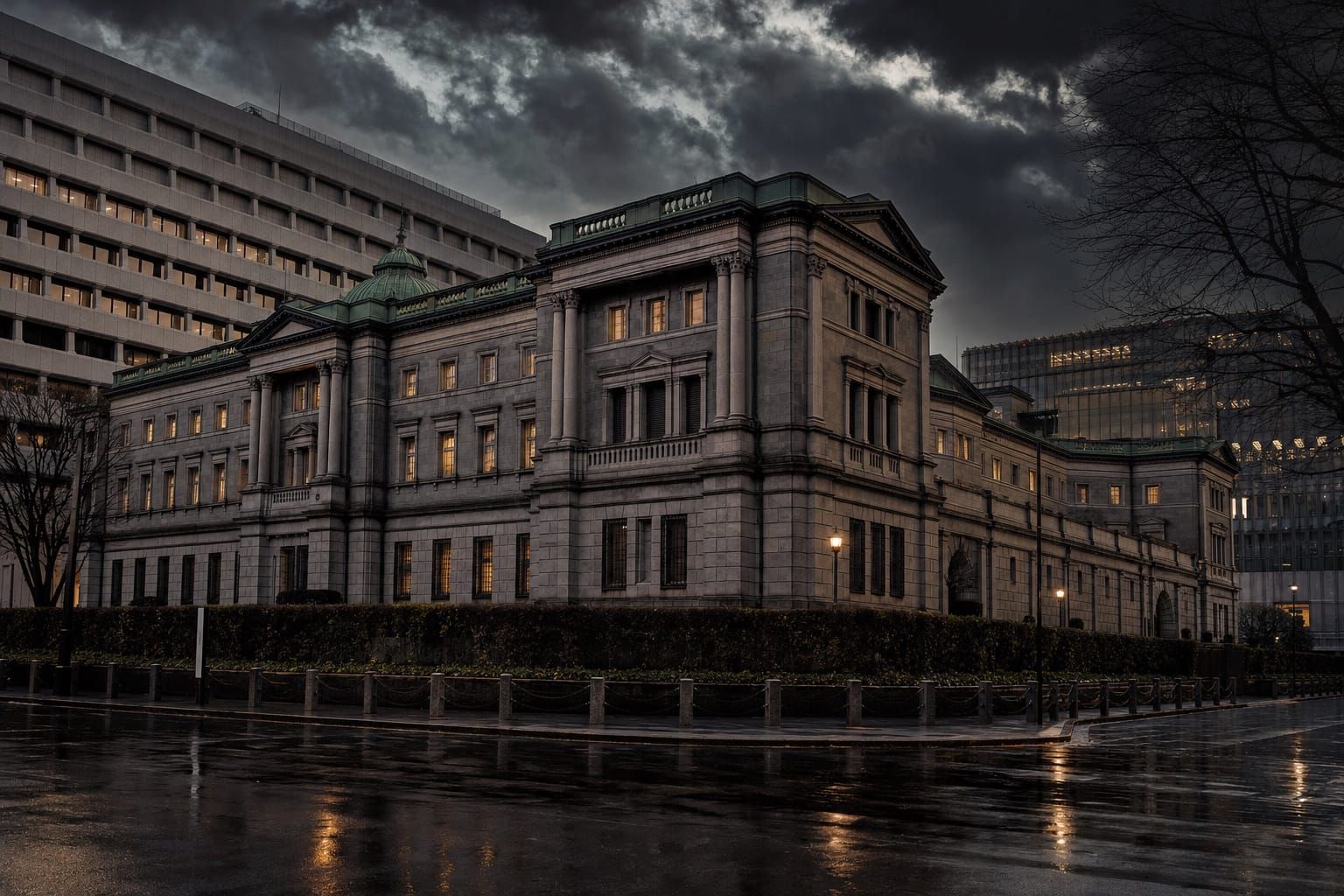
On Friday in Tokyo, the Bank of Japan changed almost nothing and announced almost everything. It held its policy rate at 1.25% — already the highest in 31 years — and then said the thing it has not been able to say since January 2013: underlying inflation has reached the 2% target.
Nearly fourteen years — spanning negative rates, yield-curve control, and the largest monetary experiment in modern history — and the declaration of victory arrived in the dry language of a quarterly outlook report. The central bank now judges that long-term inflation expectations are "moving around 2%," and it raised its core inflation forecast for the fiscal year ending March 2028 to 2.6%, from 2.4% three months ago.
Governor Kazuo Ueda was explicit about what comes next: "It's important to anchor underlying inflation around our target. That doesn't mean we will just sit and wait. We will adjust monetary policy as appropriate so that underlying inflation becomes anchored around 2%."
Translation: the hiking cycle is not done. The vote to hold was 8–1, and the dissenter, Hajime Takata, wanted to go to 1.5% immediately. Ueda said the board will debate rates at every meeting — including December. Most analysts polled by Reuters now expect that December meeting to deliver the next hike, to 1.5%. The BOJ has already hiked twice this year, in June and September — a faster cadence than the roughly twice-a-year pace of 2024 and 2025.
The bond market got there first
The irony of Friday's declaration is that the Japanese government bond market called the end of the deflation era weeks ago.
The 10-year JGB yield closed above 3% on October 1 — its highest level since August 1996, back when the Ministry of Finance's data still shared a decade with the bubble economy's aftermath. It has since eased to around 2.88%. The 30-year yield hit a record 4.13% in late September and still trades near 3.94%. Even the 2-year — the maturity most sensitive to BOJ policy — sits at 1.92%, a level unthinkable three years ago.
Remember what this curve looked like. From September 2016 to March 2024, the BOJ pinned the 10-year yield near zero by decree, buying whatever volume of bonds it took. That policy is two and a half years dead, and the repricing since has been relentless: the 10-year has added roughly 36 basis points in the past six months alone.
Briefings like this are free to read with a free AlphaBriefing membership. Join free →
The quiet bombshell: Tokyo starts selling stocks faster
Buried in Friday's statement was a decision that got less attention than the rate hold but says more about where this is going. Starting in January, the BOJ will accelerate sales of its exchange-traded fund holdings to about ¥860 billion per year at book value (roughly $5.5 billion) — 2.6 times the current ¥330 billion pace.
The BOJ is the only major central bank that bought its own stock market in size, and its ETF portfolio — widely reported at roughly ¥37 trillion at book value when sales began — is the last great artifact of the Kuroda era. Even at the new pace, clearing it would take around four decades. But the direction now runs one way: the bank that spent a decade buying everything is now a seller of both bonds and equities.
The Nikkei 225, which had closed Thursday at 64,659, finished Friday at 63,290 — down 2.1% on the day the sales acceleration landed.
The yen is the tell
Here is the uncomfortable part of the victory lap: the yen traded near 157.5 per dollar on Friday — close to its weakest levels in decades — despite Japanese rates at 31-year highs. A weak yen keeps importing inflation, which is part of why the BOJ's "underlying" inflation finally caught up to target. The central bank is, in a sense, declaring victory over a fire the exchange rate keeps feeding.
Meanwhile, two days earlier in Washington, the Federal Reserve held its target range at 3.75%–4.00% — with two dissenters who wanted a hike. Every dissent cast at the BOJ and the Fed this week pointed the same direction: up. The gap between the world's biggest funding currency and the dollar is about 2.6 percentage points, and for the first time in a generation, it is set to close from the Japanese side.
That gap financed trillions in global positions. The question that matters for your portfolio is not whether the BOJ hikes in December — it is what happens to everything priced off cheap yen when the cheapest money in the world stops being cheap.
A free membership gets you access to every free article at AlphaBriefing.com: Join AlphaBriefing
The rest of this briefing is free — it just requires a free AlphaBriefing account: the carry-trade math as the rate gap closes from both ends, why Japan's megabank stocks fell in the very month the rate story improved, and the three levels to watch into the December meeting.
Create your free account → — 30 seconds, no card.