America Can't Forge Its Own Artillery Shells
A $469 million plant was supposed to deliver two-thirds of US 155mm shell capacity. As of March, it has produced zero compliant rounds. The Pentagon's own watchdog explains why — and which defense primes carry the risk.

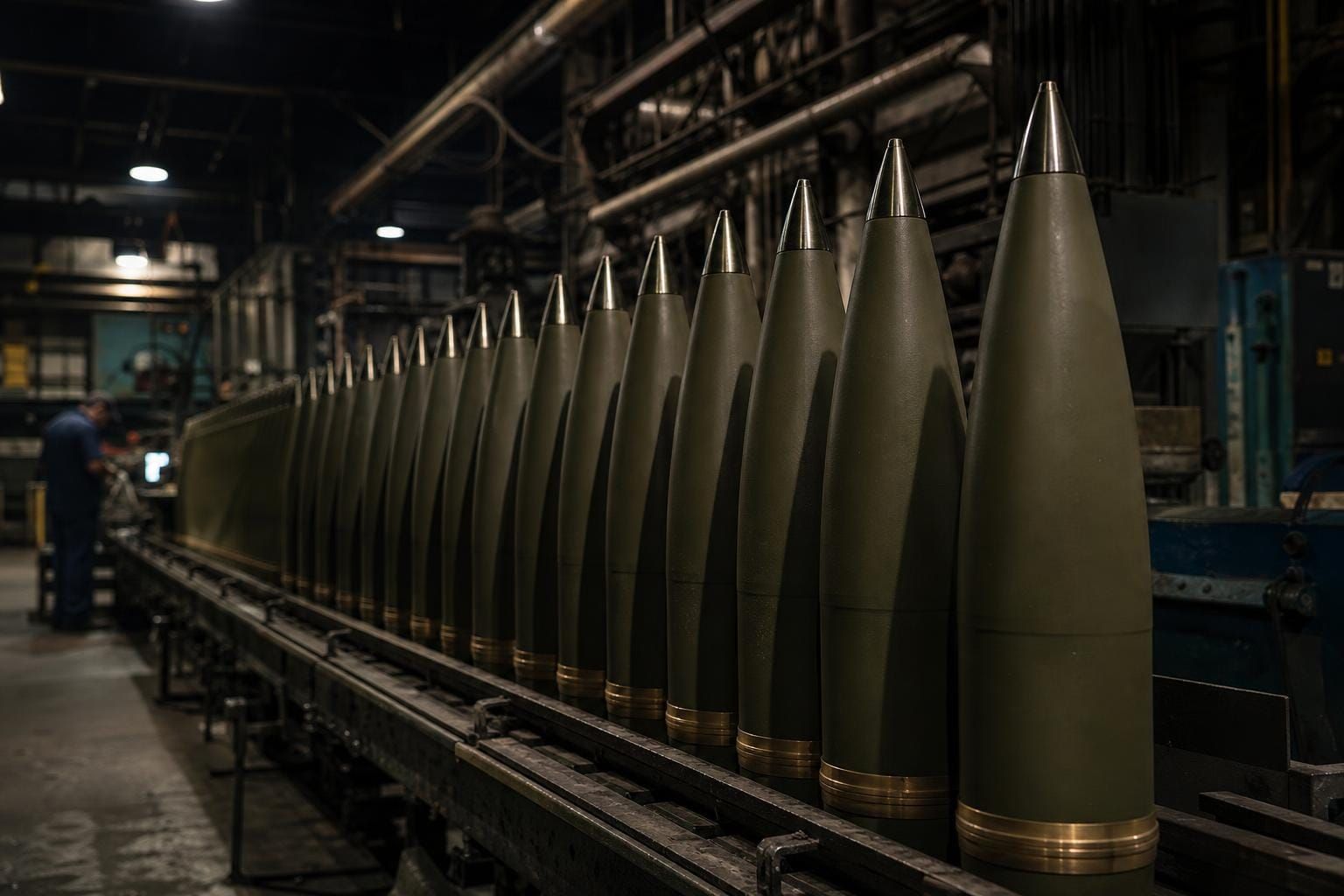
America invested $469 million in a brand-new ammunition plant in Mesquite, Texas, and set a target of 100,000 155-mm artillery shells per month by October 2025. As of March 2026, the Army was producing roughly 36,000 rounds per month across its entire network. That is 36% of a goal the Pentagon set itself three years ago, in the middle of the largest conventional-munitions war in Europe since 1945.
The number comes from the Department of Defense Inspector General's July 2026 report on the Army's ability to meet its own 155-mm shell targets. The headline finding is the production gap. The buried finding — the one with capital-markets consequences — is why.
The constraint is not energetics, not propellant, not fuzes. It is empty metal.
A 155-mm artillery shell is built in two stages. First, a projectile metal part — the forged steel body — is produced at a metal parts factory. Then that body is shipped to a Load, Assemble, and Pack facility where it is filled with explosives, fused, and crated. The second step has the glamour, the explosive fillers, the hazard pay. The first step is a forge. And the forge is where the Pentagon's plan ran into physics.
The IG was blunt: "projectile metal part production is the limiting factor for reaching the 100,000 round-per-month goal." Translated: America can fill all the shells it can forge. It cannot forge the shells.
The $469 Million Plant That Hasn't Shipped a Compliant Shell
The specific plant choking the pipeline is the Universal Artillery Projectile Lines facility in Mesquite, Texas — a 2024-opened, contractor-owned, contractor-operated site operated by General Dynamics Ordnance and Tactical Systems, a division of General Dynamics ($GD, which closed Friday at $372.59, roughly 7% below its 52-week high). The Army announced the plant in 2024 as the showpiece of its modernization push: "modern manufacturing practices, high levels of automation, and digital data capture ability" for forging large numbers of large-caliber shell bodies.
The IG's finding on Mesquite is the kind of sentence that doesn't normally appear in a Pentagon procurement document: "the contractor has been unable to produce any projectile metal parts that meet contract specifications."
Not fewer than planned. Not behind schedule. Zero compliant projectiles out of a plant that was supposed to be the single largest increment of US shell capacity since the Reagan buildup.
The root cause the IG identified is almost comically avoidable. The Army's Capability Program Executive Ammunition & Energetics (CPE A&E) accepted a contractor plan to buy and adapt production equipment originally built to make the M107 — the older, 1958-era design — and retrofit it to produce the newer M795. Different steel chemistry, different wall thickness, different internal cavity, different acceptance specifications. The adapted equipment has not, so far, produced a round the Army will accept.
The second ammunition plant — the government-owned, contractor-operated Scranton Army Ammunition Plant in Pennsylvania — has its own problems. The IG flagged "ongoing problems with the contractor in terms of responsiveness, equipment maintenance, and timeliness." Scranton is where most US 155-mm bodies have historically been forged, and its contractor is now running flat out while a Mesquite plant that was supposed to double national capacity sits unable to pass acceptance tests.
Briefings like this are free to read with a free AlphaBriefing membership. Join free →
Why This Is a Markets Story, Not a Defense Story
Artillery shell production reads like a Pentagon procurement issue — a line item buried in the FY2026 Department of the Army Procurement budget. It is not. It is the most direct test of the thesis that drove defense multiples higher through 2024 and 2025: that the US industrial base can convert dollars into deliverable munitions at scale, on a timeline that matters to the shooting wars it is being asked to supply.
That thesis is not holding up where the IG is looking. The Pentagon put money on the table — the Army's munitions modernization program has moved more than $18 billion into expanded capacity since 2022, according to Army budget documents. The capacity, so far, has not showed up. In the specific case of Mesquite, the capacity has delivered zero compliant units against a target that was supposed to be two-thirds of total national output.
A free membership gets you access to every free article at AlphaBriefing.com: Join AlphaBriefing
The rest of this briefing is for paid members: the specific contractor exposures across General Dynamics, Northrop Grumman, BAE, and the next-tier primes; the European shell-production baseline that is now outpacing the US; the three catalysts to watch between now and the FY2027 budget markup; and the bottom-line positioning framework for defense munitions names into 2027.
AlphaBriefing Paid gets you every investment thesis, scenario framework, and catalyst brief we publish — the analysis private intel clients pay four figures for, at a fraction of that.