Washington Started Paying for Weight-Loss Drugs. Your Boss Started Canceling the Coverage.
On July 1, Medicare began covering Wegovy and Zepbound for a $50 copay. The same autumn, large employers cut GLP-1 coverage for the first time in three years. The same drug now costs $50 or $300 depending on which card you carry.

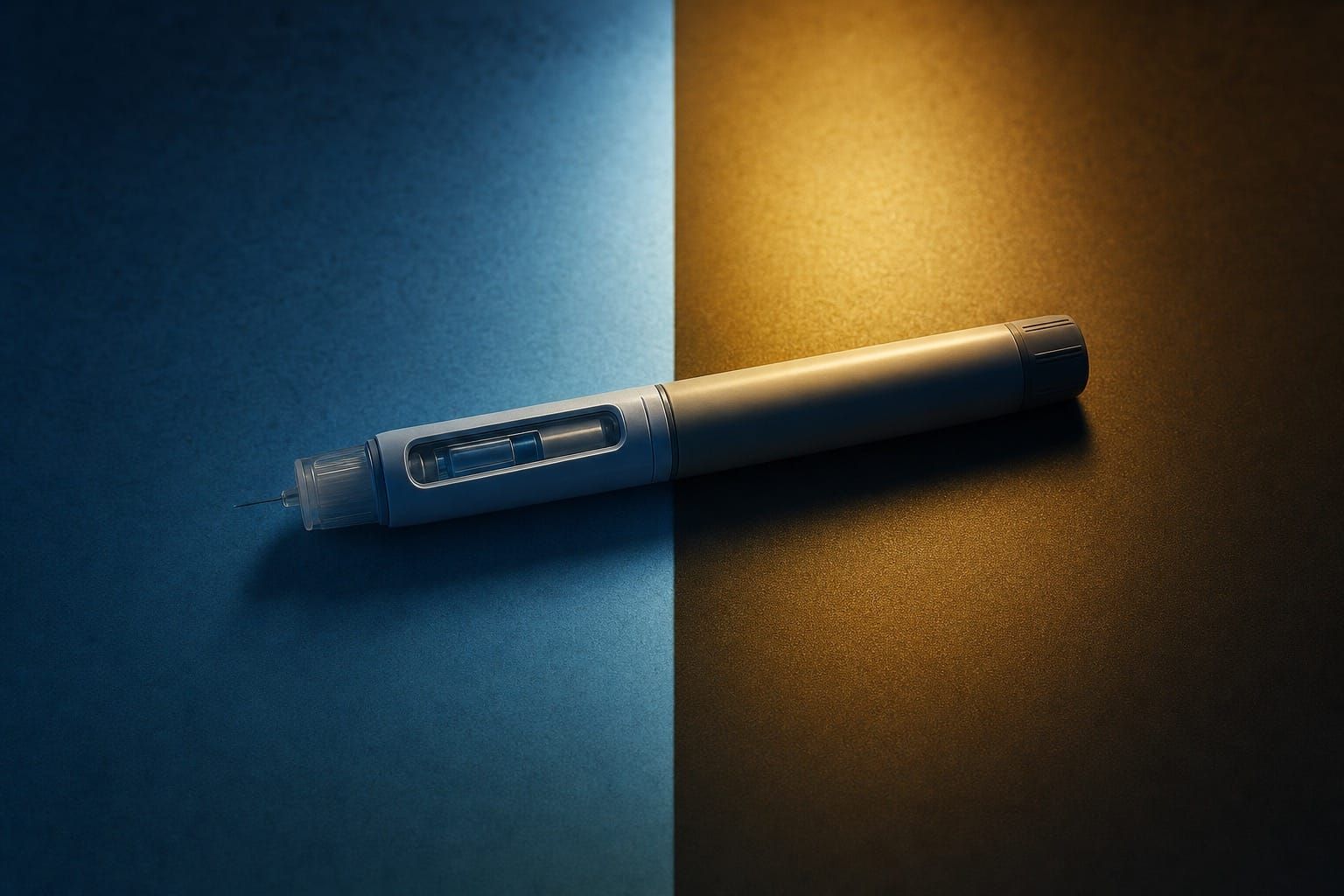
On July 1, 2026, the United States government started paying for weight-loss drugs for the first time in Medicare's history. Eligible seniors can now fill a prescription for Wegovy or Zepbound for a $50 monthly copay, with the Treasury covering the roughly $200 balance.
That same autumn, the companies that insure most working-age Americans — their employers — started doing the opposite. For the first time in three years, the share of large employers covering these drugs for weight loss fell. The ones still covering them are quietly looking for the exit.
Two halves of the same healthcare system, moving in opposite directions, on the single most consequential class of drugs in a generation. Washington is leaning in at the exact moment the private market leans out. Understanding why that split is happening — and who gets caught in the gap — is one of the more important things an American can know about their own money right now.
Here is what is actually happening.
Washington discovered the drugs work. So did the budget office.
The GLP-1 class — Novo Nordisk's Wegovy, Eli Lilly's Zepbound and Mounjaro, and the newer oral entrants — did something no previous obesity treatment managed: it produced large, durable weight loss in ordinary patients, and then kept producing cardiovascular and metabolic benefits on top. Roughly one in five American adults has now tried a GLP-1 at some point, and about one in eight is currently taking one, according to KFF's most recent health tracking poll. That is not a niche. That is a mass-market drug category forming in real time.
The federal government's relationship to these drugs changed in 2026. Medicare is legally barred from covering drugs used purely for "weight loss," a restriction written into law decades ago when weight loss meant diet pills. But as the cardiovascular evidence piled up, the Centers for Medicare & Medicaid Services built a workaround: the Medicare GLP-1 Bridge, a demonstration program running from July 1, 2026 through December 31, 2027.
Under the Bridge, select Part D enrollees can get Wegovy (injection and tablets), Zepbound, or the newer Foundayo for a $50 monthly copay when used to reduce and maintain body weight. CMS covers the rest of a cost that runs north of $200 a month even at negotiated rates, and it routed the whole thing through Humana's existing low-income transition infrastructure to get national scale quickly. It is explicitly temporary — a "bridge" to whatever permanent policy comes next — but it put the full weight of the federal balance sheet behind the most expensive outpatient drug trend in memory.
That decision did not happen in a vacuum. The Trump administration spent 2026 pressing the manufacturers on price, and both Novo Nordisk and Eli Lilly cut what Americans pay. Lilly's own third-quarter results, reported October 29, showed U.S. realized prices down 7% year over year, driven mostly by Zepbound. The quid pro quo of lower sticker prices was broader government access — and the Bridge is the clearest expression of it.
Briefings like this are free to read with a free AlphaBriefing membership. Join free →
The companies selling the drugs have never been healthier
If you want to understand why this category bends the entire system around it, look at the economics of the companies making the drugs.
Eli Lilly reported $24.4 billion in third-quarter revenue on October 29, well above the roughly $22.6 billion Wall Street expected, and adjusted earnings of $7.48 a share against a $6.26 estimate. The engine is the GLP-1 franchise: Mounjaro did $10.72 billion worldwide in the quarter, up 65%, while Zepbound added $5.35 billion, up 49%. Lilly raised its full-year revenue guidance to a $91–92 billion range, up sharply from the $85–87 billion it had guided earlier. The stock rose about 7% on the print.
Those numbers arrived despite a 7% drop in U.S. realized prices and a 29% drop internationally. In other words, the drugs are getting cheaper per dose and the manufacturers are still growing at rates that would embarrass a software company, because the number of people taking them keeps climbing faster than prices fall. Lilly now estimates it holds roughly 63% of the U.S. obesity-and-diabetes drug market and about 70% of injectable prescriptions.
This is the crux of the whole story. From the manufacturer's seat, falling prices are a feature: lower prices unlock government programs and employer budgets, which unlock volume, which more than pays for the discount. From the payer's seat — the employer writing the check — the exact same dynamic looks like a bill that compounds every year as more employees sign up. One side's growth flywheel is the other side's cost spiral.
Why employers are walking away
For the companies that actually fund most American health insurance, the math stopped working.
Covering a GLP-1 for weight loss costs an employer somewhere in the mid-$500s to mid-$600s per user per month — and unlike a course of antibiotics, it is an open-ended commitment, because stopping the drug tends to reverse the weight loss. Multiply that by a workforce in which one in eight adults might want the prescription, and the line item explodes.
The retreat is now visible in the data. According to employer-survey reporting compiled by CNBC, the share of large employers (100-plus employees) covering GLP-1s for weight loss fell to 53% in 2026, down from 57% in 2025 — the first decline in three years. More telling: 16% of the employers still covering the drugs say they are considering dropping that coverage, nearly double the 9% who said so a year earlier. Benefits consultants expect overall health costs to rise about 8.2% in 2027, with GLP-1 use alone accounting for roughly a full percentage point of that increase. To put scale on it, Bank of America has said it spends "about $250 million or more" a year on these drugs.
So employers are doing what employers do when a benefit gets too expensive to offer and too popular to cut cleanly: they are shifting the cost to the employee and calling it a new "option." The 2027 benefit menus are filling up with:
- Manufacturer direct-to-consumer cash programs. Novo Nordisk's NovoCare now lists Wegovy from about $149/month for the pill or $199 for the injection; Lilly's LillyDirect lists Zepbound from around $299/month. Cheaper than list — but it is cash out of the employee's pocket, not a covered benefit.
- Weight-management programs from the likes of CVS, Noom, Omada and Virta, running $65–$100 a month (more with a prescription attached) — coaching and lifestyle support that is far cheaper for the employer than the drug itself.
- Tax-advantaged accounts (FSAs and HSAs) pitched as the way to pay for a drug the plan no longer covers — which is simply a politer way of saying "you're paying for this now."
The pattern is unmistakable. The benefit is being converted from coverage into access — the company will help you find the drug and maybe shave the price, but the monthly check is increasingly yours.
Who falls into the gap
Lay the two trends on top of each other and the shape of the problem appears.
A 67-year-old on Medicare can now get Zepbound for $50 a month, courtesy of a temporary federal program. A 45-year-old with the same BMI and the same cardiovascular risk, working a corporate job, may find in January that her employer has moved the same drug off the formulary and onto a "cash program" at $199–$299 a month. The retiree is subsidized; the worker funding that subsidy through her taxes is not.
And affordability was already the binding constraint. In KFF's polling, a majority of GLP-1 users — including people with insurance — said the drugs were difficult to afford, and about a quarter of users reported having insurance yet paying the full cost themselves. Pushing more of the working-age population toward $200–$300 monthly cash outlays does not expand the market so much as ration it by income. The people who stay on the drugs will increasingly be the ones who can write the check without thinking about it.
There is a fiscal clock ticking underneath all of this, too. The Medicare Bridge expires December 31, 2027. Medicare Part D gross spending on GLP-1s already reached $27.5 billion in 2024 across 21.8 million claims, with Medicaid adding another $8.6 billion — and that was before the Bridge opened the door wider. Whatever replaces the demonstration program will force Washington to answer the question employers are answering right now by default: at this volume and this price, who actually pays?
The bottom line
The GLP-1 story is usually told as a miracle-drug story or a stock story. It is really a financing story. The clinical question — do these drugs work — has been settled. The only open question left is distributional: across Medicare, Medicaid, employers, and patients' own wallets, who absorbs a permanent, compounding, nationwide drug bill for a condition that affects a huge share of the population?
In 2026, the answer fractured. The government said we'll pay, for now, for some of you. Employers said we'll help you find it, but you're on your own for the money. The manufacturers, caught in the middle, discovered that lower prices only accelerate their growth. Everyone optimized for their own balance sheet, and the result is a system where the same drug costs $50 or $300 depending entirely on which card you carry.
That gap is not a glitch. It is the market telling you, in dollars, that nobody has decided who is supposed to pay for the biggest drug of the decade. Watch the 2027 benefit renewals and the fate of the Medicare Bridge — that is where the decision finally gets made.
If this analysis was useful, this is what AlphaBriefing does every day — geopolitics and markets, connected to what it means for your money. A free membership gets you access to every free article on AlphaBriefing.com; paid members get the investment frameworks, scenario pricing, and catalyst calendars behind the paywall.
Sign up free → — upgrade whenever it earns it.
Sources & Further Reading
- CNBC — Eli Lilly (LLY) earnings Q3 2026
- CNBC — GLP-1 drug coverage is being dropped by employer plans: What to know about 2027 weight-loss options
- CMS — Medicare GLP-1 Bridge: Information for Part D Plans
- Medicare Rights Center — GLP-1 Weight-Loss Drug Demonstration Begins July 2026
- KFF — Health Tracking Poll: Prescription Drug Costs and GLP-1 Use
- AARP — Medicare $50 GLP-1 Weight Loss Bridge Program
Disclaimer
AlphaBriefing is an independent intelligence publication. The content in this article is produced for informational and educational purposes only. Nothing published by AlphaBriefing constitutes financial, investment, legal, tax, or regulatory advice, nor should it be construed as a solicitation or recommendation to buy, sell, or hold any security, asset, or financial instrument.
All views expressed are those of the author at the time of writing and are subject to change without notice. Markets are volatile and unpredictable; past performance is not indicative of future results. Any investment involves risk, including the possible loss of principal.
AlphaBriefing and its principals, employees, or contributors may hold positions in securities or assets mentioned in this article. This should be considered a potential conflict of interest. No material relationship with any company referenced exists unless explicitly disclosed. Readers should conduct their own due diligence and consult qualified financial, legal, and tax advisors before making any investment decisions.
Information in this article is drawn from public sources believed to be reliable at the time of publication. AlphaBriefing makes no warranty, express or implied, as to the accuracy, completeness, or timeliness of any information herein. AlphaBriefing accepts no liability for any loss or damage arising from reliance on this content.
© AlphaBriefing. All rights reserved. Unauthorised reproduction or distribution is prohibited.