The Internet's Weakest Link Is a Fleet of 60 Old Ships
99% of intercontinental data crosses the seabed on cables that break 200 times a year — and the ships that fix them are aging out faster than anyone is replacing them. Inside the chokepoint the market hasn't priced.

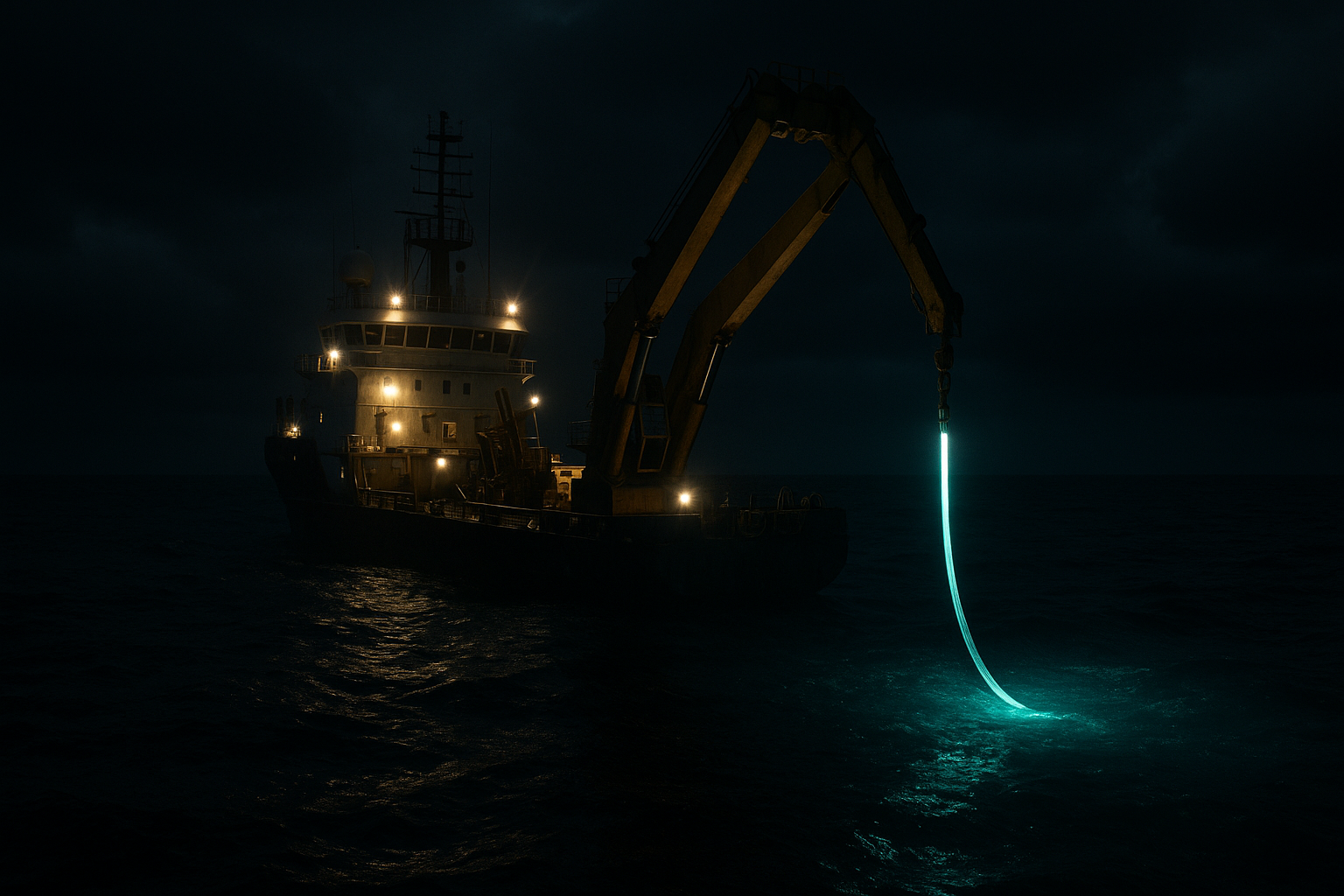
On the Saturday of Labor Day weekend 2025, engineers at Microsoft noticed something strange: traffic between Europe and Asia on the Azure cloud platform was slowing down. Nothing had been hacked. No data center had failed. The problem was 40 meters underwater in the Red Sea, where two of the world's most important fiber optic cables — SMW4 and IMEWE — had been severed near Jeddah, degrading internet connectivity for hundreds of millions of people across India, Pakistan, and the Gulf.
The likely culprit, investigators eventually concluded, was mundane: a ship's anchor, dragged across the seabed. The lesson was not. It took one anchor, in one strait, to slow a meaningful fraction of the traffic between two continents — and weeks for a repair ship to arrive, splice the fibers, and restore it.
That gap between how much the world depends on submarine cables and how little capacity exists to fix them is the subject of this briefing. It is one of the most lopsided risk-to-attention ratios in global infrastructure, and in the past eighteen months it has started attracting serious money — from NATO, from Brussels, and from the four companies that control the industry.
The internet is a maritime business
Strip away the abstraction and the internet is physical: roughly 600 submarine cable systems, each about the diameter of a garden hose, lying on the ocean floor. They carry an estimated 99% of intercontinental data traffic — every cloud workload, every video call, and the financial messaging behind trillions of dollars in daily transactions. Satellites, for all the attention they get, carry a rounding error of that load and cannot come close to replacing it; a single modern cable moves more data than every satellite constellation in orbit combined.
Cables break constantly. The International Cable Protection Committee counts roughly 200 faults per year worldwide, most of them caused by fishing gear and ship anchors, with earthquakes and equipment failure making up much of the rest. The system tolerates this because it was engineered for redundancy: traffic reroutes, a repair ship is dispatched, a robot or grapnel hauls the cable to the surface, technicians splice it, and life goes on.
That model is now under strain from two directions at once.
The seabed became a battlefield
The first source of strain is deliberate targeting. Since late 2023, at least eleven cables and pipelines in the Baltic Sea have been damaged in incidents linked to ships — many of them associated with Russia's sanctions-evading "shadow fleet" — dragging anchors across the seabed, sometimes for over a hundred kilometers. NATO responded in January 2025 by launching Baltic Sentry, a standing patrol of frigates, maritime aircraft, and naval drones over the alliance's underwater infrastructure.
The pattern repeats around Taiwan, which has logged repeated cable cuts near its outlying islands. In February 2026 the TP3 cable was severed by a Chinese-crewed vessel; in June, a Taiwanese court sentenced the ship's captain to three years in prison — the first conviction of its kind. In May, a cable linking Matsu Island to Taiwan was cut yet again with Chinese vessels operating nearby.
And in the Red Sea, the September 2025 cuts came on top of Houthi-adjacent threats that have made the Bab el-Mandeb strait — where fourteen cable systems squeeze through a corridor a few tens of kilometers wide — the single most dangerous chokepoint on the internet. Work on the Gulf extension of Meta's 2Africa system, the largest cable project ever built, was halted under force majeure in March 2026. Iran has openly threatened the region's cables.
None of this is yet catastrophic. All of it is repricing the risk of a system that was built on the assumption that cable damage is accidental.
Briefings like this are free to read with a free AlphaBriefing membership. Join free →
Sixty ships, most of them old
The second source of strain is the one almost nobody outside the industry talks about: the repair fleet itself.
The global fleet of cable ships numbers only around sixty vessels, and only a fraction of those are dedicated to maintenance rather than laying new systems. A joint study by TeleGeography and Infra-Analytics published this year put hard numbers on the problem: total cable kilometers on the seabed are projected to grow 48% by 2040, yet by that same year roughly two-thirds of the world's cable maintenance ships will have reached the end of their service life. Keeping the internet repairable, the study concluded, requires about $3 billion of investment — fifteen replacement vessels and five additional ones.
Three billion dollars is nothing next to the sums being spent on what those ships protect. Hyperscalers and consortia have more than $16 billion of new cable systems planned to enter service between 2026 and 2029 — the largest build-out since the dot-com era — much of it driven by AI workloads that must move between continents. Google and Meta now build and own entire private systems.
But new cables have a business model. Repairs do not. Maintenance is funded through decades-old cooperative "zone agreements" in which cable owners pay standing fees to keep aging ships on call — a structure built for a world of accidental faults and cheap shipping, not sabotage campaigns and $100-million-plus newbuild vessels. Everyone depends on the repair fleet; no one wants to recapitalize it.
Which raises the question the rest of this briefing answers: when a strategic chokepoint this cheap to fix meets money this motivated — NATO's, Brussels', and Big Tech's — who ends up paying, and which companies are positioned to collect?
The rest of this briefing is free — it just requires a free AlphaBriefing account: the four companies that control global cable manufacturing and which of them you can actually buy, the seabed-defense names already booking NATO and EU money, and the three catalysts that turn a maintenance gap into a repricing.
Create your free account → — 30 seconds, no card.