The Space Race Just Turned Into a Trade War
Four American space companies pulled out of Macron's Paris summit after White House pressure. Behind the boycott: the EU Space Act, a sovereign constellation, and the first open trade fight of the orbital economy.

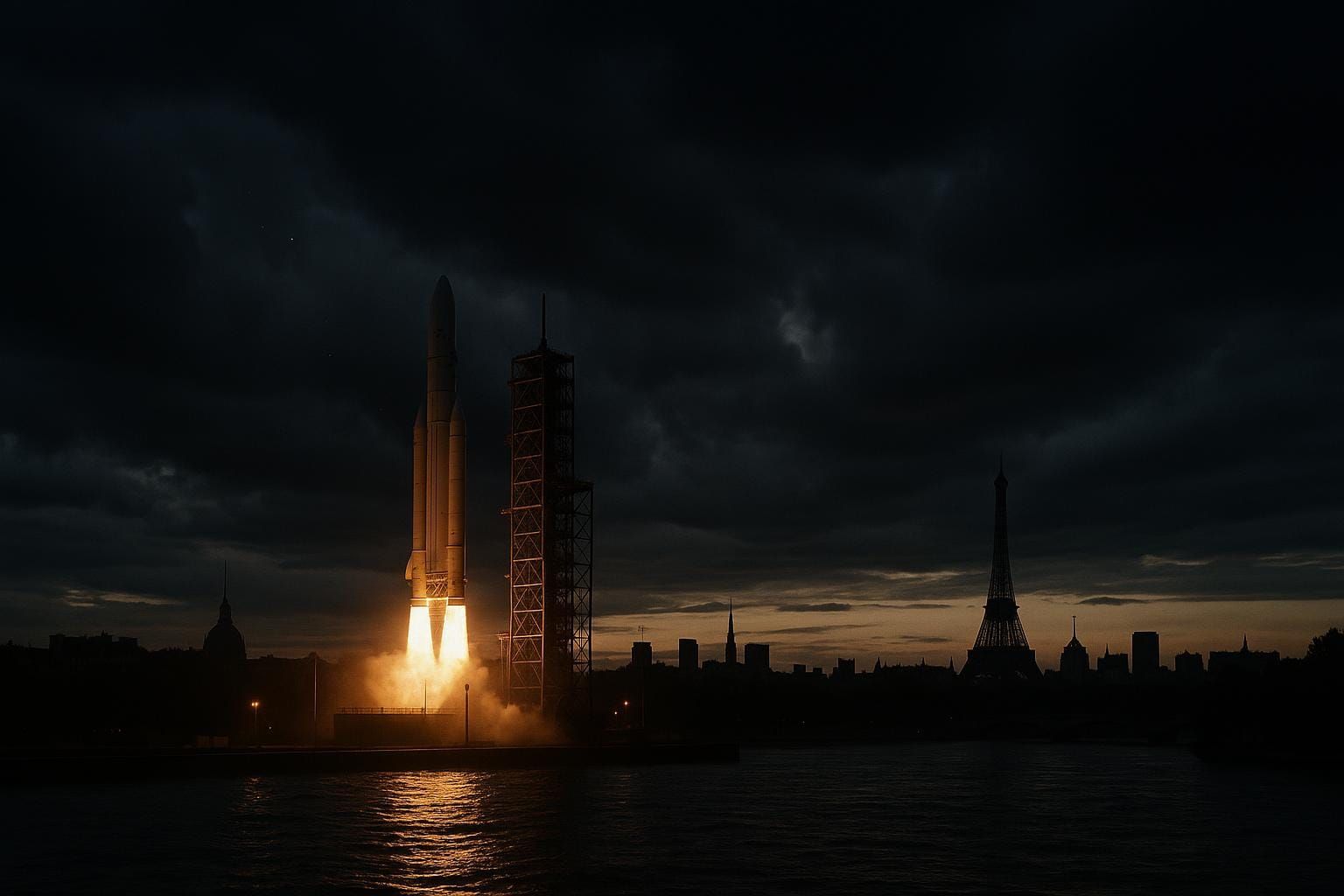
On September 3, four American space companies — SpaceX, Blue Origin, Stoke Space, and Starcloud — abruptly withdrew from the European Space Summit that French President Emmanuel Macron is hosting in Paris on September 9–10. They didn't cite scheduling conflicts. According to industry reporting, the withdrawals followed direct interventions from the White House.
Read that again. The US executive branch pressured its own commercial space champions to boycott Europe's flagship space diplomacy event, six days before it opens. That is not how allies behave when things are fine. It's how trading blocs behave when a regulatory fight has crossed from technical committees into open economic statecraft.
The orbital economy — launch, broadband constellations, secure government communications — has spent two decades as a de facto American export market. Europe bought American launches when Ariane slipped, leaned on Starlink when it needed capacity, and let US providers fill gaps its own industry couldn't. That arrangement is now ending, deliberately, and both sides know it. The summit boycott is the first shot in what looks increasingly like a transatlantic space trade war.
What Actually Triggered This
The proximate cause is the EU Space Act, the draft regulation the European Commission proposed in June 2025 and which is now working through the EU legislative machine, with implementation targeted for 2030. Brussels frames it as a safety, resilience, and sustainability framework for orbit. Washington reads it as industrial policy with a regulatory costume.
The US industry case, laid out in detail by the Information Technology and Innovation Foundation (a US tech-policy think tank, so consider the source), points to four provisions:
- A "giga-constellation" category with extra propellant-capacity requirements that, today, only American operators are large enough to trigger. No European constellation meets the threshold.
- Prescriptive reflectivity standards for low-Earth-orbit satellites that bite hardest on operators flying at lower altitudes for low-latency service — which is to say, Starlink and Kuiper-class systems — while higher-orbit European constellations are less affected.
- A "Compliance Board" review in which European regulators effectively vote on non-EU operators' market access, while EU operators get streamlined home-country authorization.
- A launch derogation regime that lets European operators buy non-EU launches only when no "readily available substitute" exists in Europe — a rule that reads as a standing order to buy European rockets whenever Ariane, Vega, or the continent's launch startups can plausibly do the job.
European officials don't really dispute that the Act favors European industry; they dispute that this is illegitimate. Their argument: the United States built its commercial space dominance on decades of NASA and Pentagon procurement that was closed to foreigners, and Europe is simply doing a version of the same thing two decades late.
Briefings like this are free to read with a free AlphaBriefing membership. Join free →
The Sovereignty Project Behind the Fight
The regulatory fight is inseparable from IRIS², Europe's answer to Starlink. The EU's Infrastructure for Resilience, Interconnection and Security by Satellite is a planned 348-satellite constellation spread across low and medium Earth orbit, built by the SpaceRISE consortium (led by European operators and primes including Eutelsat, SES, Hispasat, Thales Alenia Space, and Airbus), designed to give European governments encrypted, sovereign communications that no foreign CEO can switch off. The Commission moved this year to accelerate the program.
The unspoken reference point is Ukraine. Europe watched a private American citizen make operational decisions about Starlink coverage in an active war zone and concluded — across party lines and member states — that dependence on US commercial constellations for security-critical communications is a strategic vulnerability, not a procurement detail. IRIS² is expensive, late by Starlink standards, and will launch into a market its American rivals already dominate commercially. Europe is building it anyway, because the point isn't commercial. The point is that it's European.
From Washington's perspective, the combination is the problem: Europe is simultaneously subsidizing a sovereign competitor and writing rules that raise costs for the American incumbents it competes with — while European operators retain access to the open US market. That's the asymmetry the White House is objecting to, and the summit boycott was the pressure valve.
Why This Is Bigger Than Rockets
The pattern here should look familiar, because Europe has run it before. The Digital Markets Act initially designated only US companies as "gatekeepers." GDPR became a global template through the Brussels effect, exported to dozens of jurisdictions. If the Space Act passes in anything like its current form, it becomes the first comprehensive national-bloc space regulation in the world — and the template other jurisdictions copy. US operators wouldn't just face European compliance costs; they'd face a proliferating patchwork of Space-Act-inspired regimes globally.
For investors, three things are worth internalizing:
1. The space economy is fragmenting into blocs, and that's bullish for duplicative infrastructure. A world with one global launch-and-connectivity market is efficient. A world with an American stack, a European stack, and a Chinese stack means every capability gets built at least twice. That is structurally good news for European primes — Thales, Airbus, the Eutelsat-SES orbit of operators — which now have a protected buyer of last resort in Brussels, and for European launch startups that suddenly face a regulatory moat instead of a SpaceX price war they were losing.
2. Regulatory risk just became a line item for US space names. SpaceX is private, but Amazon's Kuiper, AST SpaceMobile, Planet Labs, and Rocket Lab all have European revenue ambitions that now carry a compliance and market-access discount. The Compliance Board mechanism — foreign regulators voting on your market access — is exactly the kind of risk US markets historically haven't priced into space-sector valuations because it had never existed before.
3. Escalation paths run through trade policy, not space policy. The White House intervening to empty a summit is a signal that the US response, if the Space Act advances unamended, will come as trade measures — and Europe's aerospace exporters, from Airbus down, are the obvious targets. Anyone holding transatlantic aerospace exposure should watch the bilateral talks that are expected to continue ahead of the next round of international spectrum and regulatory assemblies.
What to Watch
The summit itself, September 9–10, now proceeds as a largely intra-European affair — ESA leadership, European contractors, Commission regulators. Watch what Macron announces without American companies in the room: harder sovereignty language and new IRIS²-adjacent funding would confirm the rupture is policy, not pique. Then watch whether the four American companies show up in Paris the following week for the industry events that are still on their calendars — attendance there would signal this was a targeted diplomatic snub rather than a commercial withdrawal from Europe.
The deeper question runs to the end of the decade: whether the EU Space Act reaches final form with its discriminatory provisions intact by the time implementation begins in 2030, or gets negotiated down in exchange for the US dropping retaliation. The last two decades of the space economy were written by engineers and launch cadences. The next five years will be written by trade lawyers.
If this analysis was useful, this is what AlphaBriefing does every day — geopolitics and markets, connected to what it means for your money. A free membership gets you access to every free article on AlphaBriefing.com; paid members get the investment frameworks, scenario pricing, and catalyst calendars behind the paywall.
Get this level of intelligence every day. Subscribe to AlphaBriefing — free, member, and paid tiers available.
Sources & Further Reading
- SatNews — U.S. Commercial Launch and Satellite Operators Withdraw from European Space Summit Following White House Interventions
- European Commission — IRIS² | Secure Connectivity
- European Commission — Proposal for a Regulation on the Safety, Resilience and Sustainability of Space Activities (EU Space Act)
- ITIF — The EU's Space Act
- SatNews — Thales CEO Confirms Progression on EU's Multi-Billion-Euro IRIS² Sovereign Satellite Constellation
- Polytechnique Insights — IRIS²: Everything You Need to Know About This New European Constellation
Disclaimer
AlphaBriefing is an independent intelligence publication. The content in this article is produced for informational and educational purposes only. Nothing published by AlphaBriefing constitutes financial, investment, legal, tax, or regulatory advice, nor should it be construed as a solicitation or recommendation to buy, sell, or hold any security, asset, or financial instrument.
All views expressed are those of the author at the time of writing and are subject to change without notice. Markets are volatile and unpredictable; past performance is not indicative of future results. Any investment involves risk, including the possible loss of principal.
AlphaBriefing and its principals, employees, or contributors may hold positions in securities or assets mentioned in this article. This should be considered a potential conflict of interest. No material relationship with any company referenced exists unless explicitly disclosed. Readers should conduct their own due diligence and consult qualified financial, legal, and tax advisors before making any investment decisions.
Information in this article is drawn from public sources believed to be reliable at the time of publication. AlphaBriefing makes no warranty, express or implied, as to the accuracy, completeness, or timeliness of any information herein. AlphaBriefing accepts no liability for any loss or damage arising from reliance on this content.
© AlphaBriefing. All rights reserved. Unauthorised reproduction or distribution is prohibited.