The Company That Settles Every Stock Trade in America Is Moving On-Chain
The DTCC clears roughly $2.4 quadrillion in securities transactions a year through plumbing most investors have never thought about. Next month it flips the switch on tokenized settlement — and the repricing that follows won't show up where the headlines are looking.

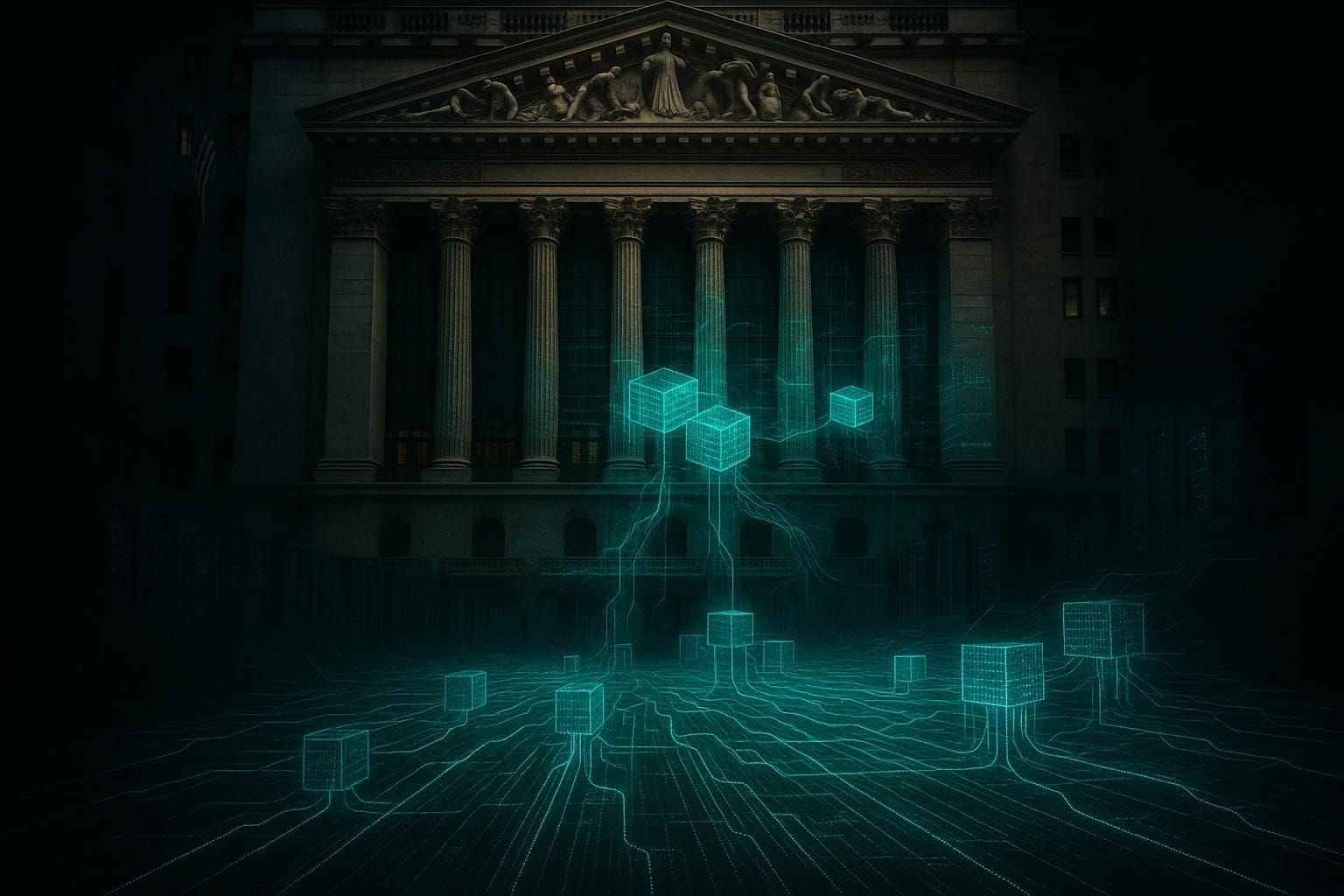
Somewhere in lower Manhattan sits a company that touches virtually every stock, bond, and fund transaction in the United States. It is not a bank, it does not appear on CNBC, and most of the investors whose trades flow through it every day could not name it. The Depository Trust & Clearing Corporation — the DTCC — processes securities transactions worth roughly $2.4 quadrillion a year. Not trillion. Quadrillion.
Next month, that machine starts running on new rails. After completing its first limited production trades of tokenized real-world assets in July, the DTCC is targeting a broader rollout of its tokenization service in October, built with more than 50 financial firms. When the entity that clears essentially all of American capital markets commits to blockchain-based settlement, this stops being a crypto story. It becomes a market-structure story — and market structure is where the durable money in finance has always been made.
The quietest monopoly in finance
The DTCC exists because paper failed. In the late 1960s, Wall Street nearly drowned in physical stock certificates; the industry's answer was to immobilize securities in a central depository and net trades against each other electronically. That architecture — a central ledger, batch processing, settlement measured in days and now, since 2024, in one day — has been the operating system of American markets for half a century.
It works. But it works the way a 1970s mainframe works: reliably, expensively, and within business hours. Settlement finality still takes a day. Collateral still sits idle overnight. Cross-border transactions still crawl through chains of correspondent banks, each adding $25–$50 in fees and hours or days of delay. A pilot last year between JPMorgan, Citi, and UBS settled a cross-border payment over tokenized rails in an average of 80 seconds — against the one to five business days the same payment takes through SWIFT's correspondent chain.
The DTCC is not being disrupted by that math. It is acting on it. The corporation is not a startup competing with market infrastructure — it is the infrastructure, and it has decided the next generation of itself runs on shared ledgers.
Ninety days that changed the plumbing
The DTCC launch is the most consequential piece of a wave that broke across roughly one quarter of 2026:
- The four largest US banks got into the same boat. JPMorgan, Citigroup, Bank of America, and Wells Fargo are building a shared tokenized deposit network through The Clearing House — the utility that already runs the RTP instant-payment rails — targeting a first-half 2027 launch, according to reporting first published by the Wall Street Journal in June. Each bank issues its own deposit token; the tokens interoperate on a common settlement layer, 24/7.
- Wells Fargo goes first. The bank said in August it will begin offering tokenized deposits to corporate clients this fall — joining the shared network rather than building a walled garden.
- BlackRock is scaling on-chain funds. Its tokenized money-market fund BUIDL crossed $1 billion in assets, has been joined by two further tokenized funds, and the firm has filed with the SEC to expand the suite. A fund share that settles in seconds and posts as collateral in real time is not a novelty product; it is a distribution channel.
- Citi opened a tokenized door into private markets. Its new Digital Depositary Receipts create a regulated wrapper for fractional interests in pre-IPO companies — arriving precisely as the most valuable private companies in history keep delaying their listings.
- The exchanges and card networks moved too. The New York Stock Exchange is reported to be planning a 24/7 venue for tokenized securities with instant settlement. Mastercard added stablecoin settlement options for issuers and acquirers; Visa is testing private stablecoin settlement on the Canton Network.
Any one of these would be an interesting pilot. Together, with capital committed and launch dates attached, they describe something else: the money layer, the asset layer, and the settlement layer of American finance all migrating to programmable rails at once — with the incumbents, not the crypto industry, holding the pen.
Which raises the question that matters for a portfolio. When settlement compresses from a day to seconds, when markets run around the clock, and when the correspondent-banking toll booths get bypassed, an enormous amount of float income, fee revenue, and intermediary margin gets repriced. Somebody loses it. Somebody captures it. The names on both sides of that ledger are already visible.
The rest of this briefing is free — it just requires a free AlphaBriefing account: the winners-and-losers map across custody, exchanges, and settlement chains; the two-tier custody battle now underway; where the $16 trillion tokenization estimate falls apart and the number that's actually credible; and the four dated catalysts to watch between October and mid-2027.
Create your free account → — 30 seconds, no card.