Fannie Mae Just Quietly Lowered the Bar on Your Home Insurance
When the nation's mortgage backstop changes the rules in the middle of a climate insurance crisis, that's not a footnote. It's a signal about who's going to absorb the losses.

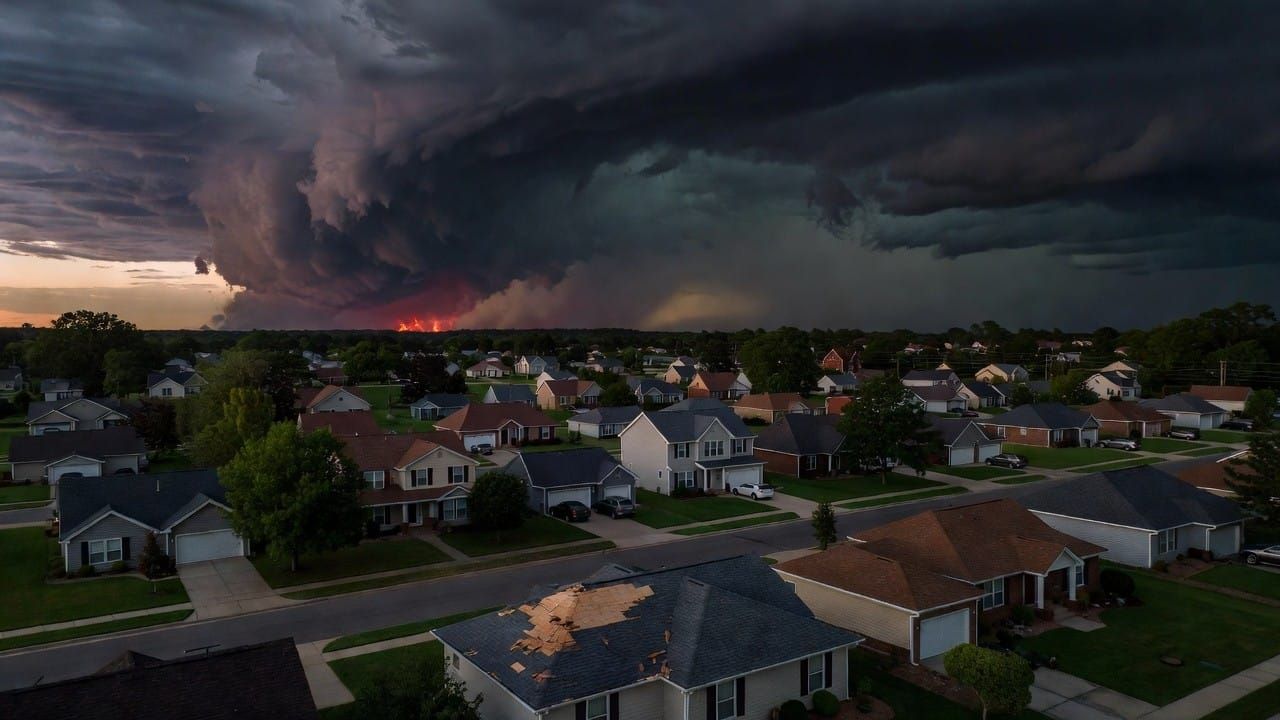
In March 2026, with almost no public attention, Fannie Mae and Freddie Mac changed the rules governing what kind of homeowners insurance Americans can carry on a federally backed mortgage.
The headline change sounds technical. Lenders can now accept "Actual Cash Value" (ACV) coverage on roofs instead of "Replacement Cost Value" (RCV). In plain language: when a hailstorm or wildfire trashes your fifteen-year-old roof, your insurer no longer has to give you the money to replace it. They can deduct depreciation and hand you a fraction of the cost.
That is a meaningful downgrade to American homeowner protection. And it didn't happen because anyone wanted it. It happened because the math underneath the U.S. homeowners insurance market is breaking — and Fannie and Freddie, which sit behind roughly two-thirds of all U.S. residential mortgages, need a way to keep the credit pipeline flowing through an increasingly uninsurable country.
The Numbers Behind the Quiet Change
Start in California, where the state's insurer of last resort — the FAIR Plan — has gone from a backwater to a systemic exposure in four years:
- 271,000 policies in force in 2022
- 684,000 policies by March 2026, a 152% increase
- Roughly $700 billion in property insured, up 317% from 2021
- A $1 billion emergency bailout in early 2025 after the January Los Angeles wildfires nearly broke the system
- A pending 36% rate hike request from the FAIR Plan itself
State Farm, California's largest home insurer, has paid out $1.26 for every $1 it collected in premiums over the last nine years — $5 billion in cumulative losses. Nearly 400,000 California policies have been canceled since 2021. In May 2026, the state's insurance commissioner opened a formal enforcement action against State Farm for mishandling LA wildfire claims, and Governor Newsom publicly warned the rest of the industry to clean up its act.
More than one in five California homeowners is now uninsured because of cancellations or unaffordable premiums.
The Florida Counterpoint
Florida — the state Americans assumed would break first — is showing the opposite picture in 2026.
Citizens, Florida's state-backed insurer of last resort, is recommending its first statewide rate decrease in a decade: an average 2.6% cut, with reductions as deep as 14% in South Florida. About 463,000 policyholders are projected to save an average of $359 each.
The reason is aggressive depopulation. Citizens has shed roughly 1.3 million policies since 2023 by pushing customers back into the private market, helped along by 2022 and 2023 tort reforms that gutted assignment-of-benefits litigation. From a peak of 1.4 million policies in 2023, Citizens will close 2025 with roughly 385,000 — its lowest in years. Lower reinsurance costs in 2026 are now flowing through to homeowner rate relief.
This is a rare American policy success story — but a fragile one. Florida solved a lawsuit-fueled spiral. It did not solve a climate one. A single Category 5 storm hitting Tampa or Miami still resets the math.
Why Fannie Mae Had to Move
This is the strategic context in which Fannie Mae and Freddie Mac changed their roof insurance rules in March 2026.
The Federal Housing Finance Agency — Fannie and Freddie's regulator — has been clear in its 2022–2026 strategic plan that the rising frequency and severity of natural disasters represents a systemic threat to housing finance. Climate risk does not sit politely inside California and Florida. It sits inside every mortgage the GSEs guarantee in a hurricane, tornado, wildfire, or flood zone.
There are only three ways the housing finance machine survives the climate insurance crunch:
- Insurance gets cheaper. Not happening at scale. Global reinsurers have been pricing climate risk in for years.
- Homeowners pay more. Politically toxic. It strangles mortgage origination, which Fannie and Freddie need to keep moving to remain financially viable.
- Lower the coverage requirement. Quiet. Technical. Almost invisible. And done.
By permitting ACV roof coverage, Fannie and Freddie made millions of homes cheaper to insure — which makes those mortgages easier to write and keeps the housing-finance flywheel spinning. The cost is borne by individual homeowners, who will discover, the next time a hailstorm or wildfire trashes their roof, that the check from their insurer is a fraction of what it would have been a year ago.
This is what climate adaptation actually looks like in a financialized economy. Not lower emissions. Not stronger building codes. A quiet rewriting of who pays when the disaster shows up.
What It Means for Capital
For investors, three implications are worth thinking through.
The property insurance market is splitting in two. California, Louisiana, parts of Colorado, and the wildland-urban interface generally are pricing toward "uninsurable." Florida, post-tort reform, is heading the other way. Watch the big reinsurers — Munich Re, Swiss Re, Everest, RenaissanceRe — for who is leaning into which side, and which primary carriers are quietly running off their exposure.
Housing values in high-risk zip codes are being silently repriced. A home that cannot be insured is a home that cannot be sold to a buyer with a mortgage. That dynamic does not show up cleanly in Case-Shiller or Zillow until transaction volume dries up — and then it tends to show up all at once. Real estate exposure to wildfire and coastal flood zones is now meaningfully different from headline national housing data.
Systemic exposure is parked on Fannie and Freddie's balance sheet. A heavy 2026 hurricane season, a bad summer wildfire run, or a mid-cycle reinsurance shock could put the GSEs right back into the conversation about explicit federal support — at exactly the moment Washington is least set up to backstop them.
Yale Law Journal's recent essay on "the uninsurable future" framed the choice starkly. Either the public sector takes on more climate risk explicitly, or it absorbs it implicitly through the GSEs, the National Flood Insurance Program, and FHA. The March 2026 Fannie/Freddie roof rule is a small, technical first answer to that question — and it is not in the homeowner's favor.
The Bottom Line
Climate change is not, for most American households, going to feel like a melting glacier. It is going to feel like an insurance non-renewal letter, a 30% higher premium, and — increasingly — a smaller check after the storm. The financial machinery is adapting. The protection it is eroding belongs to the homeowner.
If you own a home in California, Florida, Louisiana, Texas, Colorado, or anywhere in the wildland-urban interface, this is the year to read your policy's roof coverage language and price out RCV vs ACV. The default just changed underneath you.
Get this level of intelligence every day. Subscribe to AlphaBriefing — free, member, and paid tiers available.
Sources & Further Reading
- California Department of Insurance — Enforcement Action Against State Farm (May 2026)
- Office of Governor Newsom — Warning to Insurance Companies (May 2026)
- CNN — California Says State Farm Violated Law in Handling of 2025 LA Wildfire Claims
- Insurance Journal — Even Low-Risk Homes Are Caught Up in California's Climate Insurance Crisis
- Federal Housing Finance Agency — Key Initiatives to Address Climate-Related Financial Risks
- Urban Institute — Home Insurance Needs an Overhaul to Prepare for Climate Change
- Yale Law Journal — The Uninsurable Future: The Climate Threat to Property Insurance, and How to Stop It
- Insurance Journal — Florida Citizens Wants HO Rate Decrease After Years of Pushing Rate Hikes
Disclaimer
AlphaBriefing is an independent intelligence publication. The content in this article is produced for informational and educational purposes only. Nothing published by AlphaBriefing constitutes financial, investment, legal, tax, or regulatory advice, nor should it be construed as a solicitation or recommendation to buy, sell, or hold any security, asset, or financial instrument.
All views expressed are those of the author at the time of writing and are subject to change without notice. Markets are volatile and unpredictable; past performance is not indicative of future results. Any investment involves risk, including the possible loss of principal.
AlphaBriefing and its principals, employees, or contributors may hold positions in securities or assets mentioned in this article. This should be considered a potential conflict of interest. No material relationship with any company referenced exists unless explicitly disclosed. Readers should conduct their own due diligence and consult qualified financial, legal, and tax advisors before making any investment decisions.
Information in this article is drawn from public sources believed to be reliable at the time of publication. AlphaBriefing makes no warranty, express or implied, as to the accuracy, completeness, or timeliness of any information herein. AlphaBriefing accepts no liability for any loss or damage arising from reliance on this content.
© AlphaBriefing. All rights reserved. Unauthorised reproduction or distribution is prohibited.