Nvidia Gets the Headlines. Broadcom Gets the Hyperscalers.
Every cloud giant building custom AI silicon needs the same partner. Broadcom's quiet franchise — ASIC design plus AI networking — is becoming the second indispensable supplier in the data center.

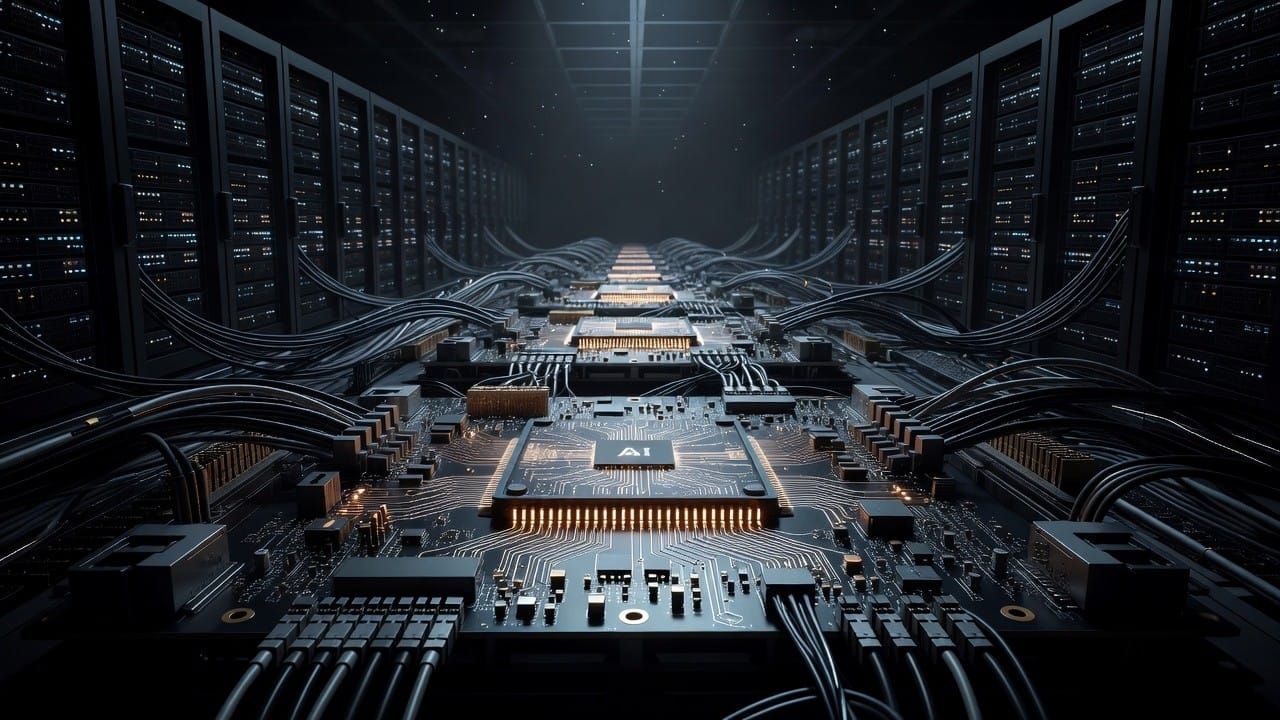
Nvidia dominates the AI story. It dominates the headlines, the analyst coverage, the magazine covers. It does not dominate the data center alone.
Behind every hyperscaler's custom silicon program — Google's TPU, Meta's MTIA, ByteDance's reported in-house accelerator — sits one partner: Broadcom. Behind every AI cluster that needs to move terabytes between racks at line rate sits Broadcom networking silicon. And in fewer than three years, what was a sleepy "AI" business line has become the company's growth engine.
The thesis is simple. The hyperscalers want to escape Nvidia's pricing power. They have neither the time nor the in-house chip-design depth to build advanced AI accelerators from scratch. So they go to Broadcom.
The Two-Front Franchise
Broadcom's AI business has two halves, and both compound on the same secular trend.
Custom AI silicon (XPUs). Broadcom is the design partner — and largely the implementation arm — for the hyperscalers' in-house accelerators. Google's tensor processing units are co-designed and manufactured through Broadcom's ASIC business. Meta's training and inference accelerator program (MTIA) runs through the same channel. Reporting through 2025 named ByteDance and additional unnamed customers; chief executive Hock Tan has guided that further hyperscale-class customers are now in design phases, with revenue expected from 2027.
These are not commodity contracts. Custom silicon is a multi-year design engagement with high engineering investment and very sticky deliverables. Once a TPU is in production, it does not get re-spun to a competing ASIC house.
Networking. The second half is the part the market still under-prices. AI clusters are bandwidth-bound: a single training run for a frontier model spans tens of thousands of accelerators that must move parameters at line rate, every millisecond, without packet loss. The switch silicon that makes this work — Broadcom's Tomahawk 5 and the AI-tuned Jericho 3-AI — sits in the spine of nearly every Ethernet-based AI fabric in the industry.
The networking half is not a side business. Hyperscalers have spent the past eighteen months moving large AI clusters off InfiniBand (Nvidia's stack) and onto Ethernet, both for cost and for vendor-diversity reasons. The Ultra Ethernet Consortium — backed by Broadcom, Meta, Microsoft, Oracle and others — exists specifically to standardize Ethernet for AI at scale. Broadcom owns the silicon layer of that movement.
The Numbers Wall Street Already Knows
Broadcom's AI revenue line has gone from roughly $4 billion in fiscal 2023 to a run-rate well above $15 billion entering fiscal 2026, with management framing a $60–90 billion serviceable market across its named custom-XPU customers by 2027. The stock has responded — Broadcom crossed the trillion-dollar market-capitalization mark in 2024 and has held it.
The headline numbers are not the interesting part. The interesting part is what comes next.
This is where the analysis gets actionable. AlphaBriefing members get the full investment framework — scenarios, positioning, and the bottom line.
Subscribe to AlphaBriefing — Free, Member, and Paid tiers available.