China's Newest Export Control Is Aimed at the Pentagon's Favorite Weapon
Beijing just curbed exports of drones and drone components to the US — weeks before the Xi–Trump summit, and a year into the Pentagon's plan to buy drones like ammunition. The parts layer is the leverage. It's also the trade.

On Wednesday morning, China's Ministry of Commerce announced a package of countermeasures against the United States: seven American entities added to its sanctions list, a national security investigation into imported office equipment running foreign software, suspension of factory-inspection cooperation — and, the item that matters most, tightened export controls on drones and drone-related components and technologies bound for the US.
The timing is not subtle. Xi Jinping is expected in the United States next month for his first summit of the second Trump term. The two governments have spent the past several weeks exchanging restrictions while insisting they want "constructive strategic stability." Beijing's spokesperson said China had "no choice but to take necessary countermeasures" — and promised more if Washington keeps going.
The retaliation ledger
Read the list of American actions Beijing says it is answering, because it explains the shape of the response:
- Last week, Washington banned imports from 43 Chinese companies over alleged forced labor in Xinjiang.
- Last month, the FCC banned imports of new humanoid and quadruped robots — a category China dominates — along with certain power converters.
- Last December, the FCC banned the import and sale of new drone models and critical drone equipment from foreign adversary manufacturers, a measure aimed squarely at DJI and its Chinese peers.
- In recent weeks: sanctions on Chinese shipping operators alleged to be moving Iranian fuel, two top Chinese universities added to a Pentagon blacklist, new forced-labor tariffs of 10 to 12.5 percent, and open threats to sanction Chinese AI firms.
Most of Beijing's reply is symmetrical symbolism — you blacklist our firms, we blacklist yours. Sanctioning a US biotech and a resource-analytics company changes almost nothing; those firms' China business was already dying. The drone-component curb is different. It is the one item on the list aimed at an actual American vulnerability rather than an American gesture.
The dependency Washington never fixed
The United States has spent three years legislating Chinese drones out of American airspace. The American Security Drone Act barred federal agencies from buying them. The FCC's covered list cut them off from spectrum authorization. December's import ban closed the front door entirely.
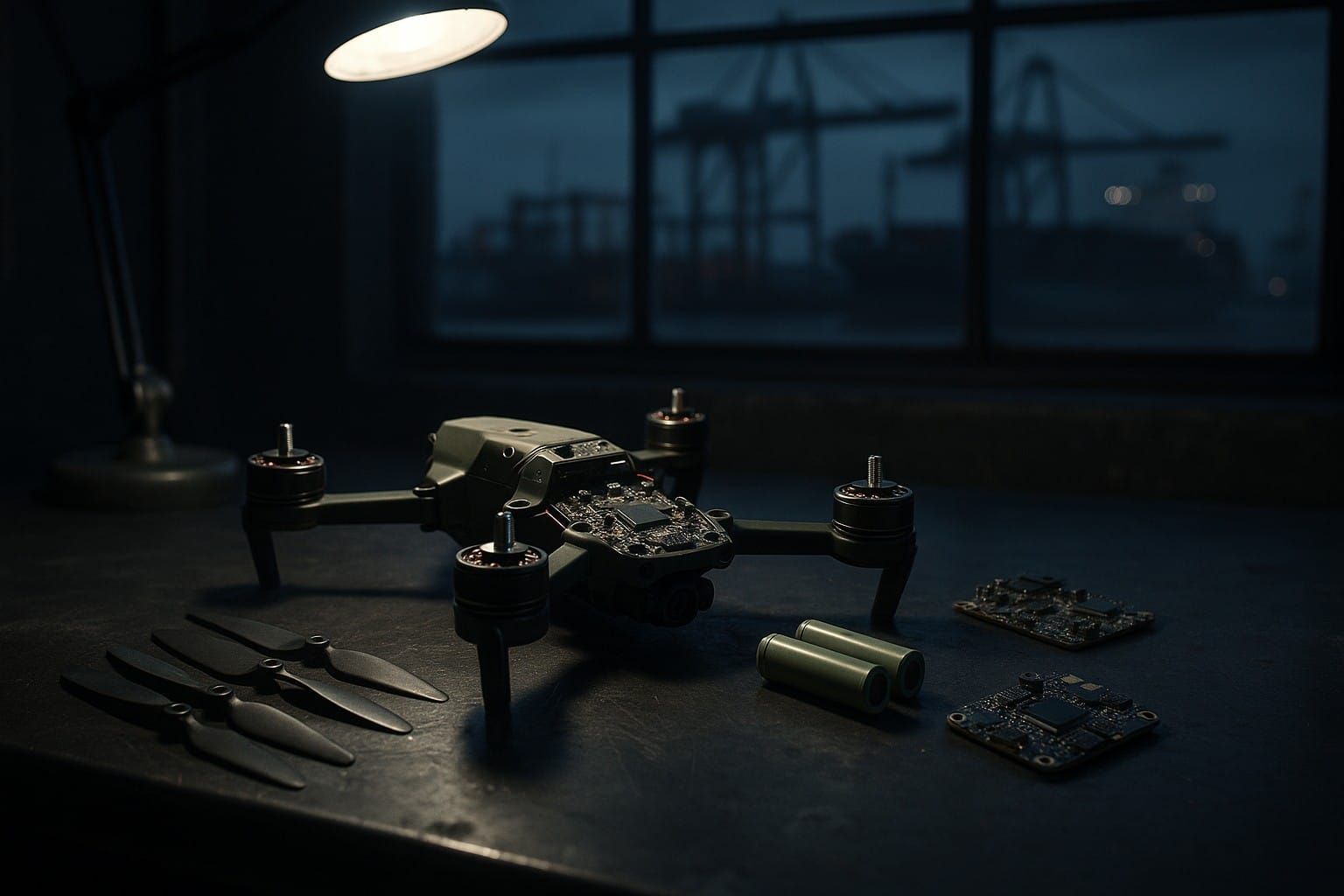
What none of that legislation fixed is the layer underneath. The small-drone supply chain — motors, electronic speed controllers, lithium battery cells, gimbals, cameras, flight controllers — remains overwhelmingly Chinese. DJI alone holds roughly 70 percent of the global commercial drone market by most industry estimates, but the deeper dependency is in parts: in several component categories, Chinese suppliers are closer to a monopoly than a market. Plenty of "NDAA-compliant" American drones have historically been American the way a Shenzhen parts kit assembled in Texas is American. The Pentagon's Blue UAS cleared list exists precisely because untangling that lineage is hard enough to require a full-time government program.
Building the same aircraft from a domestic supply chain, where it's possible at all, has typically cost a multiple of the Chinese price. That is the gap Beijing just put its thumb on.
Beijing has done this before
If you want to know what a drone-component cutoff does to an American manufacturer, there is a live precedent. In October 2024, China sanctioned Skydio — then the largest US drone maker — and its battery supply, sourced from a single Chinese supplier, stopped overnight. The company was forced to ration customers to one battery per aircraft while it scrambled to rebuild supply elsewhere. Skydio's CEO called the sanctions what they were: an attempt to eliminate the leading American drone company.
That was a warning shot aimed at one firm. Wednesday's move generalizes it — and it lands at the worst possible moment for Washington. As we detailed in July, the Pentagon has reclassified small drones as ammunition: consumable, expendable, reordered like bullets, with a program targeting 300,000 or more domestically produced units and unit prices deliberately pushed toward $2,300–$3,000. That entire doctrine rests on an assumption nobody wanted to say out loud — that the parts would keep coming.
You cannot buy drones like bullets if the components ship from the country you are trying to deter. The question that matters for investors is who closes that gap, how fast, and what happens to the companies caught in the middle.
The rest of this briefing is for paid members: the negotiating read on whether these curbs get traded away at next month's summit, the first-order effect that hurts US drone makers before it helps them, the three layers of the onshoring trade with the specific tickers in each, and the catalyst calendar through November 27.
AlphaBriefing Paid gets you every investment thesis, scenario framework, and catalyst brief we publish — the analysis private intel clients pay four figures for, at a fraction of that.