Can China Land a Rocket Before Its Starlink Window Closes?
Tonight a Chinese startup attempts the landing only three American companies have ever pulled off — with an $11 billion IPO priced off the outcome and China's twin answers to Starlink already 100-plus satellites behind schedule.

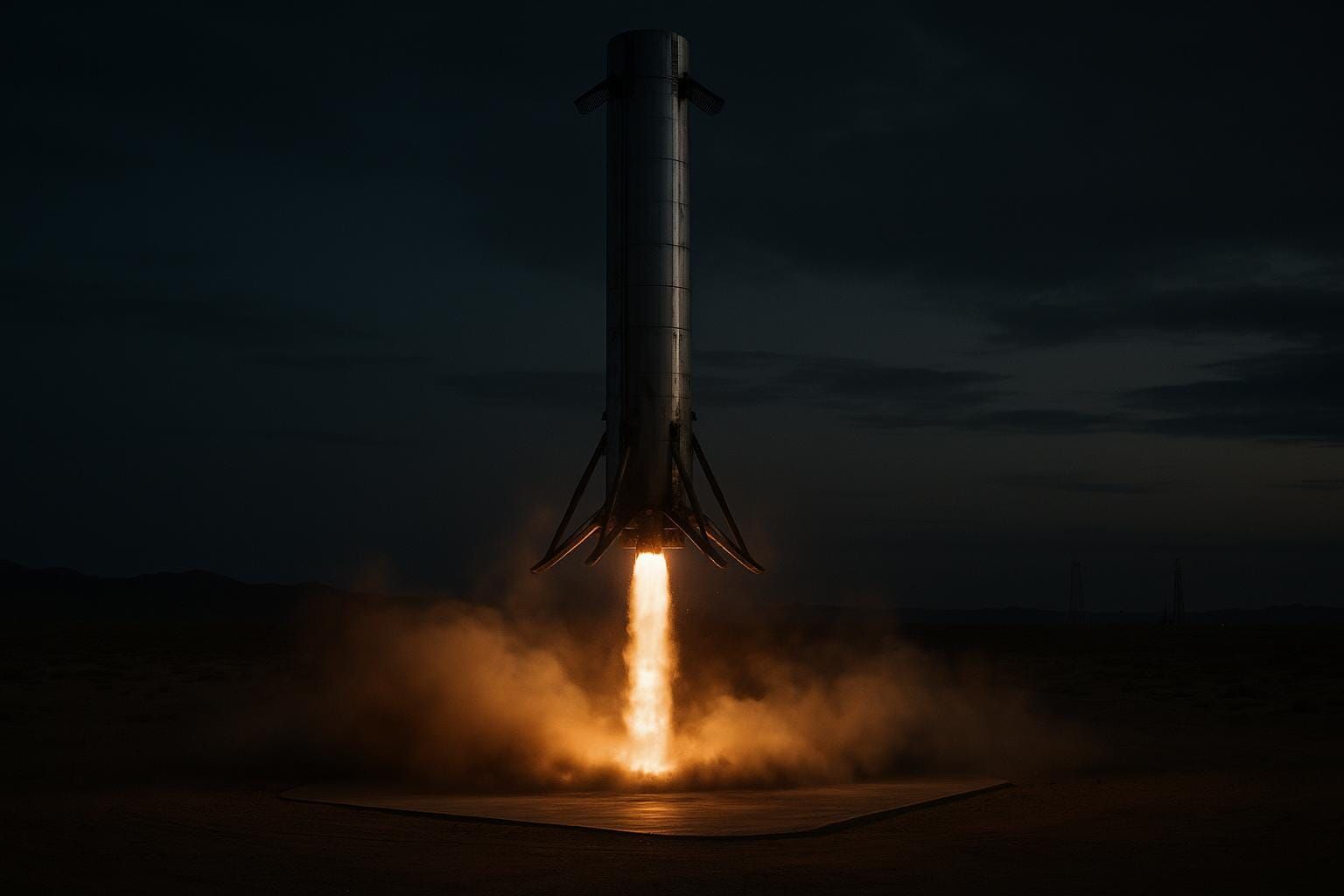
Tonight at 7:35 p.m. Eastern — dawn on Wednesday at the Jiuquan launch base in the Gobi — a 76-meter stainless-steel rocket will lift off, drop its second stage into an 800-kilometer orbit, and turn its first stage around for a powered descent toward a concrete pad in Minqin County, 390 kilometers downrange.
If the booster stands upright at the end of it, LandSpace becomes the first company outside the United States to land an orbital-class rocket stage — a club that today has exactly three members: SpaceX, Blue Origin, and Rocket Lab. All American.
The attempt was supposed to happen last week. Hours before Zhuque-3's window opened on August 10, a state-built Long March 7A carrying a communications satellite failed seconds into first-stage flight out of Wenchang, and LandSpace stood down. That coincidence — a private startup scrubbing its reusability test because the state's expendable workhorse just exploded — is the whole story in miniature. China's rocket problem is no longer about reaching orbit. It is about reaching orbit often enough, and the country's answer to that problem flies tonight with an $11 billion valuation strapped to the landing legs.
The 40-Meter Miss
Zhuque-3 has flown once. On December 3, 2025, the debut vehicle put its payload into orbit cleanly — then lost the booster in the final seconds of the landing burn. The stage flew a textbook reentry, steered itself through the supersonic aerodynamic regime on grid fins, reignited for the landing sequence, and suffered what the company called abnormal combustion roughly 17 seconds before touchdown. It came down about 40 meters from the center of the pad.
In rocketry terms, that is not a failure so much as an unfinished sentence. SpaceX needed multiple attempts across more than a year to close the same gap. LandSpace has spent the 251 days since December on what it says were the two failure points — landing-burn ignition reliability and terminal attitude control — and has at least three more vehicles in production at its Wuxi factory. The vehicle itself is a deliberate echo of the Falcon 9 playbook executed in stainless steel: nine Tianque-12 methane-liquid-oxygen engines, four grid fins, four landing legs, 18.3 tons to low Earth orbit in recovery mode, a design life of at least 20 flights.
The Bottleneck Behind the Rocket
Why does one booster landing carry this much weight? Because China's two flagship megaconstellations — its answers to Starlink — are visibly starved of launch.
Guowang, the state-owned constellation with a 13,000-satellite filing, had roughly 177 operational satellites in orbit as of late July against its own target of 310 by year-end. Hitting that number requires nearly tripling the monthly launch rate for the rest of 2026 — and the out-year plan calls for 900 satellites in 2027 and 3,600 a year from 2028. Qianfan, the Shanghai-backed rival, reached 200 satellites in June against an original plan that called for 648 by the end of last year. Its operator has been blunt about the reason: it could not find enough rockets, and has contracted about $187 million of launches from commercial providers because the state's Long March supply is spoken for.
Behind both programs sits the International Telecommunication Union's milestone regime: once a constellation's spectrum filing is brought into use, operators must deploy 10% of the system within two years, 50% within five, and 100% within seven — or watch the filing shrink to match what actually flies. Spectrum rights, the scarcest asset in the orbital economy, expire on a clock. China's constellations are not behind because satellites are hard; Qianfan builds them for roughly $1.5 million each. They are behind because every launch burns an expendable rocket, and the factories cannot pour them fast enough.
Reusability is not a prestige project here. It is the only arithmetic that closes.
The rest of this briefing is free — it just requires a free AlphaBriefing account: the IPO that is priced as if tonight already succeeded, the SpaceX-in-2015 valuation parallel and the scenario math around it, the vertically integrated constellation play LandSpace is quietly assembling, and what each of tonight's three outcomes does to the trade.
Create your free account → — 30 seconds, no card.