From Record to Correction in 45 Days
The S&P 500 and Dow closed Friday in correction territory for the first time since spring 2025, and the Nasdaq went negative for the year. What actually broke, what held, and what the next few weeks will decide.

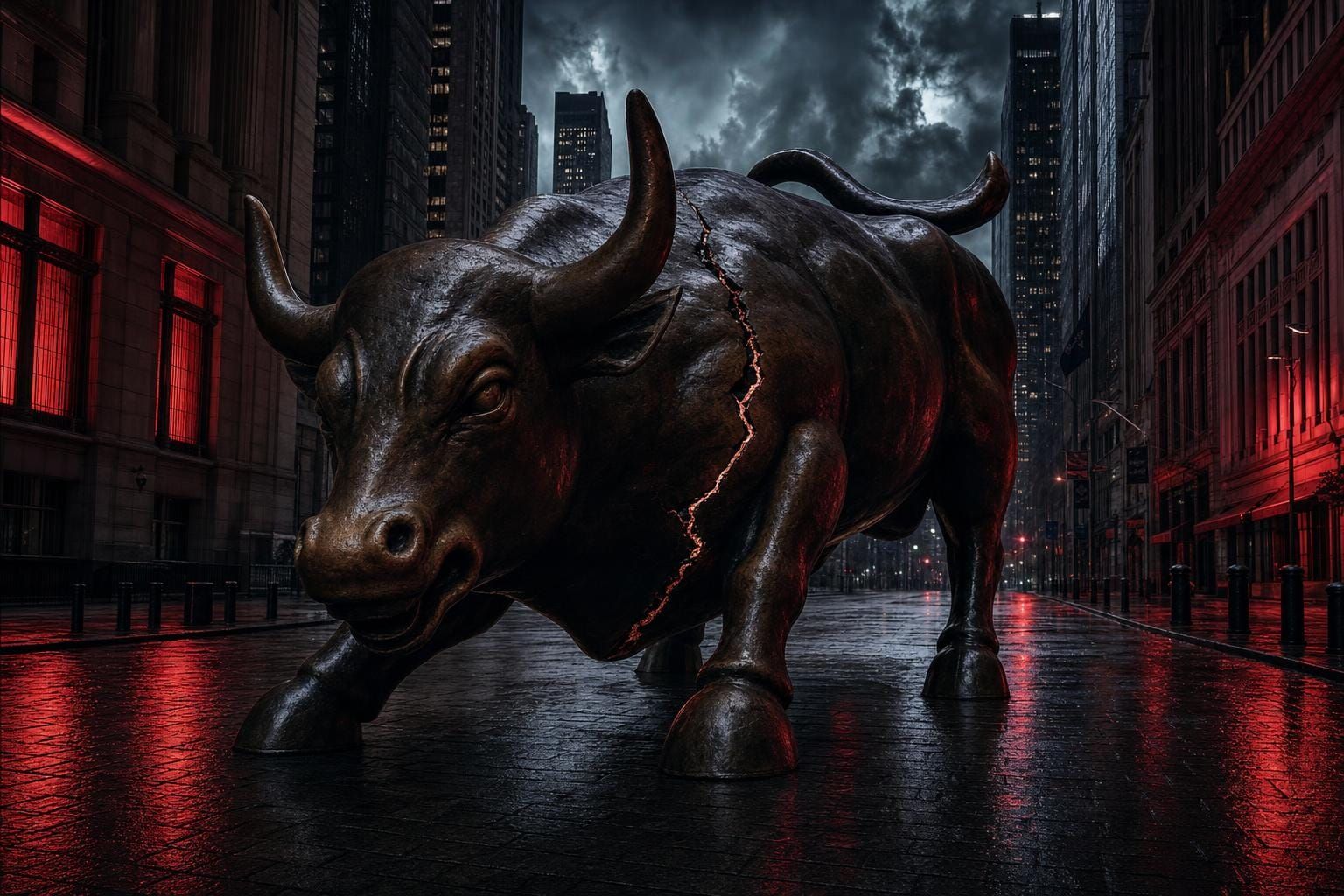
On October 6, the S&P 500 closed at a record 7,818.93. On Friday, November 20 — 45 days later — it closed at 6,910.39, down 11.6% from that high and formally in correction territory for the first time since the tariff shock of spring 2025. The Dow Jones Industrial Average crossed the same threshold the same day. The Nasdaq Composite, which was also at a record six weeks ago, is now negative for the year.
Friday was the crescendo of the worst week for U.S. stocks in more than a year. The S&P 500 fell 3.70% on the day — 265 points — and 8.6% on the week. The Nasdaq dropped 5.28% Friday and 10.0% for the week, which CNBC and Dow Jones Market Data both flagged as its worst weekly loss since the COVID crash of March 2020. The VIX, Wall Street's volatility gauge, jumped 26% Friday to close at 35.89 — its highest close in at least a year.
This is no longer a story about a few overextended AI names cooling off. It is a broad repricing. Here is what actually broke, what held, and what the next few weeks will decide.
The Scoreboard
All figures are closing prices for Friday, November 20, from live market data:
| Index / Asset | Friday Close | Friday | Week | From Record |
|---|---|---|---|---|
| S&P 500 | 6,910.39 | −3.70% | −8.6% | −11.6% (Oct 6 peak) |
| Nasdaq Composite | 22,617.73 | −5.28% | −10.0% | −18.1% (Oct 6 peak) |
| Dow Jones | 48,147.33 | −1.93% | −8.0% | −11.4% (Aug 5 peak) |
| Russell 2000 | 2,581.79 | −2.76% | −7.5% | — |
| Nvidia | $125.53 | −14.0% | −22.9% | −47.5% (Oct 6 peak) |
| VIX | 35.89 | +26% | — | Highest close in 1yr+ |
The S&P 500 is now up just 0.9% for 2026. The Nasdaq is down 2.7%. Eleven months of gains have been unwound in six weeks.
What Broke: The Sell-the-News Moment
The proximate trigger was supposed to be a celebration. Anthropic — the AI lab behind the Claude models — went public Thursday in the largest IPO on record, after raising the size of its offering a day before pricing. The stock priced at $83, opened at $111.50, spiked above $115, and then rolled over almost immediately, closing its first day at $97.17 and ending the week at $88.91.
The debut itself wasn't a disaster — the stock still sits about 7% above its IPO price. What mattered was the signal. As CNBC put it, a record-sized offering into an already-wobbling AI market played into the fear that the insiders were cashing out at the top — that the IPO, following SpaceX's monster offering this summer, marked a collective exit moment for the AI complex. When the biggest, most anticipated listing in history can't hold its opening print for an afternoon, every AI valuation in the market gets re-examined at once.
Briefings like this are free to read with a free AlphaBriefing membership. Join free →
The Nvidia Pile-Up
Nvidia was once the market's engine; this month it has been the market's anchor. The stock fell 14% on Friday alone after Reuters reported that the company's accounting is the focus of an SEC investigation — a report that should be treated as exactly that: a reported probe, not a finding of wrongdoing.
But the probe headline landed on a company already buried in bad news. Jensen Huang resigned as CEO earlier this month amid an espionage scandal that raised questions about whether restricted chips were reaching China. The Commerce Department tightened chip export restrictions on Monday to block remote access from third countries. Even a solid earnings report Tuesday — revenue growth strong, outlook raised — couldn't stop the slide, in part because the board definitively ruled out any return of Huang.
The result: Nvidia lost 22.9% this week and now trades 47.5% below its October 6 record close of $239.24 — a drawdown that press tallies put at roughly $2.5 trillion in market value. The selling spread across the entire semiconductor complex Friday: AMD fell 13.3% to $424.39, Broadcom dropped 12.2% to $304.41.
The Machines Took Over
There is also a mechanical layer to this decline that has nothing to do with AI sentiment. The S&P 500 broke below its 200-day moving average on Tuesday and decisively on Thursday. That line is the most widely watched long-term trend signal in markets, and breaking it converts a large class of systematic investors — trend-following funds and commodity trading advisors — into automatic sellers. As Wharton's Jeremy Siegel described it to CNBC on Friday: they've ridden the trend up, and once it turns, "they're selling and they're selling and they're selling," perpetuating the decline regardless of fundamentals.
This is why corrections so often feel disconnected from the news flow on the way down. The first 5% is a story; the next 5% is plumbing.
The Fed Can't Ride to the Rescue
The deeper problem — the one that separates this correction from the garden-variety dips of the past two years — is that the usual safety net is constrained. Inflation remains well above the Federal Reserve's 2% target, oil is holding above $83 a barrel with the Iran conflict keeping a persistent premium in energy prices, and Fed officials spent the past two weeks warning they may have to stay aggressive. The 10-year Treasury yield touched 5.15% a week ago — a level we covered as a story in its own right — before Friday's flight to safety pulled it back to 4.91%.
That is the trap: the selloff itself is doing some of the Fed's tightening for it, but the central bank cannot credibly promise rate cuts into an inflation overshoot. Every correction of the past 15 years taught investors to expect a policy rescue. This one, so far, comes without one.
What Held
A correction is a repricing, not a collapse, and it's worth cataloging what did not break this week. Treasuries did their job: yields fell as stocks sold off, meaning bonds hedged equity risk again — something they failed to do in 2022. The Dow fell materially less than the Nasdaq on Friday (1.9% vs. 5.3%) as money rotated toward defensive sectors rather than leaving the market entirely. Oil drifted lower on the week but held near $84, showing no sign of forced liquidation spilling into commodities. And for all the carnage in semiconductors, Anthropic — the supposed epicenter — still closed above its IPO price.
That pattern — violent de-rating of the most crowded trade, orderly rotation everywhere else — is what distinguishes a valuation correction from a systemic event. So far, this is the former.
What a Correction Is, and Isn't
The definitions matter here because the next thresholds are close. A correction is a 10% decline from a peak; a bear market is 20%. The S&P 500, at 11.6% down, is a normal correction by historical standards. The Nasdaq Composite, at 18.1% down, is two percentage points from an official bear market — and the more concentrated Nasdaq-100 already touched bear territory intraday on Friday, per CNBC.
The things to watch from here are specific. Whether the Reuters-reported SEC probe into Nvidia's accounting is confirmed, expanded, or walked back. Whether the S&P 500 can reclaim its 200-day moving average, which would switch the systematic flows back off. The next inflation prints, which will determine how much room the Fed has if the selling accelerates. And the Nasdaq's distance to the 20% line, because headlines that say "bear market" change retail behavior in a way that "correction" does not.
Forty-five days ago, the market was priced for a future in which the AI buildout never paused and the Fed never mattered. The repricing of that assumption was always going to be violent. The question the next few weeks will answer is whether it is also finished.
If this analysis was useful, this is what AlphaBriefing does every day — markets and geopolitics, connected to what they mean for your money. Every free article is yours to read with a free membership: Join AlphaBriefing.
Get this level of intelligence every day. Subscribe to AlphaBriefing — free, member, and paid tiers available.
Sources & Further Reading
- CNBC — S&P 500 correction: Five forces behind the market sell-off
- Reuters (via Yahoo Finance) — Wall St ends sharply lower on AI selloff, S&P 500, Dow in correction
- MarketWatch (via Morningstar) — Dow, S&P 500 enter correction as Nasdaq suffers worst week since 2020
- Los Angeles Times — S&P 500 falls 10% from record, entering correction as AI trade unravels
- AP (via Spectrum News) — S&P 500 sinks 3.7%, Nasdaq composite goes negative for year
- The Motley Fool — Stock Market Today, Nov. 20: Nvidia's Rout Deepens as SEC Accounting Probe Adds to Wall Street's AI Sell-Off
Disclaimer
AlphaBriefing is an independent intelligence publication. The content in this article is produced for informational and educational purposes only. Nothing published by AlphaBriefing constitutes financial, investment, legal, tax, or regulatory advice, nor should it be construed as a solicitation or recommendation to buy, sell, or hold any security, asset, or financial instrument.
All views expressed are those of the author at the time of writing and are subject to change without notice. Markets are volatile and unpredictable; past performance is not indicative of future results. Any investment involves risk, including the possible loss of principal.
AlphaBriefing and its principals, employees, or contributors may hold positions in securities or assets mentioned in this article. This should be considered a potential conflict of interest. No material relationship with any company referenced exists unless explicitly disclosed. Readers should conduct their own due diligence and consult qualified financial, legal, and tax advisors before making any investment decisions.
Information in this article is drawn from public sources believed to be reliable at the time of publication. AlphaBriefing makes no warranty, express or implied, as to the accuracy, completeness, or timeliness of any information herein. AlphaBriefing accepts no liability for any loss or damage arising from reliance on this content.
© AlphaBriefing. All rights reserved. Unauthorised reproduction or distribution is prohibited.