The Home Insurance Crisis Isn't Coastal Anymore
New data from 840 million rate quotes shows the steepest home insurance increases hit Wisconsin, Iowa, and Minnesota - not Florida or California. Hail is quietly repricing the American Midwest.

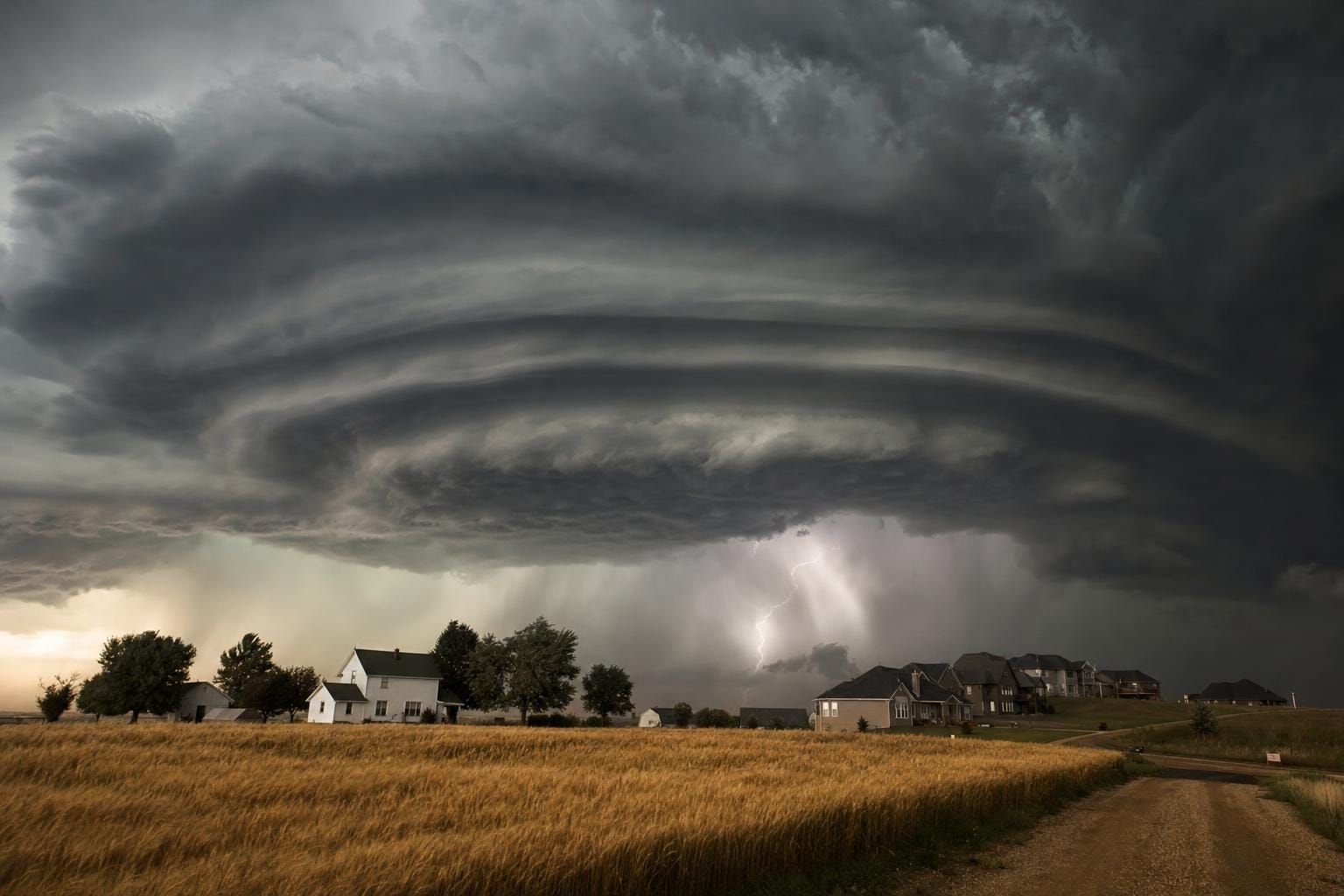
For three years, the story of America's home insurance crisis had a familiar map: hurricanes in Florida, wildfires in California, carriers fleeing both coasts. That map is now out of date. According to NerdWallet's 2026 Home Insurance Rates Report — an analysis of more than 840 million rate estimates calculated by Quadrant Information Services from insurers' own filed rating formulas — the region with the steepest premium increases of the past three years wasn't on either coast. It was the Midwest — Wisconsin, Michigan, Iowa, Minnesota, Indiana.
The numbers are blunt. The typical U.S. home insurance premium reached $2,564 in early 2026, up 24% from $2,068 in early 2023 — a median increase of $496 a year for a homeowner with good credit, no claims, and a house built in 1984. But the Midwest rose faster than any region in the country: 25% over three years, against 20.5% in the Northeast, 19.2% in the South, and 16.4% in the West. The West — home to the California wildfire narrative — posted the smallest regional increase in America.
Wisconsin homeowners absorbed a 40.9% cumulative increase between 2023 and 2026, among the steepest in the nation and behind only Arizona's 49.8%. Michigan is up 29.9%, Iowa 27.7%, Minnesota 27.3%, Indiana 27.2% — all comfortably above the national pace. Even newly built Midwestern homes, which insurers normally treat gently, saw premiums climb 13.4% over the window, nearly double the 6.8% increase for new construction everywhere else.
Hail Is the New Hurricane
What repriced the Midwest wasn't a single catastrophe. It was the relentless arithmetic of severe convective storms — tornadoes, straight-line winds, and above all, hail.
NerdWallet's analysis of NOAA storm event data found that severe hail events — storms producing hail at least one inch in diameter — more than tripled in Missouri (+276%) and Illinois (+258%) from 2023 to 2025 versus the previous three-year period, with Indiana close behind at +183%. Three of the four states with the largest increases in severe hail are in the Midwest. Per the same analysis, severe convective storms caused $51 billion in U.S. insured losses in 2025 — the third straight year above $50 billion, and more than any other category of natural disaster. Not hurricanes. Not wildfires. Hail and wind.
The damage shows up twice on household budgets: the same storms have pushed Midwest auto premiums up in parallel. NerdWallet's companion auto insurance report found six of the ten states with the largest car insurance increases since January 2023 are Midwestern. Wisconsin, Iowa, and Minnesota rank among the hardest-hit states for both home and auto coverage.
Briefings like this are free to read with a free AlphaBriefing membership. Join free →
The Reinsurance Lag Machine
Why did premiums surge in 2024 and 2025 for storms that had been battering the region for years? Timing. Insurers buy their own catastrophe coverage — reinsurance — and at the January 2023 renewal, reinsurers hiked rates 25% to 50% for carriers with clean recent loss records, and 45% to 100% for those with recent large-dollar claims.
Carriers can't pass that through overnight. They must file proposed increases with state regulators, submit evidence, and wait. In California in 2023, the average homeowners rate filing took 186 days — roughly six months — to get a decision, and in the years before that, the slowest filings took anywhere from about 660 days to nearly 1,200. That regulatory lag is why the steepest increases reached homeowners' bills in 2024 and 2025, a year or more after reinsurance costs actually spiked. The pain you feel at renewal is a delayed echo of a repricing that already happened upstream.
The Quiet Penalty on Older Homes
Buried in the data is a second repricing that gets far less attention: insurers are systematically marking up older housing stock. A home built in 1984 — right around the median age of American owner-occupied homes — now costs 81.2% more to insure than an identical new build, a gap that stood at 59.2% just three years ago. In dollar terms, the older-home penalty has grown to $1,149 per year.
The divergence is stark: premiums on new construction rose just 8.9% over three years, and actually fell slightly (-0.3%) over the past year, while rates on older homes kept climbing. Insurers are effectively telling the market that aging roofs, older wiring, and dated plumbing are risks they will only carry at a steep and widening surcharge. For the roughly half of American homes older than the 1984 benchmark, that surcharge now functions as a permanent tax on the housing stock — one that never shows up in a mortgage calculator.
The Cooling That Isn't Quite Relief
There is genuine deceleration in the data. After national increases of 7.0% (2023–24) and 10.8% (2024–25), the past year slowed to 4.6%. Premiums fell in 18 states and Washington, D.C. — up from just three states in each of the two prior years — with the biggest drops in North Carolina (-9.6%), Rhode Island (-7.9%), and West Virginia (-7.6%).
The forward indicators point the same way. Of insurer rate filings submitted from January through mid-August 2026, 53.6% requested increases with a median ask of just +1.0% — down from 68.7% of filings and a +5.4% median in 2025, and 81.6% and +10.0% in 2024. Behind that: global property-catastrophe reinsurance rates fell about 15% at the January 2026 renewal, and U.S. property-catastrophe pricing fell a further 20% to 25% at the July renewal. AM Best said in May that improving loss ratios "may signal stabilization."
But note what that combination implies. Premiums are still rising — just more slowly — while insurers' single biggest catastrophe cost is falling by double digits. The spread between what homeowners pay and what carriers pay for protection is widening, which is precisely the phase of the insurance cycle when underwriters rebuild margins. Homeowners shouldn't expect the 2023 reinsurance shock to be refunded on the way down with the same speed it was passed through on the way up. And the relief is uneven: Pennsylvania (+16.4%), Arizona (+14.9%), and Minnesota (+10.9%) still posted double-digit increases this past year.
Why This Matters Beyond Your Renewal Notice
Three things follow from a hail-driven, Midwest-centered insurance repricing.
Housing affordability math is quietly changing in "cheap" markets. At the national median, insurance now runs about $214 a month — and materially more than that in hail country. The Midwest's core affordability advantage — low purchase prices — is being eroded by a carrying cost that compounds annually and is largely outside the owner's control.
The older-home discount is becoming an older-home trap. An 81% insurance surcharge on aging housing stock, growing every year, acts as a slow-motion markdown on the resale value of pre-1990s homes — and a subsidy for new construction. Over time, that is a capital flow: toward builders, away from legacy inventory.
Climate risk is no longer a coastal line item. Reinsurers and carriers have concluded that a one-inch hailstone in Des Moines is as real a peril as a named storm in Miami. Any model — of regional housing markets, of municipal tax bases, of where Americans can affordably live — that still treats weather risk as a Florida-and-California problem is using the old map.
If this analysis was useful, this is what AlphaBriefing does every day — markets, policy, and risk, connected to what it means for your money. A free membership gets you access to every free article on AlphaBriefing.com; paid members get the investment frameworks, scenario pricing, and catalyst calendars behind the paywall.
Sign up free → — upgrade whenever it earns it.
A free membership unlocks every free article at AlphaBriefing.com: Join AlphaBriefing
Sources & Further Reading
- NerdWallet — 2026 Home Insurance Rates Report
- Newsweek — Map Shows States Hit Hardest by Rising Home Insurance Costs
- NerdWallet — 2026 Auto Insurance Rates Report
- NOAA — Storm Events Database
- Insurance.com — The State of Home Insurance in 2026
Disclaimer
AlphaBriefing is an independent intelligence publication. The content in this article is produced for informational and educational purposes only. Nothing published by AlphaBriefing constitutes financial, investment, legal, tax, or regulatory advice, nor should it be construed as a solicitation or recommendation to buy, sell, or hold any security, asset, or financial instrument.
All views expressed are those of the author at the time of writing and are subject to change without notice. Markets are volatile and unpredictable; past performance is not indicative of future results. Any investment involves risk, including the possible loss of principal.
AlphaBriefing and its principals, employees, or contributors may hold positions in securities or assets mentioned in this article. This should be considered a potential conflict of interest. No material relationship with any company referenced exists unless explicitly disclosed. Readers should conduct their own due diligence and consult qualified financial, legal, and tax advisors before making any investment decisions.
Information in this article is drawn from public sources believed to be reliable at the time of publication. AlphaBriefing makes no warranty, express or implied, as to the accuracy, completeness, or timeliness of any information herein. AlphaBriefing accepts no liability for any loss or damage arising from reliance on this content.
© AlphaBriefing. All rights reserved. Unauthorised reproduction or distribution is prohibited.