The Last Major Central Bank Just Joined the War Economy
The Bank of England raised rates for the first time since 2023 — 8 to 1, with the dissent wanting double. Gilts above 5%, a 25% energy-cap jump landing in January, and a December meeting that is suddenly live.

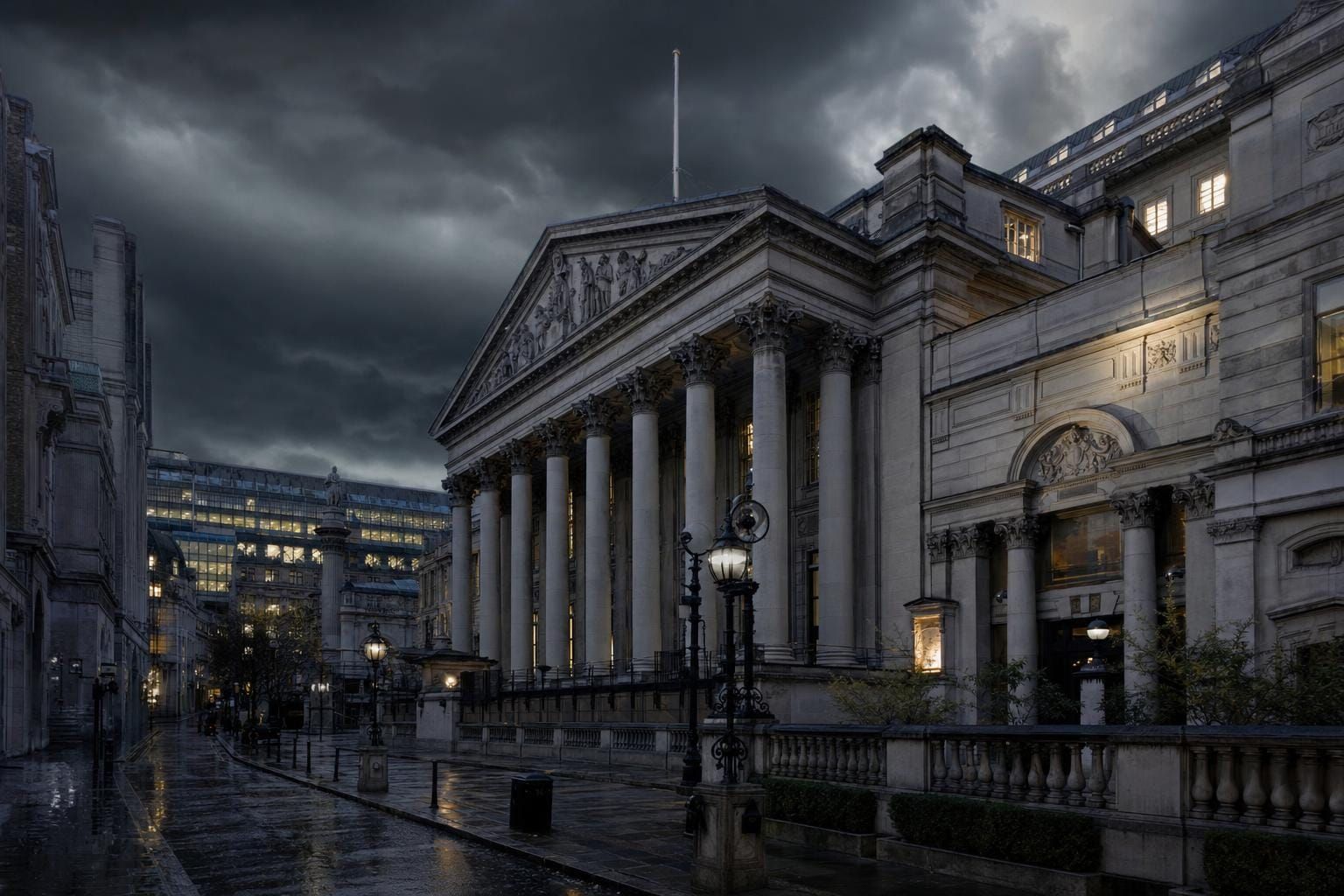
On Thursday, the Bank of England did something it last did in August 2023: it raised interest rates. The Monetary Policy Committee voted 8–1 to lift Bank Rate a quarter point to 4%, with the lone dissenter, Catherine Mann, arguing the move should have been twice as large. It was the most anticipated decision in years — markets had priced the hike at better than 99% odds, per LSEG data — and it still managed to be remarkable. Of all the major central banks, the Bank of England was the last holdout of the war economy. As of this week, there are none left.
The sequence matters. The Federal Reserve resumed hiking in September. The Bank of Japan has been tightening into the highest JGB yields in decades. The Bank of Canada raised rates at the end of October. The Bank of England, facing an energy shock it can do nothing about and a consumer already squeezed, waited eight months after the U.S. and Israel went to war with Iran before conceding that the inflation now in the pipeline could not be waited out. "The conflict in the Middle East is now in its ninth month," the MPC's statement opened — a sentence that tells you the committee has stopped treating the war as a transitory event and started treating it as the operating environment.
The Numbers That Forced the Vote
The case for the hike is in the Bank's own conditioning assumptions. Over the 15 working days ending October 27, front-month Brent averaged $108 per barrel — 38% higher than when the Bank published its July forecast. UK front-month natural gas averaged 216 pence per therm, up 81% over the same window. Britain is a net energy importer; there is no domestic production cushion to absorb a shock of that size.
The pass-through is already visible and, by the Bank's own math, about to get worse:
- CPI inflation hit 3.5% in September, with direct energy effects contributing roughly a full percentage point.
- The Bank now projects inflation around 4.5% in the first quarter of 2027 and about 5% by mid-2027 — up from the 3.2% peak it forecast as recently as July.
- The Ofgem household energy price cap is expected to jump from £1,723 to £2,150 in January — a roughly 25% increase in a single reset — and to rise again in April.
- Food inflation could reach 4.75% by mid-2027, the committee warned.
What has not yet shown up is the second round: wages and non-energy prices chasing the energy shock. The minutes are candid that firms have so far absorbed higher costs through hedges, fixed-price contracts, and compressed margins. The committee's judgment — the actual load-bearing reasoning behind Thursday's vote — is that those buffers are temporary, and that with headline inflation headed toward 5%, the risk of workers and firms repricing accordingly "had risen further since September."
Governor Andrew Bailey was explicit about the reaction function: "Without news which softens the risks to inflationary pressures, I can see the argument for a further increase in rates and thereafter taking a more conditional approach." He also tried to cap expectations — "today's increase shouldn't be seen as the first in an inevitable long sequence in hikes. But unless the conflict in the Middle East is resolved, neither does it seem likely to be the last increase."
A Hike Into Falling Oil
Here is the uncomfortable timing. Two days before the decision, the U.S. midterms delivered Democratic victories in Congress, and oil markets read them as a constraint on the administration's capacity to prolong the Iran conflict. Brent settled near $94.60 on Wednesday — sharply below the $100 level it had held persistently for months — and traded near $98 on Friday. The Bank, in other words, hiked on conditioning assumptions ($108 oil) that the market had undercut 48 hours earlier.
Bailey acknowledged the fall and dismissed it in the same breath: "This is positive news, but there is already a significant amount of inflationary pressure in the pipeline." The energy cap resets in January regardless of where Brent trades this week. The question for markets is whether the MPC follows through at its next meeting on December 17 — before the decision, traders put roughly one-in-four odds on a pre-Christmas hike, and the Bank's own Market Participants Survey has the median path reaching 4.25% by February. Oxford Economics' Andrew Goodwin was blunter: "The degree of inflationary pressure already in the system means another hike in December or February is likely."
The politics are just as tight. Chancellor John Healey delivered his first Budget on October 28, a week before the hike, built around "breathing space" for households: a £100 energy payment to 20 million households, an extended fuel duty freeze, and a VAT cut on electricity bills. The MPC estimates the package shaves a quarter point off inflation by mid-2027 — and the Office for Budget Responsibility still cut its 2027 growth forecast, with the Bank expecting real post-tax incomes to fall this year and next. A government cushioning an energy shock with fiscal policy while the central bank tightens against the same shock is not a contradiction, exactly. But it is a tug-of-war, and gilt holders are the rope.
JPMorgan Personal Investing's Scott Gardner called the hike "hugely symbolic" — "a 180-degree turn from the start of the year when many believed interest rates would come down as UK inflation had been mostly tamed." That reversal — not the 25 basis points itself — is the trade.
A free AlphaBriefing membership gets you access to every free briefing on AlphaBriefing.com — join free in 30 seconds.
The rest of this briefing is free — it just requires a free AlphaBriefing account: where gilts, sterling, and UK bank stocks actually traded on the decision, the three scenarios the MPC itself is modeling and what each one means for positioning, and the specific dates between now and February that decide whether 4% is the ceiling or the floor.
Create your free account → — 30 seconds, no card.