Every Central Bank Is Hiking. Mexico Just Cut.
The same day the Bank of England joined the global hiking cycle, Banxico defied every forecast with a 3–2 cut to 6.25%. The peso fell, stocks rallied, and the carry cushion over the Fed is down to 225 basis points. Here's what the divergence is pricing.

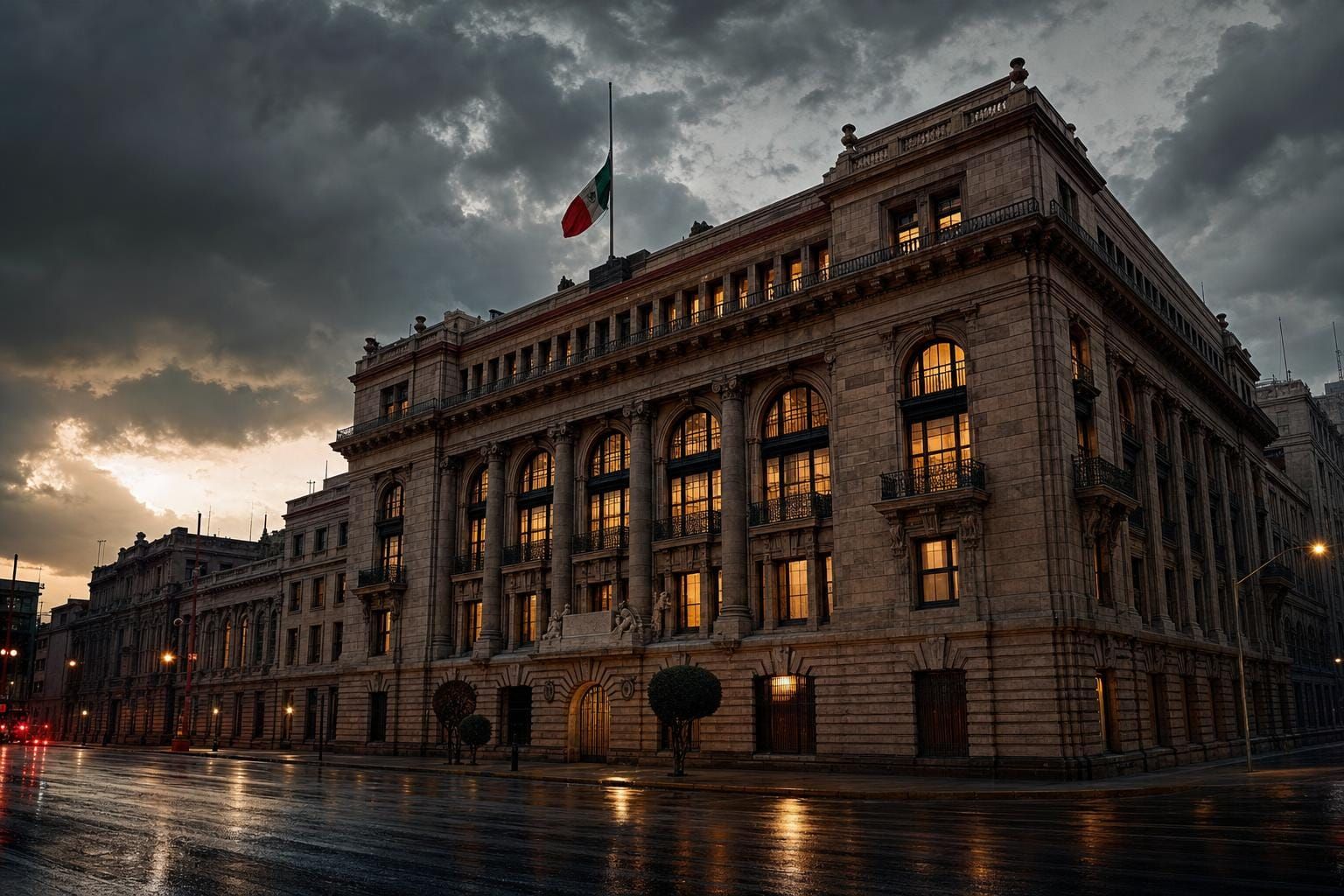
On Thursday morning, the Bank of England raised rates for the first time since 2023, completing the set: every major central bank in the developed world is now tightening into the war economy. Hours later, in Mexico City, Banco de México went the other way.
Banxico cut its overnight rate by 25 basis points to 6.25%, effective Friday — the lowest policy rate in Mexico since February 2022. Economist surveys and market pricing had a hold as the overwhelming consensus. The board had been on hold for three consecutive meetings, and had spent months telling investors the easing cycle was finished. The vote was 3–2: Governor Victoria Rodríguez Ceja, Gabriel Cuadra, and Omar Mejía carried the cut; Deputy Governors Galia Borja and Jonathan Heath voted to hold at 6.50%. Split decisions are rare at Banxico. A 3–2 split on a surprise cut, against unanimous market expectations, is rarer still.
The loneliest dove in the hemisphere
The timing is what makes this decision remarkable. The Federal Reserve resumed hiking on September 16, lifting the federal funds target to 3.75%–4.00% — its first increase since 2023 — and its projections penciled in at least one more before year-end. The Bank of Japan is tightening. The Bank of England just joined. Central banking in late 2026 has one direction of travel, and Mexico just picked the opposite one.
That choice has a price, and it is denominated in basis points. The gap between Banxico's rate and the Fed's upper bound now stands at 225 basis points. At the 2024 peak — Banxico at 11.25%, the Fed at 5.50% — that cushion was roughly 575. The spread is the engine of the peso carry trade, one of the most crowded and, for most of the past four years, most profitable trades in emerging markets. Banxico just cut the engine's fuel supply by a tenth, voluntarily, in a week when the dollar's yield advantage was widening on its own.
Banxico's case
The board's statement reads like a dare. It argued that disinflation has continued, that the economy carries enough slack to mute any pass-through from a weaker peso into consumer prices, and that demand-side inflation pressure is absent. Growth continued in the third quarter, but the board expects slack to persist through its entire forecast horizon, with risks tilted down. The cut, the statement stressed, is a one-time adjustment — the plan from here is to hold.
The awkward part: Mexican inflation is going the wrong way. Headline inflation ran 3.45% in September and accelerated to 3.62% in the first half of October, per INEGI — inside Banxico's 2%–4% tolerance band, but above the 3% target midpoint and rising for two straight months on electricity and food. The board's own new forecast concedes the point, nudging its fourth-quarter headline projection up to 3.7% from 3.5%. Cutting into accelerating inflation, with a depreciating currency, while your largest trading partner hikes — that is not a combination the textbooks recommend.
The market's split verdict
Markets delivered a divided response that mirrored the board's own vote. The peso weakened roughly 0.7% on the announcement, with the dollar pushing toward 18.8 pesos. Capital Economics called the move "hard to square" with the peso's recent slide and above-target inflation. ING's Chris Turner now sees USD/MXN above 19 as more likely than not. And despite the board's one-and-done framing, rate markets reportedly moved quickly to price high odds of another cut by year-end — the market heard "one-time adjustment" and concluded "easing cycle."
Mexican equities, meanwhile, loved it. The Mexbol index climbed 2.3% on the week to close Friday at 71,394, and the iShares Mexico ETF ($EWW) gained about 3% to $76.74. Cheaper money, a competitive currency, and a nearshoring story intact — for local equity holders, a lonely dove is a feature, not a bug.
So which market is right? The answer depends on whether this really is a one-off — and on what happens to the carry cushion if it isn't.
The rest of this briefing is free — it just requires a free AlphaBriefing account: the carry-trade math and the spread level where the unwind historically starts, three scenarios with specific USD/MXN zones, the instruments on each side of the trade, and the three-event catalyst calendar between now and the December meetings.
A free membership gets you access to every free article at AlphaBriefing.com — Join AlphaBriefing, 30 seconds, no card.