$AVAV: AeroVironment Reports Wednesday, 65% Below Its High. The Backlog and the Stock Can't Both Be Right.
AeroVironment reports fiscal Q1 September 9 with a record $1.2 billion funded backlog, a fresh $464.8 million laser production contract, and a stock near its 52-week low. The dilution math, the cash-flow clock, and scenario price zones inside.

AeroVironment reports fiscal first-quarter 2027 results this Wednesday, September 9, after the close, with a conference call at 4:30 p.m. ET. The stock goes into the print at $144.65, about 7 percent above its 52-week low of $135.20 and 65 percent below its 52-week high of $417.86. For a company the Pentagon keeps writing checks to, that is a remarkable place to be.
Because the order tape, taken on its own, describes a business in the middle of the best run in its history. Fiscal 2026, which ended April 30, produced $1.98 billion in revenue, up 141 percent. Bookings came in at $2.7 billion, a 1.4 book-to-bill. Funded backlog finished the year at $1.2 billion, up 65 percent from $726.6 million a year earlier. And the news flow since has only accelerated.
The tape says boom
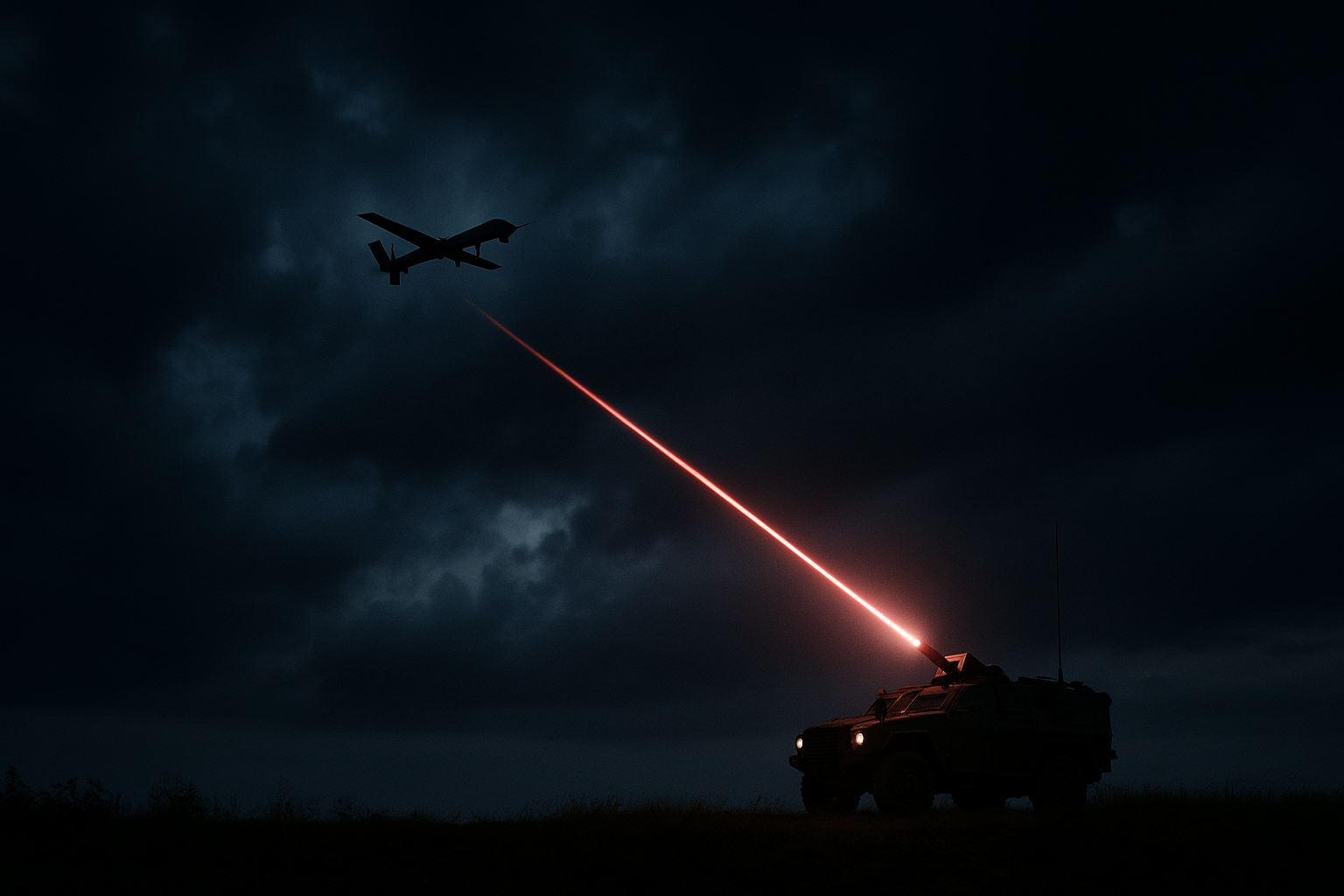
Start with the newest item. AeroVironment just secured a $464.8 million U.S. Army production contract under the Enduring High Energy Laser program for its LOCUST family of laser weapons. The company describes it as the first production procurement of directed-energy systems in U.S. history: dozens of 30-kilowatt LOCUST X3 counter-drone lasers delivered over the next few years, integrated on platforms including the Joint Light Tactical Vehicle, backed by a $30 million expansion of its Albuquerque facility. Laser weapons have been a prototype curiosity for two decades. Someone finally moved them to a production line, and it was AeroVironment's name on the award.
Behind that sits the steady drumbeat of the small-drone rearmament cycle. In August the Army placed a $51 million delivery order for additional Switchblade 600 Block 2 loitering munitions under its five-year, $990 million Lethal Unmanned Systems contract, with Block 1 systems attached for a foreign military sale. The company says Switchblade now serves more than 20 brigade combat teams. The Pentagon's Drone Dominance Program, which ordered 30,000 one-way attack drones in March, is placing its next tranche of roughly 60,000 this month, part of a stated push toward 200,000-plus fielded systems by 2027. AeroVironment is the most direct U.S.-listed expression of that procurement curve.
Add the diversification headlines: a NASA Jet Propulsion Laboratory contract to co-build three autonomous Mars helicopters for the SkyFall mission, a new joint venture in Greece with Athens-based Eyeonix, and a planned $100 million consolidated campus in Moorpark, California. This is not a company starved of demand.
The price says something else
So why is the stock sitting on its lows? Because fiscal 2026 also produced a GAAP net loss of $265 million, including a $240.7 million goodwill impairment. Because fiscal 2027 guidance, issued June 29, calls for revenue of $2.125 to $2.225 billion, roughly 10 percent growth at the midpoint after last year's 141 percent. Because operating cash flow was negative even in a record year. And because the acquisition that transformed the company, the all-stock BlueHalo deal that closed May 1, 2025, nearly doubled the share count and completely reset what a dollar of AeroVironment revenue is worth to each holder.
Wednesday's print is where the two stories collide. The Street's consensus for the quarter is $0.32 in non-GAAP earnings per share, exactly what the company earned in the same quarter last year. The estimate range runs from $0.06 to $0.78, which tells you the analysts modeling this company cannot agree on the shape of the year within an order of magnitude. Estimate revisions over the past four weeks have leaned down, not up.
Whether the record backlog or the depressed price is the better forecast comes down to arithmetic the stream rarely does: how many shares now split the pie, how fast the balance sheet is consuming cash while production scales, and how much of fiscal 2027 management has quietly loaded into the fourth quarter, again.
The rest of this briefing is for paid members: the real share count and what the BlueHalo deal did to it, the cash-flow clock behind the record backlog, the quarter-by-quarter cadence math the Street is modeling, what specifically to watch on Wednesday's call, and scenario-by-scenario price zones for the print.
AlphaBriefing Paid gets you every investment thesis, scenario framework, and catalyst brief we publish. The analysis private intel clients pay four figures for, at a fraction of that.