America's Parents Are Shopping Scared
Back-to-school spending is forecast to hit a record $147 billion — and nearly every number underneath shows a consumer in retreat. The year's first mandatory purchase has become a stress test, and it's flashing a warning for the holiday quarter.

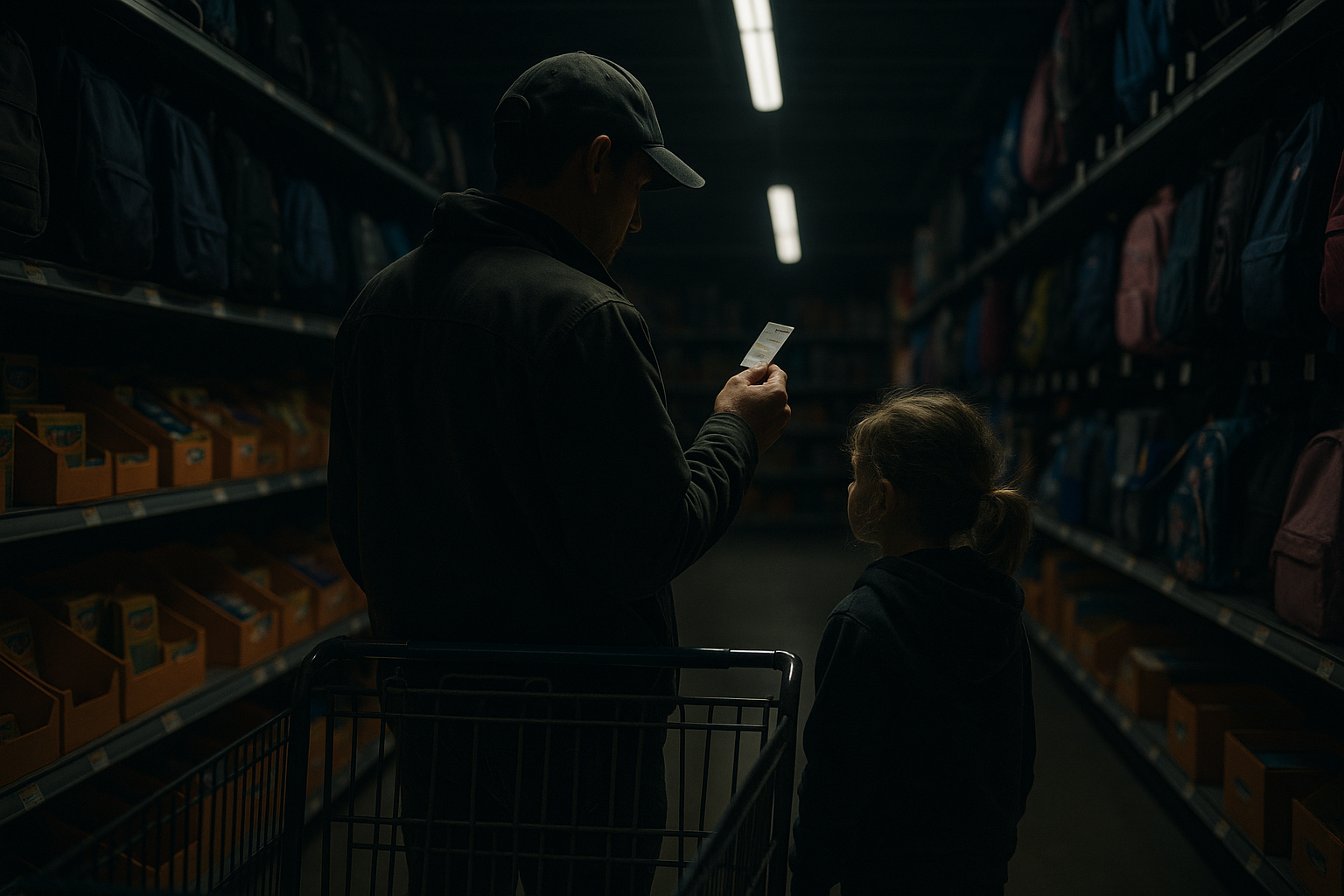
The National Retail Federation says Americans will spend a record amount sending their kids back to school this year — roughly $147 billion once you add the $43.3 billion K-12 forecast to the $103.5 billion college forecast, the first time college spending has ever crossed $100 billion. That is up from $128.2 billion last year. On its face, a 15% jump in a discretionary-adjacent category looks like a healthy consumer.
Now look at what Deloitte found when it asked 1,207 parents, in the same season, what they actually plan to spend per child: $557. That is down $13 from last year in nominal terms — and roughly 6% lower once you adjust for inflation.
Both numbers are real. The total is going up because more people are shopping and everything costs more. The basket is shrinking because the people doing the shopping are stretched. That combination — record revenue, weaker households — is the single most useful read on the American consumer available right now. And it is worth paying attention to, because back-to-school is not like other spending. You can skip a concert. You can delay a couch. You cannot send your kid to school without a backpack.
That is what makes this season a stress test. When spending is mandatory, behavior under pressure has nowhere to hide.
The record that isn't
Start with what the headline number is actually made of. The NRF's K-12 forecast rose from $39.4 billion to $43.3 billion — but the organization is explicit that the increase reflects more shoppers, not bigger budgets. Meanwhile 78% of consumers told the NRF they expect higher prices on back-to-school items this year, and they are behaving accordingly: 62% had already started shopping by early July, 54% bought during the summer promotional events, and among those not yet finished, 46% are deliberately holding out for deeper discounts.
That is not enthusiasm. That is a population trying to arbitrage its own cost of living — front-running tariff pass-through on one end and waiting out clearance racks on the other.
The price pressure is not hypothetical. During last year's season, school supply prices rose 7.3%, with individual categories like index cards up more than 40%, as the first full tariff wave worked through import-heavy categories. Federal Reserve data had school supplies at all-time-high prices before this season even began. The 2026 shopper is paying those annualized increases now — which is exactly why a flat nominal basket is a shrinking real one.
Briefings like this land in members' inboxes before the market prices them in. Join free →
The trade-down machine
Deloitte's survey reads like a field manual for a consumer in defensive posture. Among K-12 parents this season:
- 71% say they will switch brands if their preferred one gets too expensive
- 60% plan to shop at more affordable retailers
- 51% expect to buy private label instead of name brands
- ~80% of all planned spending is going through mass merchants
And here is the detail that should stop you: Deloitte identifies 31% of parents as "hyper-value seekers" — people stacking four or more cost-saving behaviors at once. Those parents still expect to spend about $610 per child, roughly 14% more than everyone else. Read that again. The most aggressive deal-hunters in America are also the biggest spenders. Couponing, cashback, brand-switching, retailer-hopping — all of it — and the bill still comes out higher. That is what it looks like when effort can no longer beat inflation.
The category mix tells the same story. Clothing spending per child is up 22% to $323 — apparel is where tariff pass-through has been most brutal, and kids outgrow clothes whether or not the CPI cooperates. Technology spending is down 16% to $417 — the one big-ticket category where a purchase can be stretched another year is the one getting cut.
Mandatory categories up. Deferrable categories down. That is a household budget being triaged, not a consumer splurging.
The split that matters
The most important number in either survey is the divergence by income. Deloitte found lower- and middle-income parents planning to spend 10–12% more this season — not because they want to, but because the same list of required items costs more. Upper-middle and higher-income households plan to spend 9–20% less.
Think about what that means. The households with the least flexibility are absorbing forced price increases in full. The households with the most flexibility — the ones whose discretionary spending has been holding up the entire consumption economy for two years — are voluntarily cutting back on one of the least discretionary purchases of the year. When wealthy families trim the school run, that is not a budget constraint. That is sentiment. And sentiment is confirmed elsewhere in the data: 57% of parents expect the economy to worsen over the next six months — the highest share Deloitte has recorded since 2020.
This is the K-shaped consumer arriving at the checkout line of a mandatory purchase, and it rhymes with what we flagged in the labor data a day ago: a frozen job market where nobody feels secure enough to spend like it's an expansion.
What it means for money
Back-to-school is the second-largest retail season on the calendar and has long served as the dress rehearsal for the holiday quarter — same shoppers, same wallets, twelve weeks earlier. What this rehearsal is showing:
The trade-down winners keep winning. Four out of five planned dollars flowing through mass merchants is a structural gift to Walmart, Target, and the warehouse clubs, with off-price retail catching the apparel overflow. Watch the August earnings calls: back-to-school commentary from the big-box operators is the cleanest available preview of holiday guidance.
Private label is a margin story with momentum. Half of American parents defaulting to store brands on a forced purchase is exactly how private-label habit formation happens — consumers who switch under duress and discover the difference doesn't matter rarely switch back. That compounds against branded consumer-products companies and mid-tier apparel names that raised prices into a trade-down cycle.
Electronics has a demand problem hiding in a record. College spending crossing $100 billion looks like a boom, but per-child K-12 tech spending falling 16% says households are sweating assets — stretching laptops and tablets an extra year. A replacement-cycle delay in consumer electronics tends to show up in the fall guides, not the summer prints.
The macro read is the real product. A consumer who front-runs purchases out of price fear, triages categories, and tells surveyors the economy is getting worse is not the consumer priced into a soft-landing holiday quarter. If the mandatory-spending season already looks like this in July, the discretionary-spending season in November has a higher bar to clear than consensus assumes.
Bottom line
The record $147 billion headline will get reported as consumer resilience. The data underneath it — shrinking real baskets, mass trade-down, deal-hunters who still can't beat the bill, and the widest rich-poor behavioral split since 2020 — describes a consumer spending under protest. Back-to-school is the year's most honest economic indicator precisely because nobody gets to opt out. This year, honesty is not flattering.
If this analysis was useful, this is what AlphaBriefing does every day — geopolitics and markets, connected to what it means for your money. Free members get the daily brief in their inbox; paid members get the investment frameworks, scenario pricing, and catalyst calendars behind the paywall.
Get this level of intelligence every day. Subscribe to AlphaBriefing — free, member, and paid tiers available.
Sources & Further Reading
- Retail Dive — Back-to-school spending forecast to reach record highs, NRF says
- Retail Dive — Back-to-school shoppers head to mass merchants as per-child spending falls
- Deloitte Insights — 2026 Back-to-School Survey
- National Retail Federation — Back-to-School Data & Trends
- CBS News — Back-to-school shopping season kicks off early as Americans try to dodge tariff impacts (2025 season)
- ABC News — School supply prices soar 7.3% amid tariffs (2025 season)
Disclaimer
AlphaBriefing is an independent intelligence publication. The content in this article is produced for informational and educational purposes only. Nothing published by AlphaBriefing constitutes financial, investment, legal, tax, or regulatory advice, nor should it be construed as a solicitation or recommendation to buy, sell, or hold any security, asset, or financial instrument.
All views expressed are those of the author at the time of writing and are subject to change without notice. Markets are volatile and unpredictable; past performance is not indicative of future results. Any investment involves risk, including the possible loss of principal.
AlphaBriefing and its principals, employees, or contributors may hold positions in securities or assets mentioned in this article. This should be considered a potential conflict of interest. No material relationship with any company referenced exists unless explicitly disclosed. Readers should conduct their own due diligence and consult qualified financial, legal, and tax advisors before making any investment decisions.
Information in this article is drawn from public sources believed to be reliable at the time of publication. AlphaBriefing makes no warranty, express or implied, as to the accuracy, completeness, or timeliness of any information herein. AlphaBriefing accepts no liability for any loss or damage arising from reliance on this content.
© AlphaBriefing. All rights reserved. Unauthorised reproduction or distribution is prohibited.